The network is never finished

Oliver Müller from Gateway International EMS tells us about the administration that goes on behind the scenes of repatriation cases
A few months ago a case came in for a traveller who had fallen seriously ill in a country that had spent most of the year working through a change of government and no small amount of unrest. The provider on file was one we’d used for close to three years: a solid ground ambulance operator with a strong reputation. Except that provider had quietly shut down five weeks earlier, a casualty of the same instability that had put our traveller in a hospital bed. We only knew because someone on our team had called to check the account three weeks prior, found the number disconnected, and already had a replacement lined up by the time anyone needed one.
It’s unglamorous, repetitive work, and it rarely gets mentioned to the client whose case happens to run smoothly because of it
That’s the part of this business nobody sees in an ad. It’s also most of the job
One provider, then the rest of the world
Gateway International EMS didn’t start as a network. It started as one ground ambulance provider we trusted, in one country, for one kind of case. From there we built it on purpose: months of reaching out to providers, vetting them, and adding them to the database, day after day, well before most clients ever asked us to.
Every so often, especially in the first year or two, a client would request something we genuinely didn’t have yet, and we’d go find it. That happened, but it was the exception, not the method. Over time those relationships turned into something closer to infrastructure. That kind of deliberate groundwork is a good way to build a company, but it’s still a hard network to keep accurate, since relationships built one at a time don’t stay correct on their own.
When the map changes without warning
Some of what changes a provider network is mundane. A company gets acquired, a manager who trusted us moves on, a service gets discontinued because it stopped paying for itself.
Other changes are anything but routine. Sanctions get imposed overnight and cut a region off from its usual suppliers. A border closes and a provider that used to cross it freely can’t anymore. A conflict displaces the population a hospital used to serve, and the hospital stops being a viable place to send anyone. None of that arrives as a notification. It shows up as a phone number that no longer connects, usually discovered at the worst possible moment, unless somebody already knew to ask.
Network hygiene isn’t glamorous, but it’s the job
So we treat the network the way you’d treat anything else that decays if left alone: it needs regular attention, not just a one-time build. Providers get re-verified on a set schedule, not only when a case forces the question. Someone checks whether a facility still offers the service we have on file, whether a certification has lapsed, whether a country’s situation has shifted enough to warrant a second look at everyone we work with there.
It’s unglamorous, repetitive work, and it rarely gets mentioned to the client whose case happens to run smoothly because of it. But the alternative is discovering a provider is gone in the middle of an emergency, and that’s not a risk worth carrying on someone else’s behalf.
‘Nobody plans to get sick far from home’ is true of the traveller. It can’t be true of us. The job is knowing, before anyone needs us to, whether the answer we gave last year is still the right one today.
Oliver L Müller is Founder and CEO of Gateway International EMS with extensive experience in global medical ground ambulance coordination. His team specialises in rapid deployment logistics, cross-border case management, and high-acuity patient transfers, working closely with global assistance and air ambulance providers to ensure safe, efficient, and clinically appropriate transport solutions.
October 2026
Issue
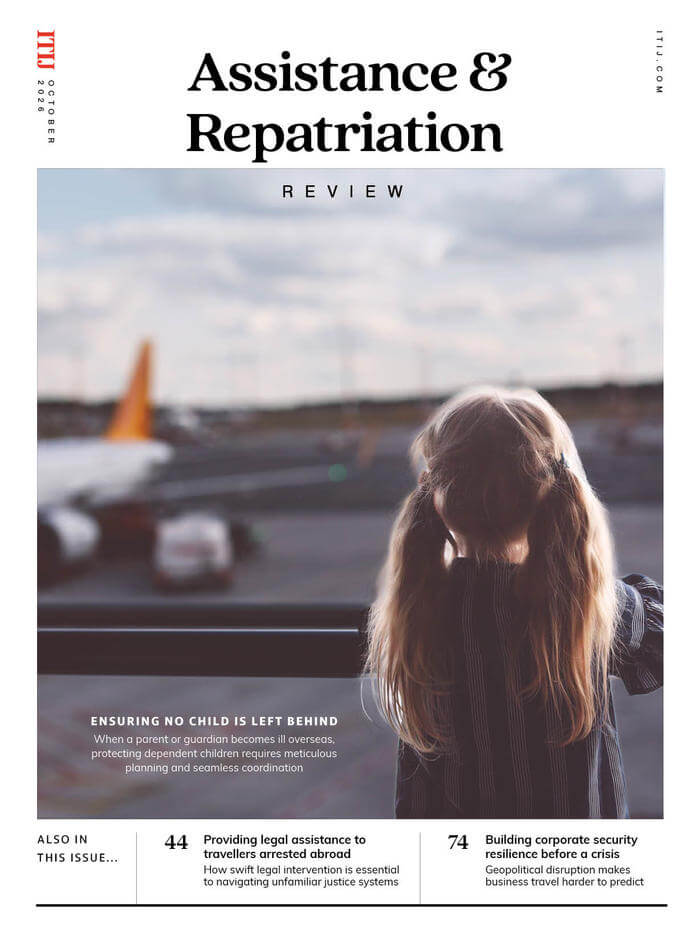
When a parent or guardian becomes seriously ill overseas, assistance providers face a complex challenge that extends well beyond clinical care. Although these cases are relatively rare, in this issue we look at how safeguarding dependent children requires careful planning, legal awareness, and close international coordination.
Editorial Team
The Editorial Team updates the ITIJ website daily, and works on features for the print edition. With expert industry knowledge and years of experience in writing about complex travel insurance issues, the Editorial Team is ready to investigate and report on the topics that matter most to ITIJ's readers.