Navigating uncertainty: a critical air ambulance transfer

A high-risk mission underscored by precision, teamwork, and adaptability
Navigating a medical emergency mid air
A life-threatening medical crisis of an 81-year-old male with late stage colon cancer and multi-organ failure on life support necessitated immediate aeromedical evacuation. Stability depended on continuous medical monitoring, real-time interventions, and rapid adaptability.
Midway through the transfer, the patient experienced two critical events: severe tracheostomy bleeding and a lifethreatening cardiac arrhythmia. Oxygen saturation dropped to 62% due to airway obstruction from thick clots, requiring urgent suctioning and ventilatory support, which successfully restored stability. Later, a monomorphic ventricular tachycardia (VT) episode sent his heart rate soaring to 189 bpm, demanding rapid amiodarone administration to revert to normal sinus rhythm. The medical team acted swiftly, balancing pharmacological intervention with continued monitoring to stabilise the patient.
The medical team: unified expertise in action
The onboard medical team, comprising a flight physician, critical care nurse, and paramedic, sprang into action. Clear role distribution, rapid assessment, and synchronised execution of critical interventions defined their response. Immediate actions included:
- Respiratory stabilisation: urgent tracheostomy suctioning, saline lavage, repositioning, and oxygen titration
- Cardiac event management: rapid identification of VT, administration of amiodarone, continuous cardiac monitoring, and post-reversion stabilisation
- Diagnostic and monitoring: frequent ABG analysis, ECG assessments, and invasive pressure monitoring to maintain physiological balance.
Throughout the crisis, the team maintained constant communication, ensuring patient stability before advancing toward the planned destination.
Medical equipment and medicines: precision without excess
Despite the compact environment of an air ambulance, each piece of medical equipment was purposefully selected to balance utility with space efficiency. Portable ventilators, infusion pumps, and emergency resuscitation kits were within reach, essential for managing life-threatening events without compromising cabin mobility. This event reinforced the importance of structured inventory planning, ensuring swift access under pressure while maintaining operational efficiency.
Aircraft selection: balancing speed, space, and medical needs
Aircraft selection is crucial in optimising aeromedical transfers. Smaller jets may offer speed and economy for short-haul missions, but have limited space for advanced medical care. In contrast, larger aircraft provide expanded working space, enhanced life-support capabilities, and better adaptability for complex interventions, albeit at higher operational costs. The ideal choice hinges on medical complexity, urgency, and logistical feasibility.
Managing bystanders in emergencies: crisis communication
In-flight emergencies often occur in full view of distressed family members. During this mission, the medical team deployed calm, structured communication, offering real-time explanations and consistent reassurance. Active listening, maintaining emotional composure, and affirming control helped reduce anxiety, enabling the crew to focus on patient care while managing family concerns effectively.
The medical team acted swiftly, balancing pharmacological intervention with continued monitoring to stabilise the patient
Overcoming language barriers: bridging communication gaps
International transfers often involve linguistic diversity. This mission demanded adaptability in communication, achieved through multilingual staff support, translation tools, and pre-briefings tailored to the family's language and cultural context. These efforts ensured clarity, consent, and comfort – foundational for smooth cross-border medical coordination.
Mission success: the culmination of strategy and expertise
This mission exemplified the intricate balance between medical expertise, logistical precision, and human empathy. The team’s unified actions, grounded in skill, preparedness, and compassion, ensured a safe patient transfer despite life-threatening events. It reaffirms that in aeromedical evacuation, success lies not just in surviving the crisis, but in how it is managed: with clarity, coordination, and care.
Nitheesh Kolattu Vijayan is a Registered Nurse, EMT, IDCCN and Flight Critical Care Nurse for Bluedot Charters & Air Ambulance Co.
September 2025
Issue
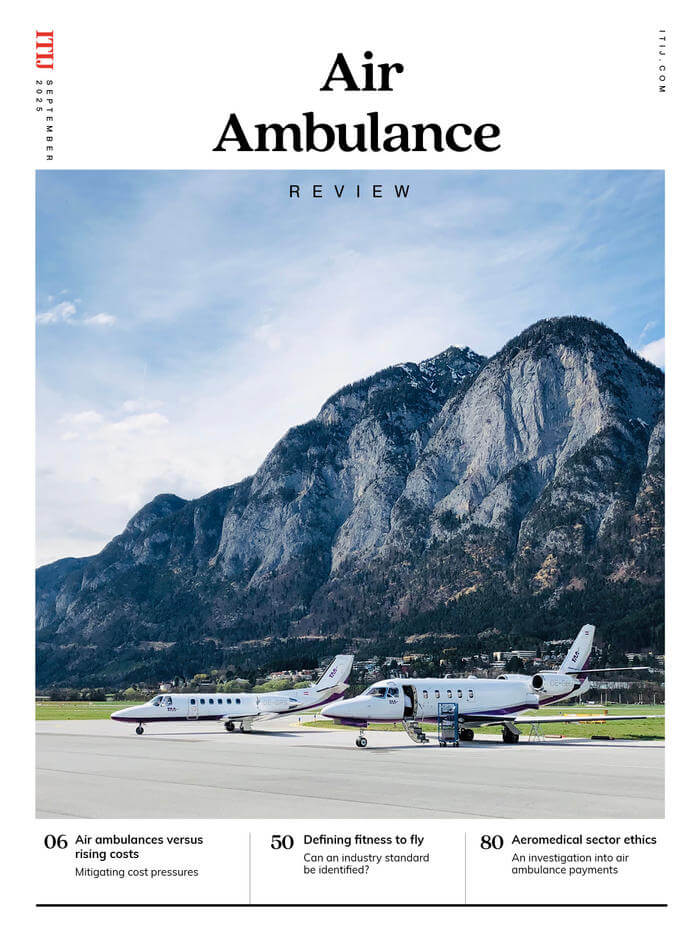
We include an examination on defining ‘fitness to fly’, and ask if an industry standard can be identified, and what that would involve. We also look at capacity in the aeromedical market and experts share their insights. Ethics and transparency in the aeromedical sector is a big issue, and we include an investigation into air ambulance payments.
Editorial Team
The Editorial Team updates the ITIJ website daily, and works on features for the print edition. With expert industry knowledge and years of experience in writing about complex travel insurance issues, the Editorial Team is ready to investigate and report on the topics that matter most to ITIJ's readers.