Multi-patient intercontinental missions

Carrying out multi-patient evacuation missions across the globe is a highly complex operation, as Redstar Aviation explains
Supported by its air ambulance fleet positioned worldwide, Redstar Aviation successfully completed another intercontinental, dual-patient medical evacuation mission – an operation spanning two continents with a continuous patient transport time exceeding 24 hours.
The first patient was transported from Oulu, Finland, presenting with a haemorrhagic cerebrovascular accident, while the second patient, picked up in Manchester, UK, sustained a musculoskeletal injury following trauma. As part of our regular medical transport preparations, both patients were carefully assessed, including evaluation of clinical risks, operational considerations, and overall suitability for acceptance as a co-transport.
Shortly after the successful completion of the mission in Adelaide, Australia, Redstar Aviation crew kept moving forward and were assigned another long-range international medical evacuation from Phuket, Thailand, to Nuremberg, Germany, for the repatriation of a critically ill bariatric intensive care patient, ensuring the patient reached the specialised medical care they urgently required.
Planning behind
The mission originated from two separate and independent medical evacuation requests submitted by the same client. One patient was located in Finland, while the other was in the UK, with both requiring transportation to Australia.
To accommodate the requirements of both patients within a single intercontinental transfer, the Redstar operations team developed a tailormade multi-patient transfer plan.
The plan involved collecting each patient in Europe using the Bombardier Learjet 45XR, which was already positioned in the region. After collecting the first patient in Finland, the Bombardier Learjet 45XR continued to the UK to pick up the second patient and transport them to Redstar’s Istanbul Sabiha Gökçen International Airport (SAW) base, where both patients were prepared for the next phase of their intercontinental journey and transferred to Redstar’s longer-range Bombardier Challenger 605 ambulance jet.
Thanks to the Redstar operations team’s planning capabilities, Redstar Aviation delivered a highly efficient solution that optimised operational resources, generated significant cost savings for the client, and reduced its carbon footprint.
The hub connecting continents
Istanbul’s unique strategic position at the crossroads of Europe and Asia became the pivotal point of the entire operation. Upon the arrival of the Bombardier Learjet 45XR at Redstar Aviation’s hangar located at Istanbul Sabiha Gökçen International Airport, the medical and operations teams swiftly transferred both patients to the Bombardier Challenger 605. With its larger cabin and superior long-range capabilities, the aircraft offered a more suitable environment for the intercontinental journey ahead.
Following the transfer, Redstar’s Bombardier Challenger 605 departed Istanbul and continued its mission with pre-planned technical fuel stops in India and in Thailand. The aircraft first landed in Perth, Australia, where the first patient was safely handed over to the receiving medical team, before continuing to Adelaide to complete the transfer of the second patient.
Through detailed planning, careful coordination, and a flexible operational structure, Redstar Aviation’s team successfully completed this complex mission where eight landings in seven different countries and 26 hours of continuous patient transport were conducted.#
Returning to Europe
In modern air ambulance operations, operational efficiency means more than precise flight planning; it involves actively managing ‘empty-leg’ capacity to support environmental sustainability while making specialised aircraft available for urgent medical needs. While the Bombardier Challenger 605 was initiating its return transit from Australia, another urgent request reached the Redstar Operations Centre: the immediate evacuation of a bariatric intensive care patient from Thailand to Germany.
Immediately upon arrival in Thailand, Redstar Aviation’s medical team conducted a comprehensive bedside assessment, closely monitoring the patient’s condition in coordination with the attending physician and client’s medical team. Following this clinical evaluation, the medical evacuation commenced once the patient was deemed fit to fly. Due to the patient’s clinical requirements, the return journey to Germany was operated with sea-level cabin pressure to minimise the physiological effects associated with altitude and provide a stable environment throughout the flight.
While Redstar crews continue flying across countries and continents, team spirit remains a crucial element of their air ambulance operations. Redstar’s in-house medical, dispatch, and operations teams work in close coordination to develop flexible and rapid solutions tailored to the diverse needs of their clients in the international assistance industry.
September 2026
Issue
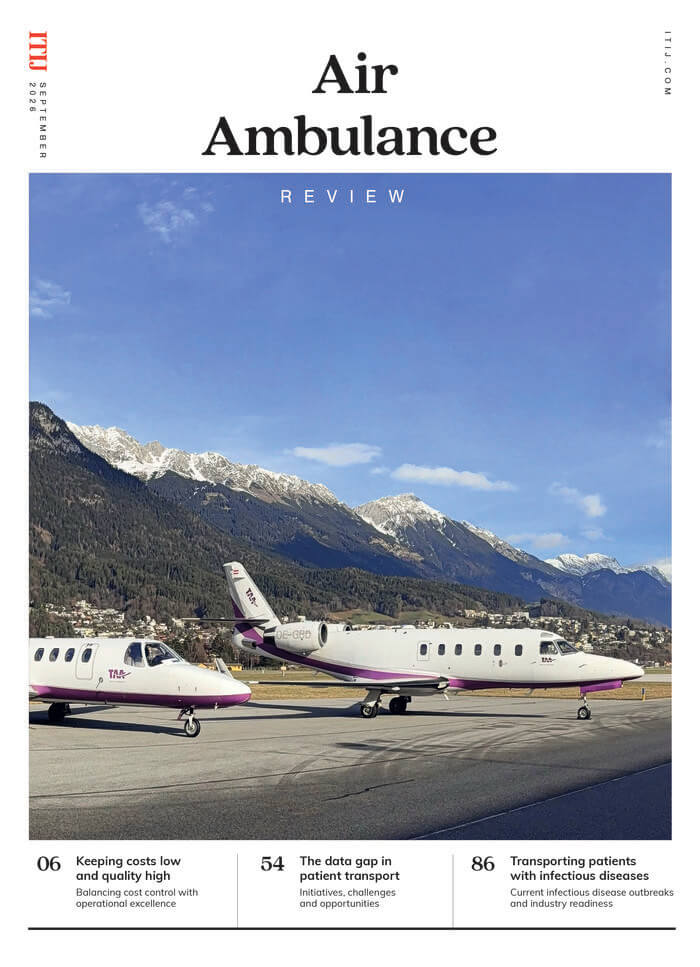
This issue we focus on the problems that rising costs are having on the industry. Air ambulance providers are facing costs across fuel, aircraft maintenance, staffing, insurance, regulatory compliance, and specialist medical equipment. As if that wasn’t enough, delayed payments from insurers are adding further financial pressure. Despite these challenges, providers agree that patient safety and clinical quality must not be compromised.
Editorial Team
The Editorial Team updates the ITIJ website daily, and works on features for the print edition. With expert industry knowledge and years of experience in writing about complex travel insurance issues, the Editorial Team is ready to investigate and report on the topics that matter most to ITIJ's readers.