
A mission to the end of the world and back

LifeFlight tell ITIJ about a complex aeromedical retrieval from Brisbane, Australia to Ushuaia, Argentina – the world’s most southern city known as the ‘end of the world’
LifeFlight was tasked in the lead up to the long Easter weekend to retrieve a male patient in his 70s with cardiac problems experienced during a cruise to Antarctica.
The challenge
This was LifeFlight’s first mission to South America (via French Polynesia and Easter Island) since 2008. It spanned seven days from 16–23 April and involved navigating multiple time zones and continents as well as some of the world’s most isolated airfields.
The huge distance involved – 17,040 nautical miles – required two full aeromedical crews to ensure the patient’s needs were catered for over the journey. LifeFlight sourced the second crew within four hours of the mission being activated and included a dedicated flight engineer to safeguard against potential maintenance issues for the Challenger 604 over the 45-hour return trip.
Operations
LifeFlight’s Operations Centre in Brisbane started planning the retrieval on 16 April. This included a raft of considerations from refuelling at remote airfields, such as Tahiti and Easter Island, through to securing permits and accommodation for crew rest and fatigue management, as well as onboard cold-chain meal storage and contingency stocks for delays. Within 24 hours, the jet was airborne enroute to Ushuaia.
LifeFlight trialled the Starlink Mini internet system, which proved highly successful for high-speed internet while transiting the remote locations. The team was able to access and provide clear on ground medical updates and real-time weather data for flight planning while between legs.
The huge distance involved – 17,040 nautical miles – required two full aeromedical crews to ensure the patient’s needs were catered for over the journey
Medical support
LifeFlight conducts a full Chief Medical Officer-led review before accepting tasking. For this mission, our CMO and 24/7 duty medical consultants maintained continuous oversight, with real-time briefings and updates throughout the retrieval. The patient’s condition and transfer plan were constantly reassessed and adapted as needed.
Upon arrival in Ushuaia, the medical team visited the hospital as part of LifeFlight’s standard practice to ensure a full picture of the patient’s needs as well as a smooth handover.
The aircraft’s journey across multiple time zones added a layer of clinical complexity to the mission, which was alleviated through carefully-timed monitoring and administering of medicine.
As the aircraft was descending into Melbourne, the patient’s condition deteriorated. LifeFlight’s medical team responded quickly, stabilising the patient and ensuring they were safely handed over to the hospital team in Melbourne for further treatment.
Final thoughts
“Once a transfer with a patient and family on board starts, it gains momentum of its own. You can’t just delay or cancel like a charter flight. A stretcher-bound patient can’t walk into a hotel. That’s the level of responsibility we own – and why every step of planning matters,” said Tyson Smith, General Manager of Air Ambulance at LifeFlight.
The Ushuaia flight showed how a complex retrieval covering thousands of nautical miles can be handled safely and efficiently with the right people, aircraft and planning. At the same time as the Ushuaia mission, LifeFlight was managing multiple missions across the Pacific. The capacity to handle multiple difficult missions has been developed over the past 20-plus years, with 1,099 patients airlifted in 2024.
Tyson Smith General Manager – Air Ambulance, LifeFlight
Tyson oversees more than 500 international and domestic jet retrievals each year. With more than 12 years’ experience in the aeromedical operations sector, he plays a key role in expanding LifeFlight’s global capability and continuously evolving clinical, operational, and commercial performance.
June 2025
Issue
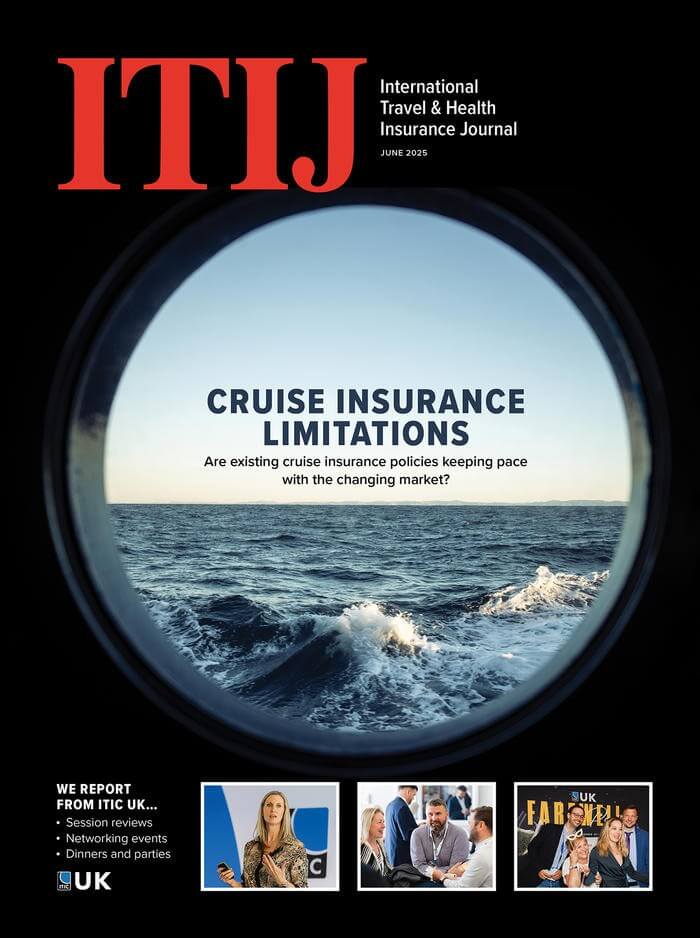
In this issue of ITIJ we examine the repatriation of mortal remains, and look at the trends, challenges and local expertise required. We also consider cruise insurance limits and exclusions and ask whether the latest cruise insurance policies are keeping up with what the travel market is offering.
Editorial Team
The Editorial Team updates the ITIJ website daily, and works on features for the print edition. With expert industry knowledge and years of experience in writing about complex travel insurance issues, the Editorial Team is ready to investigate and report on the topics that matter most to ITIJ's readers.