
Medical expertise in paradise

A conversation with SOS Medevac International’s leadership team – Thifaine Sollier, Chief Nursing Coordinator, and Dr Nicolas Hantala, Medical Director
What makes providing medical assistance in the South Pacific so challenging?
Thifaine Sollier: Geography, above all. People often picture French Polynesia as a small island chain, but it actually spans an area as large as Europe. An evacuation from the Marquesas to Tahiti covers nearly 1,500kms over open ocean. And our work extends beyond Polynesia – we operate across Samoa, Tonga, the Cook Islands, Hawaii, Rapa Nui, New Caledonia, Vanuatu, Fiji, and the Solomon Islands.
Dr Nicolas Hantala: The level of care varies widely from one island to another. Some islands have only a small health post run by a nurse, while others have hospitals comparable to European standards. Our mission is to adapt our medical response to these contrasting realities, support local teams, and guarantee patient safety under any circumstances.
How do your respective roles complement each other?
NH: The doctor–nurse partnership is the cornerstone of every mission. The physician defines the medical strategy and ensures scientific supervision, while the coordinating nurse manages logistics, liaises with families and local authorities, and maintains continuity of care throughout the transfer.
TS: It’s a relationship built on trust, communication, and precision – qualities you can only develop through real field experience.
Could you share a case that captures the spirit of your work?
NH: I remember a patient repatriated on a stretcher aboard a commercial flight to South Korea. The operation required coordinating two airlines, securing multiple technical authorisations, and arranging a wing-to-wing transfer in Tokyo. Thanks to our network and the team, everything went perfectly.
TS: When tourists face a major medical issue here, they’re far from home, family, and familiar care. The distance and isolation add to their distress – which is why our response must be deeply human, combining expertise with empathy. Seeing that patient, after weeks in intensive care, finally return home was an unforgettable moment.
How do you ensure patient safety during long-haul transfers?
NH: Stabilisation always comes first. Once the condition allows, we transfer patients to reference centres in New Zealand, Australia, or France. For urgent cardiac or neurosurgical cases, we’ve developed a unique expertise in criticalcare transfers aboard commercial aircraft – full monitoring, ventilator, infusion pumps, power supply, and 6,400 litres of oxygen. This option allows sameday departure, compared to the 24–48 hours often needed for an air ambulance. We’re proud of our close partnerships with Air Tahiti Nui and Air France.
What are the most frequent reasons for evacuation?
TS: Marine-related injuries are common – coral wounds, marine stings, or diving accidents.
NH: We also handle tropical infections like dengue, Zika, and chikungunya, as well as cardiac, respiratory, or neurological complications in older travellers.
What are your current priorities?
TS: Maintaining top-quality care while controlling costs. We’re conducting field audits, pursuing ISO 9001 certification, and developing volume-based agreements to help our partners plan budgets without compromising care.
One last thought for our readers?
TS: When your clients travel to these islands, knowing there’s a trusted medical partner on site brings real peace of mind.
NH: SOS Medevac means operational excellence in the service of the patient – anywhere, anytime.
About SOS Medevac International
SOS Medevac International specialises in comprehensive medical assistance including international medical evacuations, healthcare services for remote Polynesian sites and cruise ships, and medical coverage for events. As a key partner to international insurers, they coordinate evacuations and provide health consulting.
Thifaine Sollier
Chief Nursing Coordinator, SOS Medevac International
Thifaine is the specialised coordinator nurse at SOS Medevac Intl. She has been a nurse in French Polynesia for eight years. Her deep understanding of the territory's geographical challenges and healthcare limitations enables her to adapt to complex medical evacuations across the islands.
Dr Nicolas Hantala
Medical Director, SOS Medevac International
Dr Hantala is the Medical Director of SOS Medevac International. Trained in Paris, he holds a doctorate in anesthesiology and intensive care medicine, with advanced studies in aerospace medicine. Passionate about emergency and critical care in complex and remote settings, he has developed recognised expertise in international medical assistance and aeromedical evacuation. Based in French Polynesia, he oversees medical strategy and ensures excellence, safety, and humanity across all missions in the Pacific region.
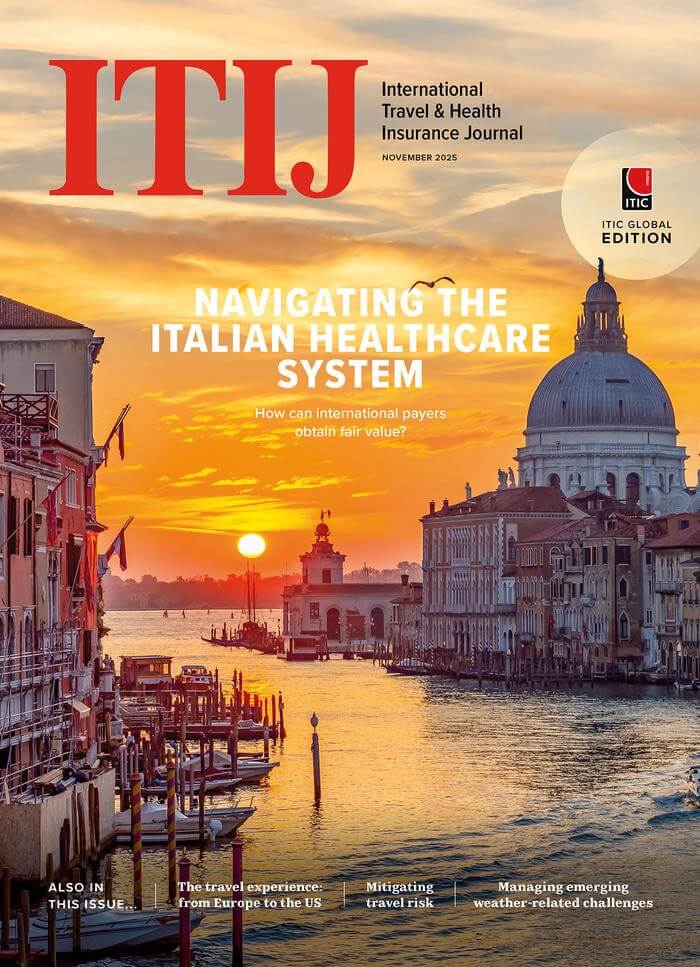
November 2025
Issue
In this issue of ITIJ we look at current travel patterns to and from the US and Europe, take a close look at the Italian healthcare system, and examine how insurers are adapting policies and coverage to manage weather-related challenges.
Editorial Team
The Editorial Team updates the ITIJ website daily, and works on features for the print edition. With expert industry knowledge and years of experience in writing about complex travel insurance issues, the Editorial Team is ready to investigate and report on the topics that matter most to ITIJ's readers.