
Managing the ‘human factor’ in failed self-evacuations

George Dagnall of SPS describes how his company repatriated a family from the UAE to the UK
In late February 2026, amid evolving geopolitical tensions in the United Arab Emirates, SPS implemented a shelter-in-place (SIP) protocol for a high-priority insured client. While the SPS Global Response Centre (GRC) maintained continuous advisory support, the situation highlights a recurring challenge for insurers and assistance providers: the gap between protocols and human behaviour under pressure.
Despite clear guidance, escalating anxiety led a senior employee to deviate from the SIP protocol. Accompanied by his spouse and three young children, he attempted a self-directed evacuation by road towards the Oman border. The attempt resulted in refusal of entry and a forced return to Dubai, significantly increasing stress and undermining confidence.
The challenge: from logistics to behavioural risk
Following the failed attempt, the situation evolved beyond a standard evacuation scenario. The family was under considerable psychological strain, and the risk of further uncoordinated movement increased.
At the same time, the client’s Crisis Management Team (CMT) activated the policy with a defined extraction requirement. A commercial departure from Muscat at 4:00am on 7 March created a narrow operational window.
The priority therefore shifted from planning movement to restoring control, stabilising the situation, and enabling a safe and compliant evacuation within a constrained time frame.
Intervention: stabilisation as an operational enabler
SPS assessed that a purely logistical response would be insufficient. A Close Protection Officer (CPO) was deployed to the family’s residence to stabilise the environment and reintroduce structured decision-making.
The intervention focused on three key areas:
• Behavioural stabilisation, with the CPO assuming responsibility for coordination to reduce stress and cognitive load
• Structured communication, providing clear, phased briefings to restore predictability and confidence
• Family dynamics, with particular attention given to the children to maintain calm and prevent escalation.
This approach demonstrates that effective evacuation is often enabled by stabilisation, not simply transport capability.
Execution: controlled movement under pressure
Extraction commenced on 6 March. With the CPO acting as the single point of coordination, the operation transitioned from reactive movement to a controlled escort.
At the Oman border, the CPO managed all interactions with authorities, including documentation and entry procedures. This removed pressure from the employee and reduced the likelihood of disruption.
Throughout transit, the family received continuous ‘next-step’ briefings, while SPS maintained realtime communication with the client’s CMT via secure channels, providing live updates and location tracking.
Outcome and insight
The family arrived safely in Muscat on 6 March and departed for the UK the following morning on a charter flight arranged by SPS. Beyond the successful extraction, the intervention restored client confidence and delivered on duty-of-care obligations.
For insurers and assistance providers, this case reinforces a critical point: evacuation risk is shaped as much by human behaviour as by external conditions. Protocols such as shelterin-place remain essential, but their effectiveness depends on the ability to recover when they are breached.
In practice, the difference between coverage and capability becomes most visible at the point of execution.
George Dagnall is Director of Insurance and Partnerships at SPS. He works with insurers to enhance assistance and crisis response capabilities, ensuring policyholders receive real-world support during complex incidents. George specialises in bridging insurance provision with operational delivery in high-risk and rapidly evolving global environments.
SPS, part of the Concentric Group, is a global assistance company specialising in the delivery of security, medical, and crisis response services, when and where they matter most. Powered by a 24/7 Global Response Centre and decades of operational experience, SPS gives clients the confidence to act decisively, ensuring the right decisions are made and the right outcomes are delivered in any crisis.
April 2026
Issue
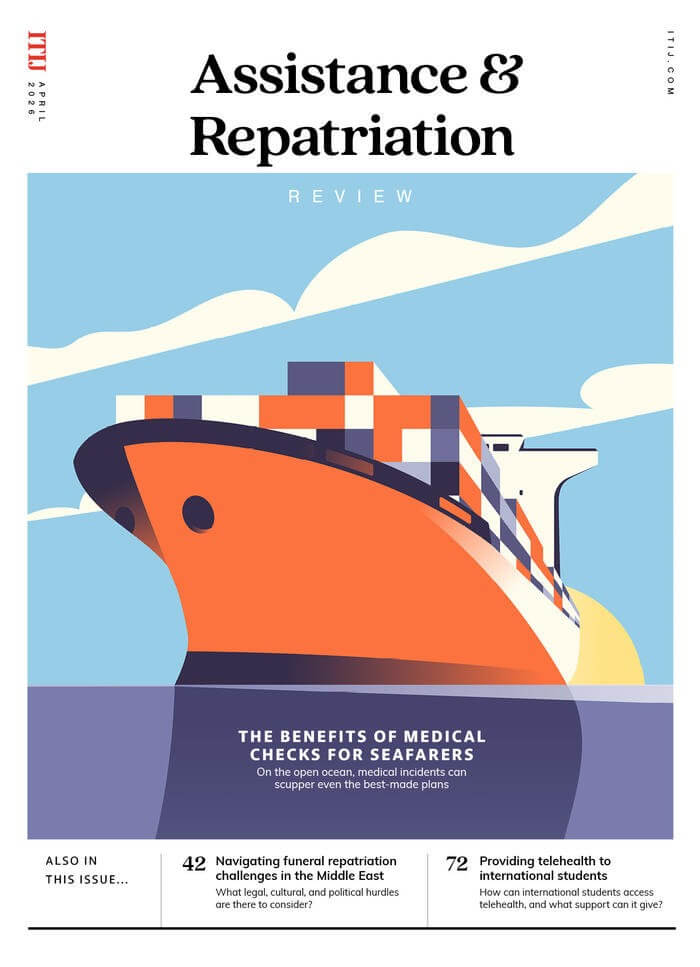
In the first Assistance & Repatriation Review of 2026, we explore the cultural, legal, and logistical intricacies of funeral repatriation in, around, and out of the Middle East. We also consider how pre-deployment medical assessments can save lives and sea voyages. The burgeoning demand for telehealth among students is covered in our third feature, plus we look at how companies are delivering services that meet that need.
Editorial Team
The Editorial Team updates the ITIJ website daily, and works on features for the print edition. With expert industry knowledge and years of experience in writing about complex travel insurance issues, the Editorial Team is ready to investigate and report on the topics that matter most to ITIJ's readers.