
Long-haul commercial stretcher transfer of a ventilator-dependent paediatric patient

How do you safely fly a ventilator-dependent child halfway around the world on a commercial flight? It takes meticulous planning, the right team, and a contingency plan for every eventuality, Dr Mohammed Afsal from Bluedot explains
At Bluedot, complex does not mean impossible. We recently completed the long-haul aeromedical transfer of a young, ventilator-dependent child from North America to the Middle East – a journey of roughly 13 hours in the air, on a stretcher, under full medical escort, aboard a scheduled commercial airline.
The challenge
This was a high-acuity patient with complex, round-the-clock needs. Tracheostomised and invasively ventilated 24/7, G-tube fed, and dependent on continuous oximetry monitoring, hourly airway suctioning, saline nebulisation, and mechanical cough assist. Add to that a rare neuromuscular condition, a paediatric patient, multiple time zones, and the constraints of a commercial cabin – and the margin for error narrows considerably.
A transfer like this leaves nothing to improvisation. Every medication, feed, circuit, filter, battery, and backup device has to be accounted for across a full day of door-to-door travel, with contingencies ready for delay, diversion, or any change in the patient’s condition.
How it’s planned and executed:
• Full airline medical clearance, coordinated and secured by Bluedot with the airline, including approval of all on-board arrangements for the stretcher, ventilator, and medical equipment
• A detailed pre-transfer bedside assessment and formal fit-to-fly evaluation, carried out at the patient’s residence before the day of travel
• A minute-by-minute transfer timeline – from bedside packaging and stretcher loading, through tarmac access, airport processing and priority boarding, to in-flight care and handover
• Close coordination between the ground ambulance team, airline ground and medical personnel, and the receiving hospital, with timings confirmed across every party
The patient remained clinically stable throughout the journey and was handed over to the receiving hospital exactly as planned
• Full equipment redundancy – primary plus backup ventilators, charged batteries with spares, suction, cough assist, nebulisation, and a complete emergency airway kit – all checked and reconfirmed
• A dedicated physician-and-nurse escort maintaining continuous ventilation, monitoring, and clinical care from the bedside in North America right through to the receiving hospital bed.
Why it matters
For a child who is ventilator-dependent and continuously monitored, the idea of a long-haul commercial flight can feel out of reach. Our role is to turn that ‘impossible’ into a safe, carefully managed reality – so a child can reach the care they need, and be closer to family, without compromise on safety.
The outcome
The patient remained clinically stable throughout the journey and was handed over to the receiving hospital exactly as planned. A safe transfer, a reassured family, and a clear reminder of what thorough preparation, redundancy, and teamwork make possible.
We work alongside hospitals, insurers, and case managers to make complex transfers safe and seamless. If you have a patient who needs to move – however challenging the case – let’s talk.
At Bluedot, we specialise in making the complex possible – safely.
Dr Mohammed Afsal is Medical Director and Chief Flight Physician at Bluedot Air Ambulance. With a Master’s in Emergency Medicine and a Fellowship in Aeromedical Sciences, he has orchestrated 500+ interstate and global patient transfers spanning 40 countries, showcasing his expertise and commitment to critical care.
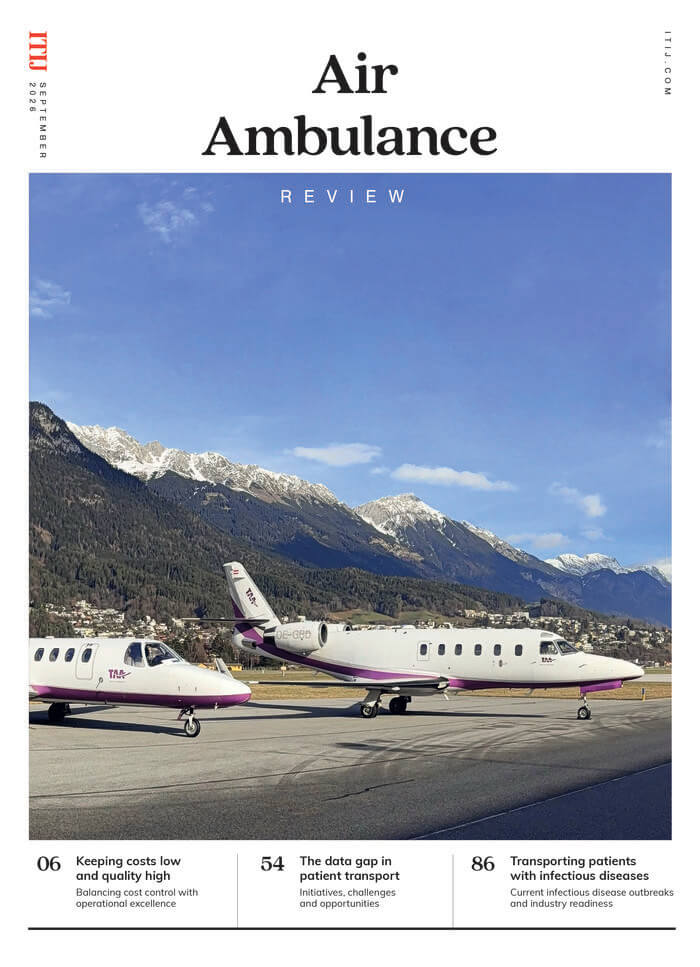
September 2026
Issue
This issue we focus on the problems that rising costs are having on the industry. Air ambulance providers are facing costs across fuel, aircraft maintenance, staffing, insurance, regulatory compliance, and specialist medical equipment. As if that wasn’t enough, delayed payments from insurers are adding further financial pressure. Despite these challenges, providers agree that patient safety and clinical quality must not be compromised.
Editorial Team
The Editorial Team updates the ITIJ website daily, and works on features for the print edition. With expert industry knowledge and years of experience in writing about complex travel insurance issues, the Editorial Team is ready to investigate and report on the topics that matter most to ITIJ's readers.