Legal, medical, global: psychiatric repatriation case review

Some missions demand more than clinical precision. They require empathy, legal coordination, and an unwavering commitment to doing what’s right. Airmedic’s mission report is a compelling example of how collaboration is the cornerstone of complex and high-stakes cases
The case involved a patient in a psychological crisis who was refusing transport. As with all psychiatric transfers, respecting the individual’s rights and autonomy was paramount. However, the situation also required timely intervention to ensure the patient’s safety and access to care.
From the outset, this mission stood out for its complexity. Legal authorisation was required due to the patient’s inability to make autonomous medical decisions, and logistical barriers had to be swiftly overcome. It was thanks to close-knit collaboration between the client, the referring hospital, and our operations and medical teams that we were able to move forward effectively. The hospital’s treating team, the patient’s family, and the court system worked together to secure the necessary legal documentation, a crucial step that ensured both ethical and procedural compliance.
Adding to the complexity of the case was the requirement for a physician to accompany the patient. We immediately engaged in the search for the right person while maintaining clear and ongoing communication throughout the process. Securing a doctor with the appropriate credentials and international experience was critical and, in a testament to our team's responsiveness and global coordination, we were able to identify and confirm a qualified physician in record time.
Collaboration: the keystone in complexity
Throughout the journey, every step was handled with heightened sensitivity. Psychiatric transports, especially international ones, require a calm and deliberate approach. Our team remained attentive not only to the patient’s clinical needs, but also to the emotional, cultural, and legal aspects that come into play during a crisis. From navigating customs discreetly to providing a safe, compassionate in-flight environment, this mission succeeded because it was rooted in teamwork.
This mission is a clear reminder of what it takes to deliver specialised medical transport under extraordinary circumstances. Its success relied on seamless collaboration, a crucial factor when navigating complex medical, legal, and family dynamics. Every step was guided by clarity, respect, and shared purpose. Upholding patient dignity and rights, even during a crisis, remained central throughout. Psychiatric repatriation demands both sensitivity and precision, and this case showed how empathy and ethical responsibility can shape critical decisions. Rapid cross-border coordination was key, with a qualified physician secured on short notice thanks to our global reach and responsiveness. Patient and crew safety remained a top priority, with every detail, legal, clinical, and logistical, executed with strict procedural compliance. The handoff at destination was just as deliberate, ensuring continuity of care from departure to arrival.
In high-stakes situations such as this, it is precisely this kind of multidisciplinary collaboration between the client, treating hospital, legal authorities, and air medical provider that ensures complex repatriation missions can be carried out safely, ethically, and effectively. Each partner brought essential expertise to the table, working in unison to overcome medical, legal, and logistical barriers. This level of coordination is not only critical to the safety and dignity of the patient, but it also ensures that no case is left without a solution.
Louis-Philippe Loiselle Fortier is Vice-President of Strategic Initiatives and Business Development for Airmedic. He has more than 15 years’ experience in the critical care medical field and has been with Airmedic for more than 11 years. He plays a pivotal role in driving the company’s growth, bringing strategic vision, strong leadership, and a patientcentred approach.
Airmedic, based in Montreal, Canada, provides trusted air ambulance services and medical escorts worldwide. With a fleet of 13 aircraft, including Bombardier Learjet 45XR, Pilatus PC12, and BK-117 helicopters, we ensure rapid medical evacuations, neonatal care, seamless coordination, and global repatriation with expert critical care and ground transport solutions.
September 2025
Issue
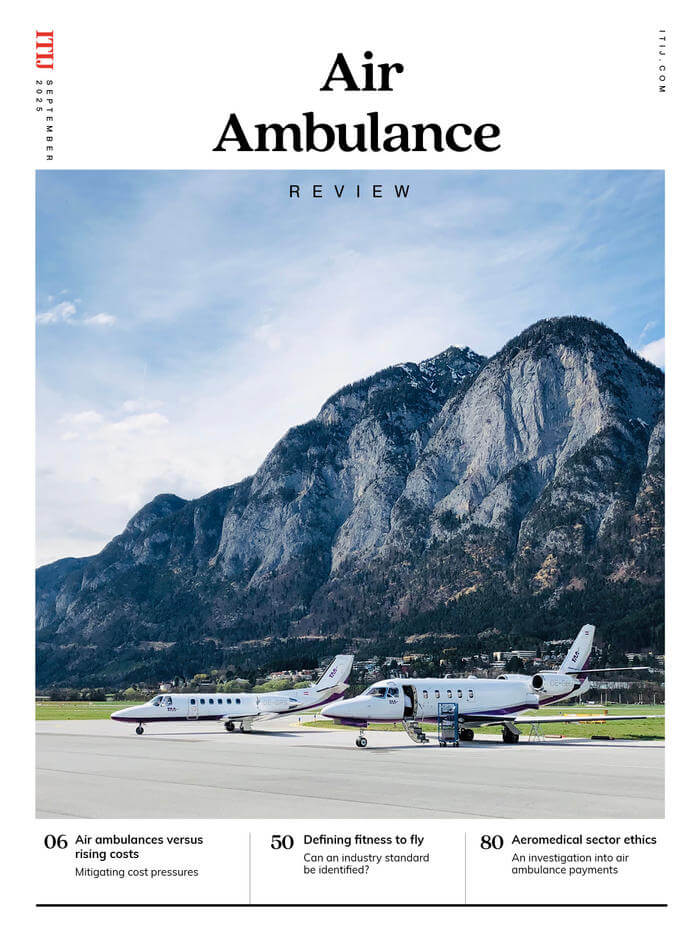
We include an examination on defining ‘fitness to fly’, and ask if an industry standard can be identified, and what that would involve. We also look at capacity in the aeromedical market and experts share their insights. Ethics and transparency in the aeromedical sector is a big issue, and we include an investigation into air ambulance payments.
Editorial Team
The Editorial Team updates the ITIJ website daily, and works on features for the print edition. With expert industry knowledge and years of experience in writing about complex travel insurance issues, the Editorial Team is ready to investigate and report on the topics that matter most to ITIJ's readers.