Introducing Redstar Aviation’s Medical Training Simulator: REDPULSE

ITIJ talks with Redstar Aviation’s Medical Training Manager, Dr Rüştü Okan EROL
What is the role of the Medical Training Manager in Redstar Aviation?
The Medical Training Manager is responsible for planning, coordinating, and supervising all educational activities within the medical department. The role ensures that every training programme aligns with international medical standards, operational requirements, and Redstar Aviation’s vision of clinical excellence.
With 34 full-time flight medical crew members from different professional backgrounds, achieving both standardisation and competency is vital for the unique challenges of air ambulance missions.
The Training Manager designs and implements simulation-based and educational programmes, supervises instructors, and manages collaborations with external training providers.
By continuously monitoring and evaluating training effectiveness through feedback and performance assessments, the role plays a critical part in improving patient safety, strengthening crew readiness, and maintaining the highest standards of aeromedical services.
The role ensures that every training programme aligns with international medical standards, operational requirements, and Redstar Aviation’s vision of clinical excellence
What types of training programmes does Redstar Aviation provide for its medical team?
Our flight medical crew come from diverse specialties and professional backgrounds, which enriches Redstar Aviation’s operational expertise. However, standardisation and adherence to international procedures are essential to ensure consistent and safe practice. All training programmes are structured according to the Redstar Aviation Medical Training Manual.
Every new crew member completes standardised orientation training (MeCOT), which includes flight physiology, aircraft familiarisation, and certified courses such as ACLS, PALS, NRP, and PHTLS, alongside civil aviation trainings like CRM and ESET. Continuous education is equally vital, both to refresh knowledge and to raise awareness of evolving medical approaches. For this reason, we conduct frequent theoretical and practical sessions to reinforce competencies and maintain operational standardisation. In addition to individual training, we have recently launched Redpulse, our simulation-based team training, which provides highly realistic, scenariodriven exercises designed to strengthen both technical skills and crew coordination.
Redstar Aviation has a new medical training simulation centre within your newly constructed hangar premises. What does it represent for your company’s long-term vision for crew training?
Our new simulation centre, Redpulse, is a cornerstone of Redstar Aviation’s long-term vision to embed continuous learning into our culture. By integrating it into the hangar, we combine clinical, technical, and operational training in one location, mirroring the conditions of real missions.
Redpulse represents our commitment to future-proofing crew competencies and raising standards of patient care in the air ambulance sector. More than a facility, it is a symbol of innovation and a tangible expression of our belief that simulation-based training is essential for ensuring safe, efficient, and effective aeromedical operations.
What type of technology is Redstar Aviation using in the new medical simulation centre?
One of Redstar Aviation’s first Learjet 45 aircraft, after completing many successful missions, has been retired and repurposed as a dedicated medical simulation mock-up, creating an authentic training environment.
The mock-up is also equipped with audiovisual systems to record and debrief training sessions. To complement this, we invested in advanced patient simulators and selected the Gaumard HAL S3201 mannequin for its ability to replicate human physiology with exceptional realism. HAL allows trainees to monitor vital signs and respond to evolving conditions in real time. Crucially, it integrates seamlessly with our medical equipment – ventilators, defibrillators, and patient monitors – so that crews train with the same devices they use in actual missions.
The system provides comprehensive parameters including heart rate, SpO₂, EtCO₂, NIBP, rhythms, and full 12-lead ECG, while also supporting mechanical ventilation, invasive procedures, drug recognition, and physical examination. This integration of advanced simulation with real-world practice makes our training both realistic and operationally relevant.
How has the medical team responded to the new simulation training?
The response has been overwhelmingly positive. Our flight medical crew consistently say the simulations provide the closest experience to an actual in-flight emergency without leaving the ground. They appreciate the realism of training in a mock-up aircraft, which recreates the challenges of confined spaces.
Importantly, they emphasise the value of practising as a team – developing leadership, communication, and decision-making under pressure. Post-simulation debriefings further strengthen learning by allowing crews to reflect on their actions and refine their performance. Ultimately, the training has built confidence, improved cohesion, and reassured our teams that Redstar Aviation is fully committed to their preparedness and professional development.
Which skills are most commonly developed in medical simulation training?
Our simulations are designed to develop a comprehensive set of skills. Clinically, we focus on advanced airway management, resuscitation, trauma stabilisation, and neonatal or paediatric emergencies. Operationally, crews practice working within the constraints of an aircraft cabin, managing equipment during turbulence, and prioritising interventions under strict time limits. Equally important are non-technical skills such as teamwork, leadership, and situational awareness.
At Redstar Aviation, we believe that clinical expertise must go hand in hand with operational resilience and strong human factors. This holistic approach ensures that our teams can deliver safe and effective care even under the most demanding circumstances.
How do you assess the success of your training programmes?
Assessment is multi-layered. On a basic level, structured checklists are used to evaluate technical accuracy. We also conduct formal debriefings after each simulation, focusing on both clinical performance and teamwork effectiveness.
Individual and team progress is tracked over time, while participant feedback provides insights into the realism and relevance of scenarios.
Beyond the classroom, mission outcomes serve as the ultimate measure of success – safer operations, smoother coordination, and higher-quality patient care. Together, these evaluation methods ensure that our programmes are effective, evidence-based, and continuously improving.
Our new simulation centre, Redpulse, is a cornerstone of Redstar Aviation’s long-term vision to embed continuous learning into our culture
From your perspective as Medical Training Manager, how do you see the role of simulation evolving in the future of aeromedical services?
Simulation has become the backbone of Redstar Aviation’s training philosophy, transforming how medical crews prepare for complex, high-risk missions.
The next decade will likely see greater integration of artificial intelligence (AI) into training, offering personalised feedback and adaptive learning pathways.
At Redstar Aviation, our role will be to remain at the forefront of these changes, ensuring that our crews continue to benefit from the latest tools while staying grounded in the human values that define patient care. Blending cutting-edge technology with a culture of continuous learning, Redstar Aviation is setting new benchmarks in aeromedical care.
Every scenario trained today represents a life potentially saved tomorrow – a vision that reflects both the company’s mission and its personal dedication to advancing patient safety and clinical excellence.
Dr Rüştü Okan EROL
Medical Training Manager, Redstar Aviation
Dr EROL has been working at Redstar Aviation for eight years. He has over 25 years of prehospital emergency medicine experience, including 13 years in air ambulance services. He has been interested in pre-hospital emergency training since 2005.
November 2025
Issue
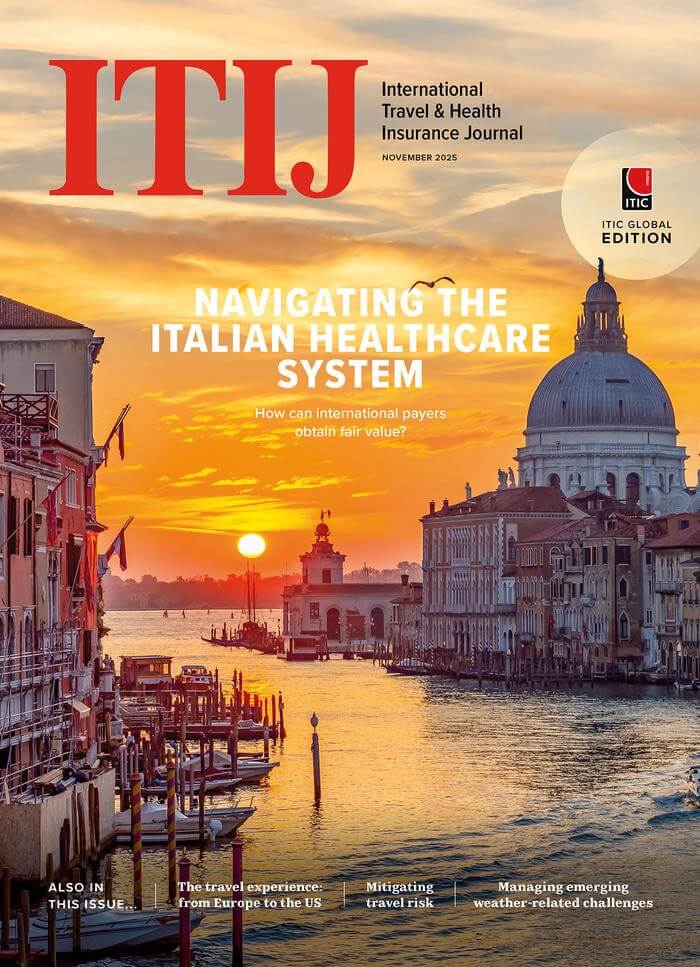
In this issue of ITIJ we look at current travel patterns to and from the US and Europe, take a close look at the Italian healthcare system, and examine how insurers are adapting policies and coverage to manage weather-related challenges.
Editorial Team
The Editorial Team updates the ITIJ website daily, and works on features for the print edition. With expert industry knowledge and years of experience in writing about complex travel insurance issues, the Editorial Team is ready to investigate and report on the topics that matter most to ITIJ's readers.