

Interview: Tom Bishop, Sompo

Michelle Royle speaks with Tom Bishop, VP Head of Travel, A&H, at Sompo, about his new role, digitalisation, and putting the customer first
You started your position at Sompo just over a year ago. What does your role involve on a day-to-day basis?
My role is focused on growing Sompo’s travel book within Accident & Health and identifying where we can support growth through the underwriting capacity we bring to the market. Day to day, that means working with brokers, MGAs, and other partners to understand where there are attractive opportunities and how Sompo can support them as a long-term underwriting partner.
Our model is very much partnership-led. We provide underwriting capacity on a delegated basis in the UK and European Economic Area (EEA) and reinsurance capacity globally, working with partners who own the product, customer proposition, and distribution strategy. A key part of my role is making sure those relationships are set up for success from the outset, with the right structure, risk framework, and commercial alignment in place.
That means looking across the full product life cycle, from initial proposition discussions and underwriting approach through to performance management, service delivery, and claims outcomes. Even where the product and distribution sit with the partner, we believe there is real value in bringing end-to-end expertise to help support sustainable growth.
In practical terms, my day-to-day role is about combining underwriting discipline with market insight and collaboration, and making sure Sompo is a strong, reliable capacity provider for partners building travel propositions in a competitive and evolving market.
How is Sompo positioning its Accident & Health portfolio in an increasingly competitive global market? Where are the growth areas?
In a competitive market, the key is to be clear about where you can genuinely add value. For us, that means focusing on areas where specialist underwriting, strong relationships, and a high-quality service proposition can make a real difference, rather than chasing volume for its own sake.
There are clear growth opportunities where customer needs are becoming more complex and more visible. Travel is one of them, particularly as businesses focus more on duty of care and travellers expect broader, more responsive protection. International health is another, driven by workforce mobility and changing expectations around access to care.
What clients are looking for today is not just capacity. They want clarity, consistency, and confidence that the product will work when it matters. That is especially true in travel and health-related lines, where the customer experience is such a key part of the value proposition.
So for us, growth is about building in the right areas, with the right partners, in a way that is sustainable and aligned with where the market is heading.
With travel protection for business and leisure travellers gaining increasing prominence as travel risk becomes ever more obvious, how is the market responding to increases in demand for, and expectation of, travel insurance benefits?
What we’re seeing is that customers now expect travel insurance to do much more than it did in the past. It’s no longer just about medical emergencies abroad. People want protection that reflects the realities of modern travel, whether that’s disruption, cancellation, delays or simply being able to access help quickly when something goes wrong.
For business travel, that shift has been especially clear. Employers are much more focused on traveller wellbeing and duty of care, so travel protection is increasingly seen as part of a wider people-risk strategy rather than a standalone purchase.
In the leisure market, expectations have risen as well. Customers want products that are simpler to understand, easier to buy, and much easier to use. They also expect a more immediate service experience, particularly through digital channels.
The market is responding by sharpening their products and investing more in seamless service provision, and that is clearly the right direction. The challenge is doing that with products that are properly priced and enable good customer outcomes in what is an increasingly complex risk environment.
What more can the travel insurance sector do to work with other lines of insurance to increase awareness of travel protection products and how they align with other parts of the insurance ecosystem?
One of the biggest opportunities is to stop treating travel insurance as a standalone product. In reality, it connects naturally with health, personal accident, employee benefits, and wider duty-of-care thinking, particularly in the corporate market.
If you take business travel insurance as an example, it can sit alongside international medical cover and broader people-risk programmes in a much more joined-up way than it often does today. On the consumer side, there is also scope to better connect travel protection with health and financial wellbeing products, especially through banks, affinity schemes, and digital distribution.
Part of the challenge is how the product has traditionally been sold. If it is presented only at the point of booking, the conversation can become overly price-driven. That makes it harder to explain the real value of the cover and how it complements other protections customers may already have.
The sector can do more by working across the wider insurance ecosystem and by communicating in simpler, more practical terms. If we explain travel insurance through the lens of medical access, assistance, and continuity, people are much more likely to understand why it matters.

Are we seeing a shift from traditional insurance to more service-led health ecosystems?
Yes, I think we are, and it is being driven largely by customer expectation. People still want the core insurance promise, but they also want more visible and practical support around it. That is why we are seeing a move towards models that combine insurance with services such as telemedicine, assistance apps, care navigation, and digital health tools.
In health, that shift feels quite natural because customers increasingly expect easier access, faster support, and a more joined-up experience. In travel, it is very similar. If something happens while you are abroad, what matters is not just whether you are covered, but how quickly you can get help and how easy it is to navigate the situation.
That does not mean traditional insurance becomes less important. Risk transfer remains at the core of the proposition. What is changing is how value is delivered and experienced. Increasingly, customers judge a product by how it performs in real time, not just by the wording in the policy document.
For insurers, that means service, technology, and partnerships are becoming much more central to the proposition rather than sitting around the edges of it.
Growth is about building in the right areas, with the right partners, in a way that is sustainable and aligned with where the market is heading

How is Sompo leveraging digital tools in A&H in general, and in travel protection lines specifically?
The most important thing about digital tools is that they should make the product easier to access and easier to use. In A&H, there is real value in anything that improves the customer journey, enables better decision-making or helps us respond more quickly when someone needs support.
Digitalisation is helping insurers streamline onboarding, improve data capture, make claims more efficient, and create a more connected experience. Across assistance and claims, Sompo have a small panel of preferred providers who are able to respond in real time, using effective digital communication and offering immediate access to support, which can make a real difference in producing great outcomes to insured travellers.
There is also strong potential in areas such as analytics and AI to support underwriting insight and operational effectiveness. In health-related lines, telemedicine is a good example of how service and protection are coming closer together.
Ultimately, the technology itself is only part of the story. What really matters is whether it solves a genuine customer problem. Across A&H and travel, the priorities are usually quite simple: speed, clarity, and confidence. If digital tools help deliver that, they become very powerful.
What role do partnerships play in growth for the travel business?
They play a central role. Travel insurance is one of those areas where underwriting alone is not enough. Growth depends on having the right distribution relationships, the right service infrastructure, and the right customer journey around the product.
Brokers are critical, particularly in corporate travel and more specialist areas, because they understand client needs in detail and help shape solutions around how organisations actually manage travel risk. They also give us a clear view of how expectations are changing in the market.
At the same time, digital and affinity partnerships are as important because they bring protection closer to the point where customers are making decisions. That is especially relevant in travel, where convenience and timing are such a big part of the buying process.
Healthcare and assistance partners are equally important because they shape the customer experience when it matters most. In travel insurance, that real-world service delivery is a big part of the value proposition.
For me, growth comes from building the right ecosystem. If you have strong broker relationships, effective distribution, and dependable service partners, you are in a much better position to deliver something that customers genuinely value.
Tom Bishop, VP Head of Travel, Accident & Health, Sompo
Prior to his current role, Tom led Direct Line’s Travel Insurance business for 15 years, providing cover to up to four million customers through large bancassurance and direct leisure travel schemes. His assistance experience also provides a strong understanding of the operational management of travel risk, particularly the complexities of travellers needing emergency support in real time. At Sompo, he is focused on providing insurance capacity for partners with responsive travel propositions in an ever-evolving risk landscape.
July 2026
Issue
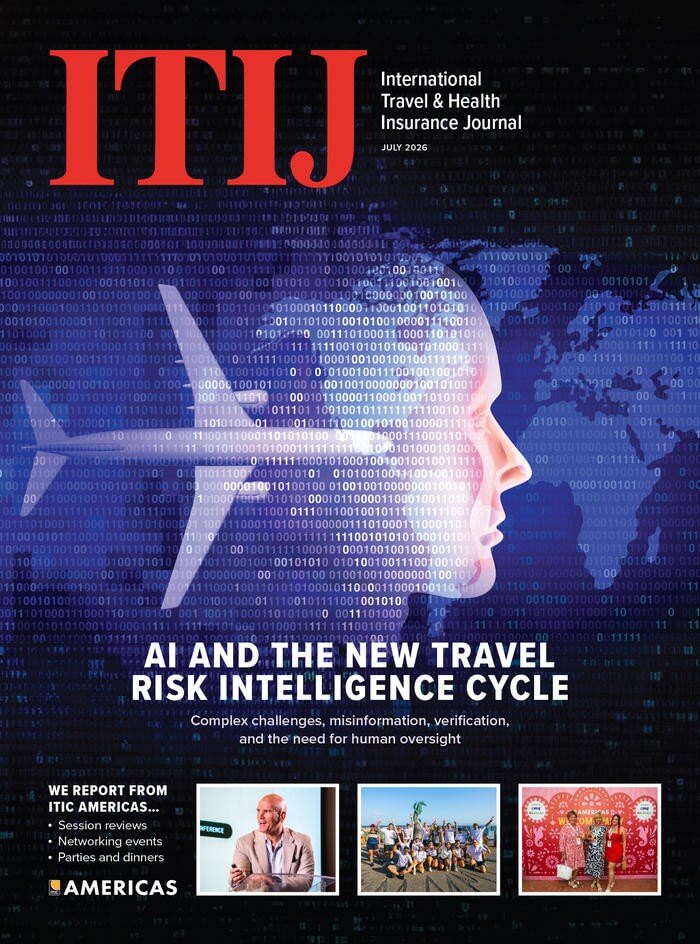
Welcome to your July issue! This month we look at how artificial intelligence solutions are changing the way in which travel risk information is gathered and communicated, plus we ask whether providers should do more to educate their customers, ensuring they understand the products they are buying and using them appropriately.
Michelle Royle
Michelle is Editor of ITIJ.