
Interview: Silvia Adjigeryaeva, fraud consultant

Silvia Adjigeryaeva, freelance Insurance Investigator, talks to Michelle Royle about the increase in fraud, social media scams, and the tools that can help insurance companies
How have you seen travel and health insurance fraud evolve in the past three to five years, particularly with increased mobility and cross-border claims?
Naturally fraudulent practices evolve faster than fraud detection tools and investigation specialists’ skills. Fraudulent practices are becoming more sophisticated with the digitalisation of claims online, which helps facilitate claims processing for insurance companies. There has been a rise in fraudulent practices in the travel and health sector specifically. Claims made for ‘A sudden fall on a slippery floor’ or ‘An accident tripping over a curb’ take great effort from the insurance handler to prove the opposite, especially for international claims, as insurance companies would have extra financial expenses to hire an investigator on the ground without any guaranteed payback on investment. Fraudulent practices include:
- Using false medical certificates and inflating travel-related expenses
- Using non-disclosure restrictions of the health facility provider to the third-party investigator, preventing them from automatically obtaining all details of the case
- Using ‘staged medical treatments’, substituting actual provided services, for example ‘Aesthetic rhinoplasty surgery’ disguised as ‘Broken nose emergency surgery’.
What psychological factors or behavioural patterns do fraudsters typically exhibit, and how can investigators leverage behavioural cues when assessing a suspicious claim?
Analyses of psychological factors inevitably have a degree of subjectivity, so are always controversial. Nevertheless, evidence and experience show that, in most cases, claimants base their perception on claimed financial reimbursement as ‘deserved compensation’ as they are the ones who suffered and paid for the insurance policy. However, such claims based on perceived entitlement for reimbursement often face unforeseen obstacles and may contain mistakes indicating the claim is fraudulent.
In some cases, overconfidence and boldness step in, with the allure of possible financial benefits, as claimants are convinced they are smarter than the system. They may underestimate counter-fraud processes and systems and may believe that it would cost much more for the insurance company to conduct an investigation than to pay off their hospital bill.
In fact, fraudulent behaviour patterns are quite predictable and notorious:
- Failing to notify the insurance carrier and getting approval due to an emergency
- Being unable to provide details or giving vague explanations due to unstable health state
- An absence of documentation, failing to provide any at all or little, due to alleged complications from the procedures of the local health provider or by saying simply “I forgot them” or “They didn’t give me any”
- Filing immediately on the first or second day of a trip and/or just before the policy expiry.
Which emerging technologies (e.g. AI, machine learning, blockchain, biometric verification) do you believe are the most impactful in detecting and deterring fraudulent claims in travel or health insurance?
Clearly artificial intelligence (AI) tools and engines are a great assistance in search, analysis and verification of the data.
AI detects discrepancies in submitted documents, whether it is inflated medical bills, suspicious travel itineraries or unusual formatting of submitted documents.
Blockchain helps deal with records, whether they are hospital discharge records, travel bookings, hotel or flight bookings. One booking does not confirm the actual travel itinerary: a flight ticket may be booked, paid for and provided to the insurance carrier, and then cancelled and booked for another flight, for a cheaper price or even to another destination.
Biometrics are at the disposal of the authorities, so are subject to non-disclosure regulation. Even having an authorisation letter obtained from the claimant or the client does not guarantee that the authorities would cooperate, although occasionally they may help on a verbal basis.
How do you think social media is being used by fraudsters to commit fraud, and by insurers/assistance companies to try and detect it?
As we say, when there is a demand, there is always an offer.
There is undoubtedly demand for information for fraudsters on social media platforms. There are multiple groups on social media platforms, with advisory notes, consultation, claim processing, and sharing experiences. These and many more on messenger chats are even named without fear, like post-traumatic stress disorder (PTSD) claims. They are becoming widely popular. Furthermore, there are ones specialising in providing medical certificates upon certain financial aid, travel documents, prescriptions etc. Sophisticated and professional-level claimants may even stage fake profiles or comments, in order to validate their cases.
Upon receiving a case, the insurance company should initiate a background check. The probability of your claimant being present on some social media platforms is high, therefore partial data can be collected online. Cross-checking claimants’ stories against public posts sheds a great deal of light on PTSD claims, for example. A claimant would be seen consuming alcohol in a loud public area, whereas his claimed health state restricts consumption of alcoholic beverages due to an acute reaction with medication. Loud noise stress irritation may be claimed, which does not align with posts from nightclub surroundings.
How do your remote investigation methods, such as digital forensics or open-source intelligence (OSINT), differ from traditional in-person tactics like surveillance or on-site verification?
Remote methods go hand-in-hand with on-the-ground investigation methods throughout the process. Initial information is gained remotely, and the rest depends on the groundwork.
Remote investigation methods may include examining metadata in submitted documents (e.g. hospital invoices or flight tickets) to check authenticity. For example, a submitted medical certificate may have been created before the alleged treatment date, or a flight ticket cancellation letter may have been digitally altered. Open-source intelligence may be applied in this case to verify whether the flight was actually cancelled based on data provided by the airlines/airport; also, news media reports of accidents, which can be checked against traffic collision fatal cases, and many more.
Remote background checks can greatly impact the effectiveness of ground-work verification.
In your experience, how significant a role does social engineering play in insurance fraud schemes, and what countermeasures are most effective?
Social engineering plays a peculiar part in fraud schemes, and is successful at times, due to the human-related factor.
Fraudsters may try to manipulate claim handlers, medical staff, travel agents, or even the investigator. They may exploit sympathy by exaggerating illness, family emergencies, or distress abroad, and much more.
Experienced claims handlers recognise manipulation tactics and resist pressure. Investigators seek independent confirmation of medical records, travel disruption, and identity documents. It is necessary for the investigator to stay neutral and impartial, ensuring that empathy and customer service do not compromise security.
Can you describe how insurers, law enforcement (e.g. specialist fraud units), and tech partners can collaborate effectively to investigate and prevent sophisticated fraud rings?
Insurers, claim handlers, or even law enforcement identify suspicious claims through anomaly detection, internal audits, and customer interaction. The claim is initialised and assigned after conducting data analysis and a background search using technical staff, AI tools, blockchain registers, and social media investigations to build a complete picture of the claim.
Fraud rings are increasingly sophisticated, exploiting both digital and cross-border vulnerabilities. Thus, collaboration and assistance of each party conducting the investigation is vital. They need to be supplied with necessary data to facilitate successful completion of the case.
What ethical frameworks and quality controls do you implement to minimise wrongful fraud flags and ensure genuine claimants are not unfairly disadvantaged?
A true investigator must treat each case with vigilance and with respect for genuine claimants. Every flagged case is treated as suspicious, not guilty. No assumptions are made and it is important to keep an open mind.
All additional background, AI, blockchain, and other tools are supplementary to mitigate the risk of false positives. With knowledge, experience, and vigilance based on real data, the investigator can protect against fraud while ensuring genuine claimants are treated fairly and respectfully.
Looking forward, what do you think will be the biggest challenge for fraud investigation teams in the next decade, and how should the industry be preparing now?
Fraudsters will master AI tools, create deepfakes, and cooperate in cross-border networks to establish claims with the best chance of getting guaranteed successful results.
In international travel and medical tourism, claimants will continue exploiting jurisdictional gaps, e.g. non-disclosure regulations to the third parties, as there is reduced risk of punishment for the case falsification. The insurance claims handler may reject financial reimbursement or claim compensation based on proven and confirmed fraud facts, leaving the claimant ‘unpunished’ for the falsification of the claim.
Authorising access and building stronger partnerships between insurers, law enforcement, and technology providers to share intelligence globally, as each party has a right to know for the transparency and veracity of the claim, may be one of the key steps in verification of the fraudulent cases.
April 2026
Issue
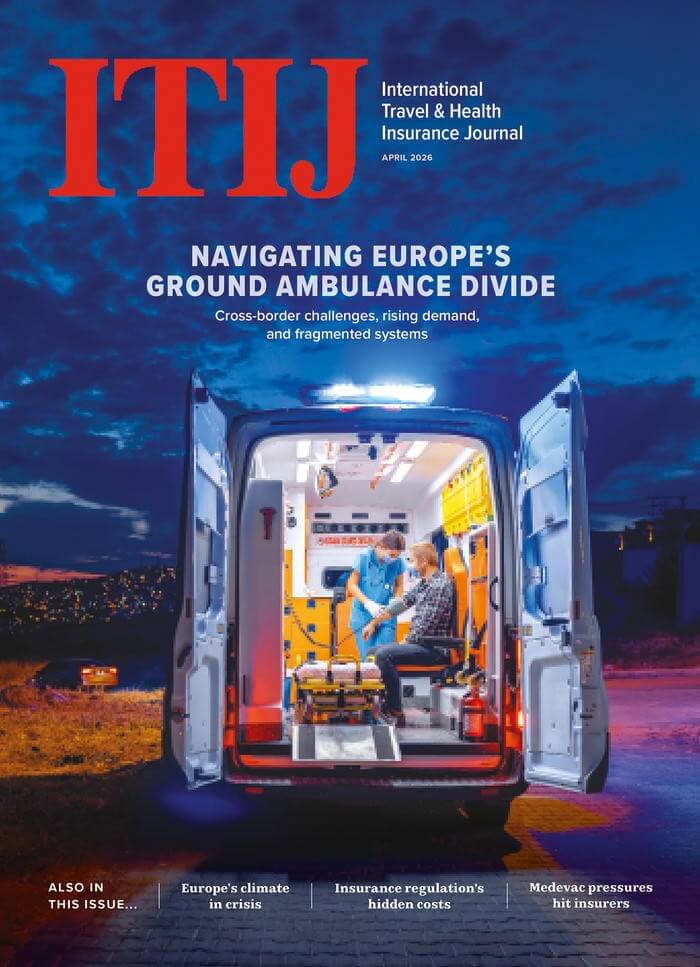
Across Europe, demand for ground ambulance services is rising, while capacity, workforce availability, regulatory limits and inflationary cost pressures intensify. We look at the evolving landscape, highlight major market stress points, and assess how stakeholders are responding. We also have anassessment of the latest regulations in different jurisdictions that are hindering insurance development and growth. We cover the most important regulatory frictions across major and emerging jurisdictions, explain how they impede growth, and propose actionable mitigations for industry stakeholders.
Editorial Team
The Editorial Team updates the ITIJ website daily, and works on features for the print edition. With expert industry knowledge and years of experience in writing about complex travel insurance issues, the Editorial Team is ready to investigate and report on the topics that matter most to ITIJ's readers.