
Interview: Seth Krummrich, Global Guardian

Michelle Royle speaks to Seth Krummrich, Vice President of Client Risk Management for Global Guardian, about the volatility the world is facing right now, and why proper preparation for every eventuality is essential
How has your experience in US Army Special Operations shaped your approach to corporate risk management in volatile regions like the Middle East or Central Asia?
My experience in the Middle East, Horn of Africa, and Central Asia Special Operations taught me understanding local perspectives is essential to assessing and understanding risk – the biggest lesson was that the local perspective matters most. If you try to assess risk through a Western lens, you’ll misread the signals, make wrong security predictions, and put yourself at risk.
I was a Green Beret for over 28 years and Green Berets are unique commandos that get paid ‘from the neck up’, which means being immersed in local cultures, living alongside communities, and seeing the world the way they do. I describe it as the ‘Lawrence of Arabia’ model. By recognising how local populations interpret the world, you learn how they perceive risk, how threat actors perceive the environment, and how those perspectives differ from our own goals. Once you see the world through those lenses, you achieve informed decision-making and risk reduction.
When I frame risk and risk reduction to my corporate partners now, I provide local, street-level intelligence from our global network of professional security agents that live in-country. My analysis provides a level of nuance and clarity that goes beyond surface-level, open-source data analysis. This corporate risk management strategy helps our clients protect their employees and maximise their business opportunities while reducing overall risk.
How is Global Guardian leveraging real-time intelligence and local partnerships to stay ahead of fast-moving threats like cartel violence or political unrest?
Modern threats like cartel violence or political unrest move incredibly fast in unpredictable and dynamic environments. Most countries, even governments, struggle to anticipate the next big shift. That’s why we focus on having the network in place, communicating with us in real time, before the crisis hits.
We use a three-part formula. First is intelligence: integrating real, street-level insight from our teams on the ground. Second are assets, such as planes, ships, and vehicles to complement our security and crisis response teams. The truth is, once a crisis occurs, everyone is scrambling for scarce available resources. If you don’t already have assets staged before the crisis, you’re behind. And third is digital integration; the speed of communication today is the binding mortar that connects everything. When roads are blocked or neighbourhoods are on fire, our digital platforms let us instantly alert clients, track locations, and adjust plans in real time.
Resourcing and synchronising accurate intelligence, assets, and digital integration is how you stay ahead of fast-moving threats. It’s about being ready everywhere, so when the unpredictable happens, our clients are first in line for protection and response.
How do you balance data-driven risk models with on-the-ground intelligence when advising clients in high-risk environments?
I’d frame it less as ‘balancing’ and more as ‘weaving’ data-driven risk models with on-the-ground intelligence.
Most models are built on open-source intelligence, but the problem is that they’re only as accurate as the country allows them to be. In authoritarian or unstable regions, a lot of what you see is restricted or filtered and manipulated information. If you rely on that alone, you end up with blind spots.
Predictive models are also backward-looking; past incidents feed them. The challenge is that the world is moving so fast, it doesn’t always repeat itself neatly. Cities change, neighbourhoods evolve, threats adapt. You can’t assume the next event will look like the last one.
That’s why we weave in intelligence from trusted people on the ground with our teams and local partners. They give us the finger-on-the-pulse feel of what’s happening in real time. When you bring that together with the data models, you create an accurate intelligence picture. That’s what allows us to make informed decisions and advise clients on how to best allocate their limited resources in truly high-risk environments.
Modern threats like cartel violence or political unrest move incredibly fast in unpredictable and dynamic environments
With cyber threats becoming increasingly sophisticated, how does Global Guardian integrate cybersecurity into broader corporate risk planning?
Cyber must be a part of today’s whole risk spectrum. It’s not a separate risk event; rather, cyber is integrated in all aspects of security. Threats are moving faster on the cyber side than they are on the physical side, and that’s where many companies underestimate their vulnerability.
In my experience, clients struggle to see and understand themselves. In many cases, they are not aware of how they’re perceived by customers, detractors, or even individuals who might have a grievance. That lack of self-awareness becomes a weakness. Add in the fact that technologies like crypto, artificial intelligence (AI), and deepfakes make extortion easier than ever and suddenly you’ve got multiple new attack angles that most businesses aren’t preparing for.
Our approach at Global Guardian is to integrate cybersecurity directly into broader corporate risk planning. We start by helping companies understand their digital footprint, whether that’s the vulnerabilities in a corporate network or even in a home environment where executives are working remotely. From there, we layer that with operational and physical risk.
The most important security priority is taking care of your employees and their families. When you bring those cyber and physical elements together, you understand the threat and build a plan that protects not just the company, but also its leadership and their families.
What role does cultural understanding and local relationship-building play in keeping clients safe in complex environments?
Cultural understanding and local relationships are vital to keeping clients safe in complex environments. If you don’t understand those cultural dynamics, you’re at a huge disadvantage and so is your client.
That’s where Global Guardian stands out. We don’t just drop into a country and try to impose a Western playbook. We have a global network of seasoned local security agents (all tested, vetted, and insured) who know the local culture and the way relationships and negotiations work. And, if something goes wrong, we can launch a team immediately to work with local law enforcement, reduce tensions, and protect our clients.
It is a model that comes right out of Special Operations, like how the Green Berets integrated with local populations. Cultural understanding isn’t a ‘nice-to-have’; it’s the foundation of operating safely around the world, and especially in high-risk areas of
the world.
What are the most overlooked operational vulnerabilities in corporate risk assessments today?
One big vulnerability we see in corporate risk assessments is that clients don’t truly understand themselves. They’ll spend time analysing the market or the space they’re operating in, but they don’t stop to ask, ‘How are we perceived?’ or ‘Who sees us as the enemy, a competitor, or a symbolic target?’
The reality is, if you are the face of a company, you are a target, no matter how successful or respected you are. There will always be disgruntled customers, activist groups, or individuals who disagree with your policies or practices. Example: an oil and gas executive must recognise that environmental groups will see them as a problem and target them to amplify their message.
If you don’t reduce your attackable surface area, such as your data, daily travel patterns, and physical site security vulnerabilities, you not only put yourself at risk; you put your company and your family at risk
If you don’t reduce your attackable surface area, such as your data, daily travel patterns, and physical site security vulnerabilities, you not only put yourself at risk; you put your company and your family at risk. Leaders who don’t understand how exposed they are become the weakest link in corporate security.
What are the key elements of a successful corporate evacuation plan in politically unstable regions?
A successful evacuation plan comes down to preparation. The most valuable resource you have in a crisis is time, and the only way to buy time is to plan and rehearse in advance.
To understand the potential crisis evacuation triggers, you need clear ‘If – then’ scenarios and a plan that directs an employee on what to do if a trigger is met. That plan must be informed by both digital models and street-level intelligence, so evacuation execution runs smoothly.
Next, everyone who’s part of the evacuation has to be informed. They should know where to meet, what to bring, who to contact, even what the evacuation team looks like when they arrive. From the Global Guardian side, we also have to know the client, how many people are involved, if there are medical needs, pets, or anything that can potentially complicate the move.
Finally, you’ve got to rehearse. Whether it’s a tabletop exercise or a full walk-through, practising the plan reveals the gaps. And there has to be quality control. For example,
if you tell employees they need a go bag, make sure they actually have it packed and ready. With preparation, rehearsals, and resources in place, you turn a chaotic scramble into an organised response, and that’s what saves lives in politically unstable regions.
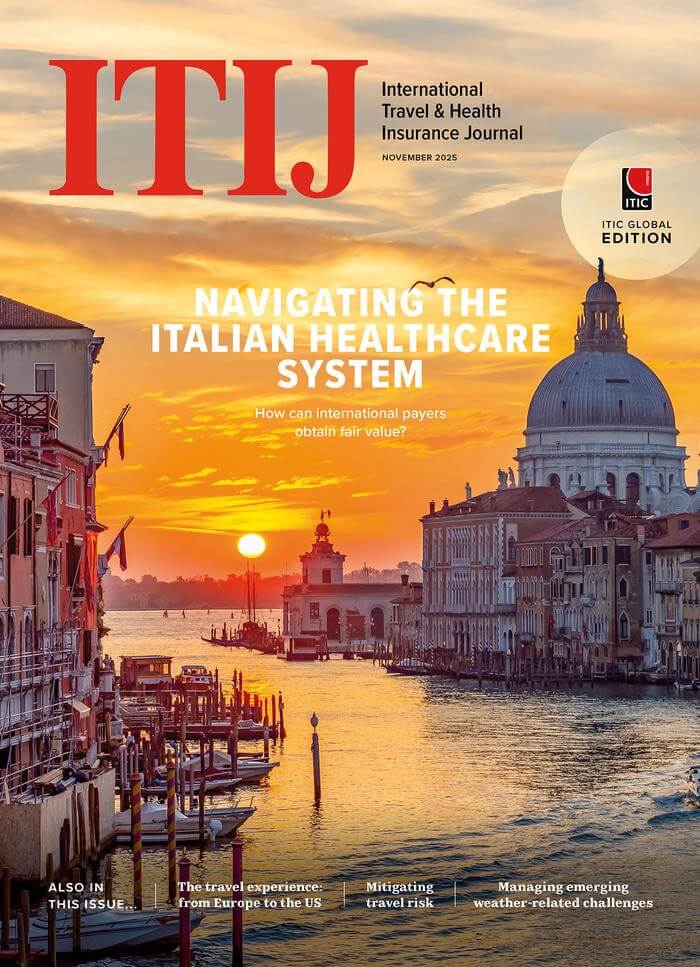
November 2025
Issue
In this issue of ITIJ we look at current travel patterns to and from the US and Europe, take a close look at the Italian healthcare system, and examine how insurers are adapting policies and coverage to manage weather-related challenges.
Michelle Royle
Michelle is Editor of ITIJ.