
Interview: Robert Gallagher, the US Travel Insurance Association (USTIA)

Mandy Langfield spoke to Robert Gallagher, Head of Americas for AIG Travel, and President of the US Travel Insurance Association (USTIA), about his career in the industry, and the challenges facing the North American travel insurance market
Can you share a brief rundown of your career so far? Who have you worked for, in what positions, and where you are currently?
I began my travel industry career 45 years ago with Delta Air Lines working as a part-time ramp service agent at Boston’s Logan Airport. My time at Delta spanned 25 years in positions of increasing responsibility with airport operations, passenger service, marketing, finance, and sales and distribution. While I started in Boston, I later transferred to Chicago, Washington DC, back to Boston, then Los Angeles and ultimately settled into corporate life at Delta’s world headquarters in Atlanta.
When I left Delta, I was General Manager of Business Development & Strategic Planning for the sales and distribution group. I joined AIG in 2004 as Vice President of Leisure Travel for the domestic accident and health division, with oversight of the Travel line of business in the US and Canada. Subsequent to AIG’s acquisition of Travel Guard in 2006 and the introduction of AIG Travel, Inc., I took on more global roles with AIG Travel in marketing, strategic planning and industry relations. For a concurrent six years, I was Managing Director for a Paris-based AIG Travel distribution technology subsidiary.
Over the course of my career, in addition to my time at USTIA, I have been involved with a variety of travel industry organisations, most notably as Board and Executive Committee member of the US Travel Association and Advisory Council Member of the World Travel & Tourism Council. Coming full circle, I returned as Head of North America at AIG Travel in 2017, which later expanded to my current role as Head of the Americas.
When did you become President of the USTIA, and what have been your most satisfying achievements since you became President?
I became President in November 2023, and while it is otherwise a two-year term, we changed the by-laws that same year so the two-year terms of officers and board members would align with the budget cycle, which is the calendar year. Hence my term as President will conclude in December 2025.
My most satisfying achievement thus far is effectively engaging with my fellow officers, the board and the committee chairs at USTIA. It’s not about one person, but rather a multitude of professionals from various segments of our industry who, as committee volunteers, bring a diversity of talent and skills and are collectively committed to achieving the Association’s strategic goals. While the officers and the board have management oversight and provide guidance, the real work gets done at the committee level.
What do you find to be the most challenging part of your role?
The most challenging aspect is keeping up with the demands of my job at AIG Travel while allocating the time necessary to be effective in a leadership role at the Association. I’m not alone there. The same can be said for the other officers, board members and committee chairs at USTIA. All are volunteers who have full-time jobs; some run companies or divisions of companies. Only the president role has some added responsibilities. Maintaining the appropriate balance takes a conscious effort, a modified perspective on priorities, a bit of sacrifice and, more generally, a step-up in time-management practices.
Meeting Gen Z where they are on digital platforms, and providing an easy and fast way to purchase travel insurance from a valued travel advisor, travel supplier, or directly from the insurance provider, is one of the top drivers of innovation in the industry
The USTIA was founded 20 years ago, and has achieved a great deal since its inception. What are your hopes for its future?
Since its founding, USTIA has indeed made great strides and we have many to thank for the accomplishments of the first 20 years. At USTIA’s 2024 annual conference this past April, we commemorated our 20th anniversary, and in doing so, paid tribute to those that have gone before, both founders and past presidents, all of whom contributed significantly to establishing a firm foundation on which we continue to build. At present, we are very much focused on USTIA advancing its strategic agenda and consistently, albeit meaningfully, delivering against three overarching strategic objectives:
- Advocacy: the Travel Insurance Model Act being adopted in all 51 jurisdictions
- Education and awareness: effectively expanding our multimedia public relations initiatives across a variety of audiences
- Membership value: ensuring member retention and overall membership growth.
It’s not about hope, it’s more about hard work and a sustained commitment. To that end, we are making excellent progress and USTIA’s future looks bright.
What are the biggest barriers to growth for the US travel insurance industry?
In the US travel insurance market, general understanding and take-up rate of travel insurance remains a challenge. Only 30–35% of US leisure travellers travel with some sort of coverage on their vacations. Many US travellers are still not aware of the valuable benefits of travel insurance, nor do they fully understand the potential financial loss for having to cancel a vacation, or sizeable, unexpected costs for things like medical emergencies or medical air evacuations while travelling abroad.
What role do you think that technology will play for travel insurers seeking to cement their position and/or grow their business?
Technology already plays a large part in the US travel insurance industry with online purchases and apps to reach out for emergency travel or medical assistance, as well as filing of claims.
Where do you think the most potential for growth lies for our industry?
The largest opportunity for growth still remains in educating and building awareness around the financial and travel inconvenience benefits of buying travel insurance.
Working collaboratively with our state representatives is crucial and we believe that this continued dialogue will remain critical for success
Is there a particular type of policy that is going to meet the needs of Gen Z travellers?
Gen Z travellers seem to be more willing to invest the time necessary to understand insurance differences and various policy coverages to allow for more tailored policies than have been historically sold in the US travel insurance market. Meeting Gen Z where they are on digital platforms, and providing an easy and fast way to purchase travel insurance from a valued travel adviser, travel supplier, or directly from the insurance provider, is one of the top drivers of innovation in the industry.
Another state – Colorado – recently signed up to the Travel Insurance Model Act. Could you share a bit of background about the Act, for those who aren’t familiar with it, and its progress of adoption across the US?
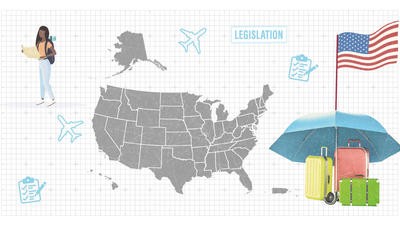
We are extremely pleased that both Colorado and now, Pennsylvania have enacted a version of the Travel Insurance Model Act this year. The NCOIL/NAIC Travel Insurance Model Act was developed over a more than two-year period by state insurance legislators (NCOIL) and state insurance regulators (NAIC) during a collaborative process that included consumer groups, the industry, and legislators and regulators. The Model Acts establish uniform definitions, permitted and prohibited sales practices, a standard way for travel insurance products to be filed around the country, and other uniform provisions that essentially codify the existing market practices into the insurance laws of the states. NCOIL enacted the Model in 2017, and the NAIC followed in 2018. This has been a very successful effort, with 37 states so far having enacted a version of the Model, including Colorado and Pennsylvania this year.
Working with state and federal authorities can feel frustrating at times, with a somewhat disjointed approach to regulatory affairs for insurers; what is the USTIA doing to try and build a rapport with regulators and improve the situation for insurers in the US?
USTIA has a Law and Regulation Committee that is very active in providing information to state legislators and state insurance regulators about travel insurance and working with them in getting a version of the NCOIL/NAIC Travel Insurance Model Act in place around the country. We also maintain an ongoing dialogue with state legislators and insurance regulators through attendance at conferences and meetings with them. We understand that working collaboratively with our state representatives is crucial and believe that this continued dialogue will remain critical for success.
What is the USTIA doing to encourage states to adopt the Act and advocate for travel insurance companies and sellers to have more freedom to sell products across state lines?
Generally, see above, as the Law and Regulation Committee of the USTIA, Co-Chaired by Caren Alvarado of Crum & Forster, and Duke de Haas of Allianz, are working hard to continue to get a version of the Model enacted in those states that have not yet adopted it. We will continue to be a leading voice with regulators and legislators to adopt these needed solutions on a nationwide basis.
Robert Gallagher
Robert Gallagher is Head of Americas for AIG Travel, and President of the US Travel Insurance Association (USTIA). Robert brings over 20 years of industry experience to his role, where he oversees key initiatives to promote consumer education and advocacy within the travel insurance sector.
November 2024
Issue
This month we look at affinity partnerships and ask if online travel agencies are the perfect partners for insurers; we cover the trends around cruising in the Mediterranean; we delve into the specifics of the Austrian healthcare system; plus we examine international healthcare and technology, asking how far can technology go.
Mandy Langfield
Mandy Langfield is a Director of Palladium Media Partners and former Publishing Director at Voyageur Group. She has written extensively on international travel and health insurance, medical assistance provision, and air medical transportation.