
Interview: A customer-first approach

Jody Baker, CEO of Charles Taylor Assistance, talks to Michelle Royle about digitalisation, the changing needs of travellers, and why human interaction is still so vital
You’ve just celebrated a decade with Charles Taylor Assistance (formerly CEGA): what’s changed most about the company in the last 10 years?
It’s been a decade of huge change and development, starting with CEGA’s acquisition by Charles Taylor in 2016 and culminating in significant business growth. Along the way we’ve even celebrated our 50th birthday!
Of course, Covid-19 struck four years after our acquisition, bringing in hybrid working and accelerating claims digitisation, transforming the way we communicate with customers, and they with us (more on this below). Alongside our digital developments and prompted by our growth, we’ve also focused more than ever on creating specialist customer support – for instance, to meet the niche needs of our high-net-worth and vulnerable travel insurance customers.
Today, drawing on Charles Taylor’s global offices, and on our membership of the Astrum Assistance Alliance, we’re meeting insurers’ needs in much wider international markets than a decade ago. For instance, we’re now supporting local insurers in Australia, Singapore and Spain, and we’ve penetrated new sectors such as aviation claims.
With people now travelling further and for longer, often with multiple health conditions, the volume and complexity of medical repatriations have also increased
The last 10 years have also seen us expanding our footprint with a new office in Mallorca, and a larger head office on the UK’s south coast to double our capacity. In short, we’ve grown from a family enterprise into a global provider of medical and security assistance, claims solutions and travel risk management, and our clients have come on that journey with us.

Where are you seeing the greatest increase in customer demand?
The business as a whole has grown by around 20% over the last year, and we’ve seen increased demand right across our services.
With international travel now back to pre-pandemic levels, claim volumes are on a par with 2019. But today, claims are more complicated and higher in value, customers are more exacting, and there are added legislative demands such as Consumer Duty. So, like others in the travel insurance sector, we need to be more innovative and customer-focused than ever.
At the same time, with people now travelling further and for longer, often with multiple health conditions, the volume and complexity of medical repatriations have also increased. This year, we’ve managed twice as many repatriations as in 2024, overcoming hurdles like higher-than-inflation rises in global medical fees, tougher legislation, and a shortage of hospital beds in the UK and Europe.
In the context of travellers’ increasing health conditions, global demand for our intuitive medical screening tool and telemedicine services is gathering pace too: they’re just two more ways of easing the customer experience whilst mitigating insurers’ risks.
How is digitisation transforming travel claims management and containing insurers’ costs?
By resolving claims within minutes, end-to-end digitisation is transforming the customer experience for lower-value claims, and not just during claims surges.
We first introduced electronic notification of loss (ENOL) back in 2018 and we’re continuing to develop digitisation, most recently with real-time claims tracking. Today, around 60% of our travel claims are notified online, with about 30% settled via straight-through processing (STP), with no human touch. Customers can access these digital options via a website interface, or interactive voice response (IVR) technology.
To contain insurers’ costs and provide the best customer experience, digital claims capabilities need to be synonymous with fair decision-making and consistent claims journeys. Key to this is implementing automated fraud detection and decision engines with individual data decision points to segregate fraud risk and provide either immediate automated payment, automated repudiation, or automated requests for more information. All this calls for significant investments in time and financial outlay.
STP technology also needs to quickly verify the customer as a valid and eligible policyholder and ask dynamic question sets relevant to the claim type and the customer’s answers. And it needs to be flexible enough to allow for bespoke and changeable automated claims payment thresholds. Thresholds may need to be revised at speed, for example during claims surges, as delays could challenge the seamless end-to-end experience.
Beyond the visible claims journey, digitisation is also supporting genuine customers and containing costs via tools that provide everything from automated billing for hospital invoices to speedy claims validation. Tools for the latter can find hard-to-locate fraud intelligence on open source and social media sites and run forensic checks on claims evidence to spot artificial intelligence (AI) generated or manipulated metadata.
By resolving claims within minutes, end-to-end digitisation is transforming the customer experience for lower-value claims

Why is human expertise still so important in travel claims management?
One of the benefits of claims digitisation is that it frees up human resources for complex claims, vulnerable policyholders, and customers who’d just rather talk to a human being.
Customers still want claims teams to be on hand to process payments by phone, offer advice, and make the right timely interventions. They also need human skills to support their niche requirements, be those related to a winter sports claim, a vulnerability, or a myriad of other factors.
Creating and retaining a strong workplace culture is crucial to this loyalty
It follows that automated technology needs to quickly differentiate complex from simple claims and assign them appropriately to a human call handler or a fully automated process.
Either way, maximum choice about how and when claims are made is integral to a satisfying claims experience. So too is gauging customer satisfaction, for instance via Net Promoter Score (NPS) surveys.
How have you retained your workplace culture in the face of substantial growth?
Just recently, our Group Chief Executive paid us a visit to celebrate our long-service employees. We worked out we had 88 staff who’ve been with us for more than 10 years and between them, they’ve worked for us for 1,457 years!
Creating and retaining a strong workplace culture is crucial to this loyalty. It’s all about building a community and creating an environment of constant development where wellbeing is prioritised.
So, we celebrate colleagues who go the extra mile, offer access to wellbeing champions, and organise a lot of collaborative staff events, from beach cleans to bake days. We’ve also doubled the number of employees taking professional qualifications.
Working in such a human business means we really need to get the ‘fit’ right for staff. And our new interactive assessment centres for job candidates are playing an important part here, bringing our roles to life and ensuring candidates understand exactly the qualities they need to join the company and thrive.
What does the future hold for Charles Taylor Assistance?
The real joy of our business is that every time the phone is picked up, we’re doing something for someone else. At the same time, we’re not afraid of change. We’re always asking ourselves what we can do better, and this will shape our future.
Going forward, it’s great to be forging partnerships with new international markets and brands alongside our longstanding partners, and to be using intelligent automation to take simple processes away, so we can better concentrate on customers’ needs. The latter is bringing some exciting development opportunities for our people as they upskill to meet customers’ niche and changing demands.
Travel (along with gardening!) seems to be something that people are reluctant to give up when times are hard, and the recent Association of British Travel Agents (ABTA) Holiday Habits Report confirms this, with 65% of respondents saying their holiday is the most important time of the year. So it looks as if claims volumes won’t be reducing any time soon.
In this context, it will be more important than ever to capture, share, and analyse real-time and reported claims data to keep understanding customers, so we can tailor our service offering accordingly.
Meanwhile, as we look to see where our technology and innovation can be applied to other high-volume claim areas in the travel and international health sectors and beyond, one thing is certain – we won’t lose sight of the golden thread that runs through businesses like ours: empathy. It will always be customers first.
Jody Baker, CEO, Charles Taylor Assistance
Jody joined Charles Taylor Assistance in 2015 as Commercial Director and has held the role of Chief Executive since 2020. He also sits on the board of the Astrum Assistance Alliance.
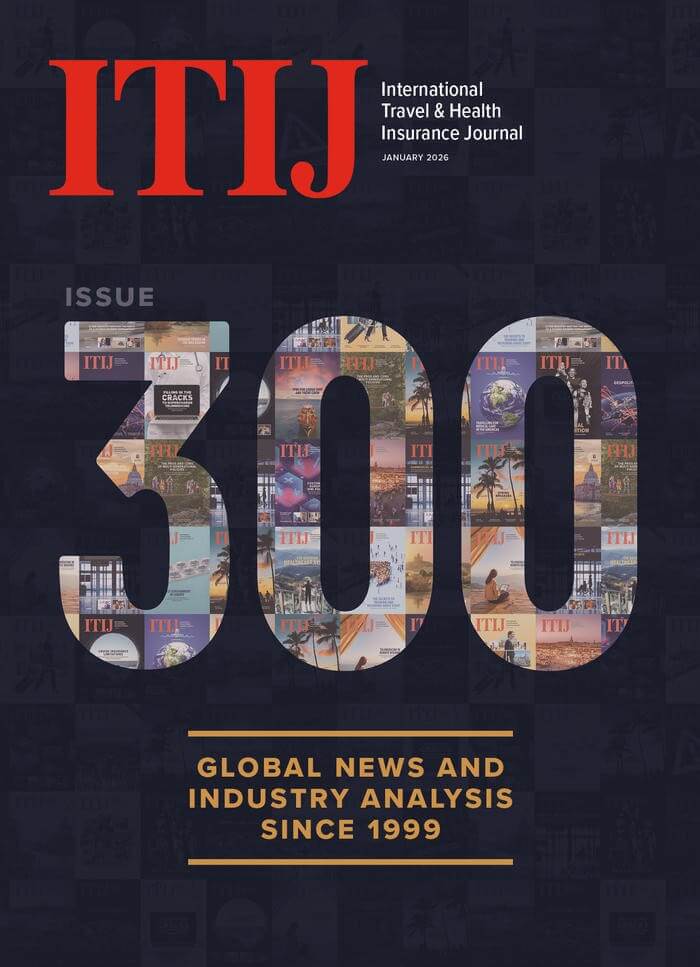
January 2026
Issue
In this issue of ITIJ we ask whether insurance companies up to date with IPMI benefits; examine how insurers are using automation and AI to streamline claims; and consider whether specialist reputation consultancies can help destinations restore their reputations after a crisis.
Michelle Royle
Michelle is Editor of ITIJ.