Inside US and Dominican Republic healthcare: insights from IAG’s 2025 Summit and EduTour

The International Assistance Group (IAG) 2025 US Healthcare Summit and Dominican Republic EduTour brought members of the global network together to explore regional healthcare capability, cost pressures and operational realities across two of the Americas’ busiest travel markets, Louise Heywood, General Manager IAG, tells ITIJ
As international travel across the Americas continues to grow, assistance organisations are managing increased activity in two of the region’s busiest corridors: the US and the Dominican Republic.
While their healthcare systems differ in scale and structure, the two are closely connected through geography, migration, clinical partnerships and long-standing referral pathways. Miami functions as a major medical hub for the Caribbean, while the Dominican Republic’s private sector is rapidly expanding its capability and international orientation.
In December, the IAG hosted its 2025 US Healthcare Summit in Miami, followed by a five-day EduTour across the Dominican Republic. The connected events gave delegates the opportunity to explore two popular travel markets where assistance organisations face distinct but interconnected operational challenges. The immersive programme brought IAG partners closer to the realities on the ground, helping them connect with local providers and strengthen their understanding of regional healthcare capabilities.
Delegates heard how economic pressures such as tariffs, labour shortages and supply chain constraints continue to drive up the cost
of devices, imaging and pharmaceuticals
Across the visits, the group saw MCI Latam’s expertise in coordinating care, managing communication and supporting international patients firsthand, including a stop at their new offices
Miami Summit: navigating the realities of US healthcare
Co-hosted by IAG Accredited Service Provider Jackson Memorial Hospital, the Summit explored the pressures shaping the US healthcare landscape. Presentations from New Frontier Group and GMMI highlighted a system that remains highly advanced yet increasingly volatile.
Delegates heard how economic pressures such as tariffs, labour shortages and supply chain constraints continue to drive up the cost of devices, imaging and pharmaceuticals. Consolidation across hospital groups has also shaped pricing dynamics, while limited compliance with federal price transparency rules can make it harder for insurers and assistance providers to anticipate costs or negotiate effectively.
Cruise medicine was another key focus. With more than 20 million passengers embarking from North American ports each year, onboard medical centres function as small emergency departments, managing 95% of acute illness and injury at sea.
Delegates gained insight into the limitations that drive referrals, from the absence of CT and MRI to the operational constraints of evacuations, diversions and weather-dependent access to ports. These realities reinforce the importance of early planning, clear communication and strong relationships with receiving hospitals.
The group also explored the patient experience. International patients often arrive in the US anxious about costs, cultural barriers and the risk of unpaid bills. Assistance organisations play a vital role in guiding travellers to trusted facilities, supporting navigation and ensuring continuity of care.
Having a clearer understanding of the pressures on the US system helps our network anticipate challenges and support partners and their customers more effectively.
Dominican Republic EduTour: on-the-ground insights
After the Summit, delegates travelled to the Dominican Republic for IAG’s seventh EduTour, co-hosted by IAG Core Partner MCI Latam. Over five days, the group visited hospitals and clinics across Puerto Plata, Santiago, Las Terrenas, Santo Domingo and Punta Cana, gaining firsthand insight into the country’s private healthcare sector.
One theme that emerged was that capability was higher than many expected. Facilities such as HOMS, Union Medica and CEDIMAT demonstrated advanced diagnostics, 24- hour catheterisation labs, neurosurgery, NICUs and modern emergency departments. Many hospitals offered single rooms, strong infection prevention practices and dedicated international desks with English-speaking staff.
Delegates also saw how capability varies by region. High-complexity services are concentrated in Santo Domingo and Santiago, while coastal areas rely on smaller private hospitals with fewer specialist capabilities. Referral times between regions can range from one to three hours, making preidentified pathways essential for timely decision-making. Delegates also observed that while private hospitals are modern and internationally oriented, public facilities face greater resource constraints.
Across the visits, the group saw MCI Latam’s expertise in coordinating care, managing communication and supporting international patients firsthand, including a stop at their new offices. Their strong provider relationships and understanding of local capacity help insurers navigate a system where capability is strong but unevenly distributed.
IAG EduTours offer a level of understanding that only comes from being on the ground.
Standing among the 16th-century stone arches, delegates were reminded of the country’s long medical history and the rapid evolution of its private sector.
For insurers and assistance organisations, the insights gained in Miami
and the Dominican Republic translate directly into operational readiness
Knowledge that strengthens decision-making
Across both destinations, the combined programme reinforced the value of firsthand knowledge in improving case management, cost containment and patient outcomes. Delegates left with a clearer understanding of facility capabilities, stronger relationships with local providers and greater confidence in making referral decisions in two of the region’s busiest travel markets.
For insurers and assistance organisations, the insights gained in Miami and the Dominican Republic translate directly into operational readiness. Better understanding of US cost drivers, cruise medicine constraints and FWA risks supports more effective cost avoidance strategies. Greater familiarity with Dominican referral pathways, regional variation and private sector strengths enhances the ability to place patients appropriately and manage cases efficiently.
Our network thrives on shared experience. Bringing partners together in the places where they operate gives them the insight and confidence to make better decisions for travellers when it matters most.
Looking ahead
With travel to the Americas continuing to grow, the need for accurate, on-the-ground healthcare intelligence will only increase. The IAG Healthcare Summit and EduTour was a practical, collaborative way for assistance organisations to deepen their understanding of regional systems, strengthen operational relationships and improve outcomes for international patients.
Building on this success, IAG will host three EduTours in 2026. The series begins in Kenya in March, followed by Egypt in May and Thailand in December. Each destination gives partners a clearer view of the healthcare realities in some of the world’s most visited, and often challenging, tourist destinations.
Louise Heywood
General Manager, International Assistance Group (IAG)
Louise is General Manager of the International Assistance Group (IAG), a global alliance of independent assistance companies operating in more than 160 countries. For more information visit international-assistance-group.com
February 2026
Issue
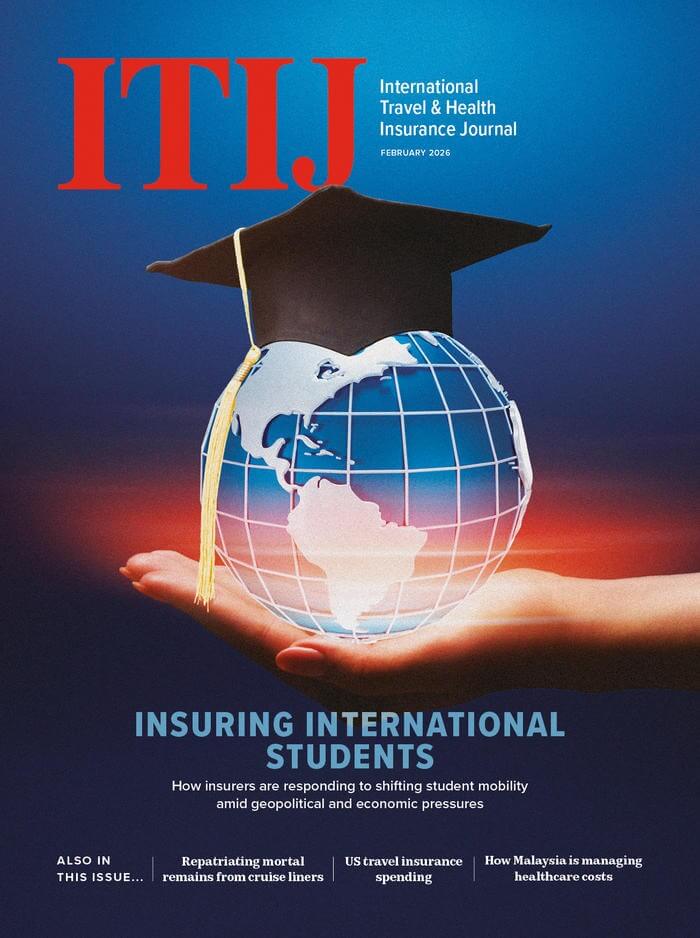
In this issue of ITIJ we look at international student insurance, and consider the impact of geopolitical decisions on market demand; we examine what ensues when a fatality happens on board a cruise ship, and what the protocols are for management of the remains; and we look at younger groups eschewing travel insurance.
Editorial Team
The Editorial Team updates the ITIJ website daily, and works on features for the print edition. With expert industry knowledge and years of experience in writing about complex travel insurance issues, the Editorial Team is ready to investigate and report on the topics that matter most to ITIJ's readers.