Inside Phoenix Aviation’s life-saving missions

Captain Kyle Lucas, Accountable & Managing Director at Phoenix Aviation, tells ITIJ about their fleet, geopolitical risks, and the importance of accreditation
You have had many roles within the industry during the past 23 years. Can you tell us about your career?
I am incredibly fortunate because I was surrounded by people who believed in me. Coming from a modest background, aviation felt like a distant dream. Yet my parents made it possible by finding a way to fund my pilot licence.
When I joined Phoenix Aviation, I progressed through the fleet, and was eventually offered the role of Director of Operations, which I served for five years. I felt I had more to contribute at a strategic level, so I pursued a Master’s degree in Business Administration and Aviation Management. After graduating, this new leadership opportunity became available. I applied, and as they say, the rest is history.
Phoenix operates across Africa and beyond. Can you tell us about your fleet?
Phoenix Aviation operates a total of 11 aircraft, a strategic mix of turbine and jet aircraft tailored to meet diverse client needs across Africa and beyond. We have two Citation Sovereign C680, one Citation Excel C560XL, three Citation Bravo C550, two Beechcraft King Air B200 and three Cessna Caravan C208EX. This carefully designed fleet ensures both regional accessibility and international reach.
Aircraft such as the Beechcraft King Air B200 and the Cessna Grand Caravan C208EX renowned for their short take-off and landing (STOL) capabilities allow safe operations from short, unpaved, mountainous, or remote runways. These aircraft are vital in reaching underserved areas where infrastructure is limited.
These aircraft play a crucial role in connecting remote regions where infrastructure and access to healthcare are limited. Across much of the region we serve, reliable air support is essential – often where it’s needed most. Through a strategically diverse fleet and extensive operational expertise, Phoenix ensures that even the most hard-to-reach areas remain within reach.
Current global geopolitical situations are causing problems for the industry. How does Phoenix cope with these challenges?
This is especially prevalent within our region, where over 35 armed conflict zones across the continent have left safe flight corridors at a minimum. As a result, our operations are forced to increase range in order to avoid these restricted airspaces. This directly increases the overall cost of each mission, reducing our competitiveness.
Short- to mid-range aircraft, in particular, are heavily impacted. Their limited range requires multiple technical stops, which not only raises costs but also extends flight times and introduces fatigue as a serious risk to both crew and clients.
In response, Phoenix Aviation urgently assessed how to remain both safe and competitive. Leveraging our long-term partnerships across the region, each mission is now approached on a case-by-case basis, supported by comprehensive security reviews and stringent risk analyses conducted by our Safety Department prior to tasking.
It became clear that mid- to long-range capability is essential. The Citation C680 Sovereign emerged as the logical solution to cover the vast distances required to safely circumnavigate conflict zones while remaining cost-competitive. Consequently, we invested in a second Citation C680 Sovereign, which joined our fleet in early October 2024.
Accreditation is now extremely important for the industry. Can you tell us about your certifications and why you value them?
Phoenix Aviation holds several prestigious accreditations, including European AeroMedical Institute (EURAMI), American Heart Association (AHA), and Authorised Third Country Operator (EASA TCO). These accreditations are a reflection of our commitment to the highest standards of safety and care, while serving as a strong framework for accountability, excellence, and continuous improvement.
We uphold these standards not merely for compliance, but because our clients deserve nothing less. It's truly a win-win for everyone involved.
Can you tell us how the business coped with the pandemic, and if there have been any learnings since?
When the pandemic hit, it quickly became clear that there was an urgent need to transport patients from remote areas, particularly in Africa, to better-equipped medical facilities.
Recognising the seriousness of this challenge, we sought expert guidance and training in infectious disease management. From aircraft ventilation systems to isolation chambers, we made sure that every detail was scrutinised.
A volunteer mission soon became a coordinated operation. In 24 months we carried out 164 Covid-19 evacuations and 150 other medical-related missions.
Captain Kyle Lucas
Accountable & Managing Director, Phoenix Aviation
Kyle is a 23-year aviation veteran who began his journey with Phoenix Aviation in 2013. He has risen through the ranks from Junior Pilot to his current role. He holds a valid Airline Transport Pilot License, is a Designated Check Pilot, and continues to fly as a senior Captain with over 7,000 flight hours. In addition to his operational experience, he holds a Master’s in Business Administration and Aviation Management.
November 2025
Issue
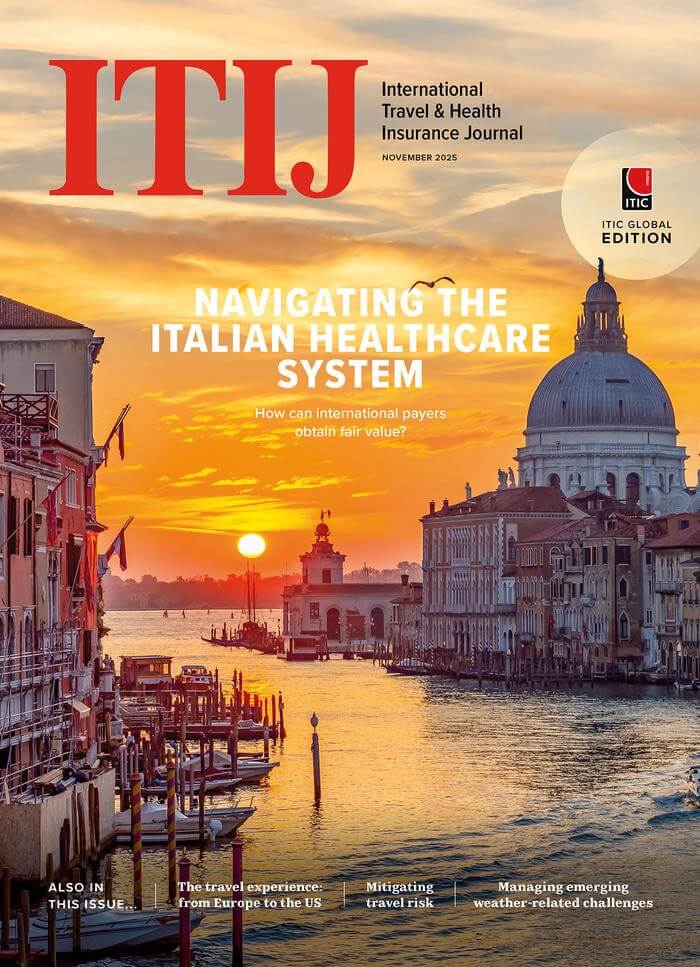
In this issue of ITIJ we look at current travel patterns to and from the US and Europe, take a close look at the Italian healthcare system, and examine how insurers are adapting policies and coverage to manage weather-related challenges.
Editorial Team
The Editorial Team updates the ITIJ website daily, and works on features for the print edition. With expert industry knowledge and years of experience in writing about complex travel insurance issues, the Editorial Team is ready to investigate and report on the topics that matter most to ITIJ's readers.