
Industry Voice: Underwriting travel insurance – a story of two parts

Our extended industry voice examines underwriting travel insurance in two parts – from the physician’s point of view, and from the perspective of an actuarial consulting firm. Our experts share fascinating insights and thought-provoking observations with ITIJ
Part one: A physician’s perspective on the travel insurance industry
Dr Ian Paterson and Dr Christian Lamarre reflect on the need for changes in risk assessment and pricing in light of new medical findings, research, diagnoses, and outcomes
As physicians with a combined 60 years of experience, Drs Christian Lamarre and Ian Paterson are frequently asked to complete insurance forms on behalf of patients. A commonly encountered issue is the insurance industry interpretation of ‘medical stability’, where a recent minor event in an otherwise medically stable patient can lead to travel insurance coverage restriction or even denial.
Dr Lamarre recently experienced this issue with a close family member. A couple of years ago, his father, a retired physician, was denied travel insurance coverage five months after a successful pacemaker implantation for a slow heart rhythm. He had no other active health issues and was otherwise medically stable. His travel insurance provider defined medical stability for persons over the age of 65 as no change in health status over the last six months. As medical professionals, we know that age is an important predictor of medical events, but many other factors also impact risk.
In Dr Lamarre’s father’s case, the insurer was unwilling to consider other health data with the potential to mitigate risk, and he ultimately had to cancel his travel plans.
What is really relevant?
After a careful analysis of general underwriting practices, we came to the conclusion that the travel insurance industry collects a surprising amount of medical information that is not predictive of short-term risk, while neglecting potentially impactful parameters. Travellers are commonly asked if they are receiving treatment for cholesterol. While cholesterol elevation is an important consideration for the 10-year risk of a cardiac event,1 studies have shown that it does not predict short-term risk.
Conversely, female travellers with a recent myocardial infarction and prior bypass surgery have been shown to be strong predictors for rehospitalisation within the first 12 months.2 In some cases, the risk of travelling shortly after a medical event may be prohibitive regardless of age. For example, travellers recently hospitalised for heart failure have a 30% risk of rehospitalisation within the first 30 days and 20% at 90 days.3 In these cases, the high risk of an event may preclude providing insurance coverage.
Rehospitalisation within the first 30 days is a major healthcare and health economic concern. Hospital readmissions in the US cost approximately $17–26 billion annually,4 and it has been estimated that one quarter are avoidable.5 Furthermore, readmission rates are an important quality measure of healthcare delivery, and underperforming hospitals are often financially penalised.4 Consequently, there is a strong incentive to develop effective strategies predicting the short-term risk of medical instability.

Using new technology to measure risk
Over the last 20 years, several algorithms have been developed to identify high-risk patients requiring early medical attention following a hospital admission. Recent iterations of these risk models have shown significant improved model performance when data from blood testing during the index hospitalisation is included.6,7 There is also the potential for risk model performance to be further enhanced through the use of artificial intelligence (AI). There are now several studies showing that large healthcare data sets can be used to develop and train machine learning models that outperform traditional risk predictors of rehospitalisation.8,9 Given that large insurers have similar data sets on travellers requiring medical attention for health events, it would be possible to adopt a similar data-driven approach to predicting risk in future travellers. Indeed, machine learning modelling is being developed to accurately estimate life expectancy,10 but, to our knowledge, this technique is not yet used by the travel insurance industry.
Data from portable devices can also be utilised to predict risk of events. Vehicle insurance providers often offer rebates for safe driving habits determined from data shared by smartphones. Similarly, wearable devices such as smartwatches provide detailed information
on health that could be utilised to predict risk. These devices have become more ubiquitous in society due to their small size, greater ease of use, and the proliferation of lower-cost alternatives. Physiological data from wearable devices can be used to predict common medical issues encountered by travellers, including risk of fall,11 cardiac events,12 and infections.13 One study recently found that 82% of patients were willing to share data from wearable devices with their healthcare providers.14 A similarly high rate of acceptance may be observed in travellers with the potential incentive of obtaining discounted insurance premiums.
Developing more accurate risk prediction models would allow travel insurers to more effectively identify high-risk travellers who should either be denied coverage or charged higher premiums. Similarly, low-risk elderly travellers who are currently denied coverage would be correctly identified as low risk and offered an appropriate insurance plan. Given the high number of baby boomers projected to travel in the upcoming decade, the timing could never be better for the travel insurance industry to modernise their approach to risk prediction.
Pierre Saddik shares his wealth of experience in the underwriting sector and considers what the industry could do to adapt
Having been involved in the Canadian travel insurance and reinsurance space for nearly four decades, I have been able to witness a monumental shift from the no-risk era of the 1980s when provincial governments1 covered almost all medical risks incurred abroad to the hit-and-miss era in the ’90s when these same governments disengaged from medical out-of-country insurance by cost shifting to private insurers, creating a massive market that attracted dozens of insurers and hundreds of distributors overnight.

Not a smooth start
Most of the insurance groups entered the snowbird market because of high potential sales but were unprepared for, or had little understanding of, the risk. Inevitably, they took huge losses, causing many to leave the marketplace, radically modify their products, eliminate coverage, or sell out.
The causes of losses ranged from a lack of understanding of (primarily) the US for-profit healthcare system, deficient underwriting, and insufficient pricing to high commission costs for distributors, poor policy wording, and weak assistance, claims management and cost containment.
A more structured approach
As we moved closer to 2000, the insurance industry learned the hard way about how to design and manage the product lines, the background of the type of travellers buying the products, and best practices in claims management. This new era saw the emergence of more seasoned and structured medical underwriting approaches, where insurers used their historic claims experience, especially an understanding of their own larger claims, to tweak medical underwriting questionnaires on an annual basis. This created a new successful model for business, with regular reviews of premiums, losses, types of claims, province of residence of policyholders, and their travel destinations.
However, perhaps we haven’t learned enough from the past. Medical questionnaires today seem to be getting increasingly longer, more complicated, and even more ambiguous, which could negatively affect customer buying behaviour. These days, one needs to be well versed in medical terms to understand and properly fill out a medical underwriting form.
While many clients will flawlessly answer the form, others with medical issues might make an ‘honest mistake’, knowingly or not, depending on their interpretation. Some will take their chances to enter a preferred risk classification by bending their answers to pay lower premiums.
Work still to be done
There are ways to simplify the process, using the right underwriting format to screen out the unwanted risk, attract the risk you want, and create a better user experience. Educating customers about the consequences of bending, misrepresenting, or withholding medical information will become key.
Unfortunately, I have seen many insurers in Canada, in order to acquire sales, rely heavily on underwriting at claim time. Shifting the onus/responsibility on to the policyholder by forcing them to correctly respond in detail on an application form causes them to take the risk of claim denial due to misrepresentation, makes it difficult for applicants to have a clear expectation of coverage, and causes fear that they won’t be protected.
I recently had independent conversations with two advisers specialised in snowbirds sales. One told me that most of their sales were phone-based, with a 25- to 30-minute average call duration leading to underwriting and enrolment. The other adviser indicated they were more reliant on online sales and, as a result, enrolment time was only a handful of minutes. When I asked the latter if they had many legal backlashes, he responded in the negative.
It is not practical to underwrite 100% of customers who need travel medical cover for the potential of a claim risk, as only about 5% will end up claiming. The problem cases lie with 5–10% of claimants ending up with a large claim amount, constituting 0.25–0.5% of all applicants.
It is quite easy to underwrite and accept a risk with no current pre-existing medical conditions. It is also a no-brainer to decline a diabetic applicant aged 84 who has undergone heart bypass surgery and is experiencing neuropathy symptoms and taking home oxygen.
An insurer must therefore strike a delicate risk-reward balance: too much underwriting may lead to higher sales costs and potentially lost sales
However, somewhere in the middle lies a wide range of medical conditions, some of which are stable and medicated, which would be acceptable at standard rates, but some would be at substandard rates and some totally uninsurable.
An insurer must therefore strike a delicate risk-reward balance: too much underwriting may lead to higher sales costs and potentially lost sales. By contrast, underwriting thinly will lead to higher loss ratios, claims denials/litigation, and therefore negative publicity, in addition to shifting a great deal of risk to the insured.
A look at what is done in the UK and Australia shows that regulators have raised the bar on insurers, forcing them to shift towards more front-ended underwriting decisions. This has caused insurers to rely more on scoring techniques and algorithms, especially for the elderly travelling for longer periods. In my opinion, Canadian regulators will likely follow such examples, especially with regulators tightening compliance across Canada.
However, with the advent of telemedicine more than a decade and a half ago, portable health devices, data analytics, and AI in the last few years, I am convinced that with this abundance of innovation and technology, new solutions will make their way into travel medical insurance underwriting. The travel insurance market is primed and ready to embrace it.
Not all products are created equal
Travel medical insurance products generally comes in two types:
Product type A, focused on claims-based underwriting:
• More suited for younger travellers who know (or think they know) they don’t have any medical issues
• To include a clear and concise cautionary statement to be consented to by the traveller about misrepresentation of their health, that they risk seeing their claim not being eligible, so there is no denial surprise
• Will likely not cover applicants exceeding some risk thresholds and/or higher travel duration.
Product type B, with extended medical underwriting:
• For anyone not eligible under product A above, and for anyone who voluntarily wants to ascertain whether any of their known medical conditions will be covered
• Policies issued would have a 100% expectation that any potential claim would be responded to by the insurer
• Will likely need a longer time from application start to issuance
• Will require medical scoring (connection with public electronic medical records, if possible, would help accelerate issuing timeline)
• Would obviously be more expensive than plan A
• Should provide an option to upgrade to a multi-year guarantee coverage (for an extra cost)
• For some risks, may require the use of a digital health wearable or other monitoring device or telemedicine access, determined by the insurer.
In Canada, the vast majority of sales are for product type A (underwritten at claims time). While some of the medically underwritten products with type B are already available in the market, they are seemingly downplayed and not pushed very hard by distributors, therefore not successfully sold. Why? In my view, it is because the time to issue a policy is simply too long and most applicants (or even advisers) will not have the patience nor the wisdom to wait.
If we keep pushing product type A with underwriting at claims time, claims denial rates will inevitably rise, which could/should eventually lead to a bolder intervention and pushback by regulators. To avoid that, I rather recommend the industry work upstream in collaboration with the regulators. I believe this is the direction the Travel Health Insurance Association of Canada (THIA) is taking, but all stakeholders will need to do their part.
While perfection is impossible, I am challenging the industry to design more performant underwriting models that would put applicants in their correct slots. In other words, we have got to reinvent ourselves, our current business model, and our underwriting methods.
For example, as proposed by Drs Lamarre and Paterson, we might revisit our overreliance on age as the determinant underwriting risk factor in favour of others such as the use of prescribed medication or having been treated for a heart, respiratory, or cancerous condition in the last two years.
In conclusion, the future belongs to insurers, distributors, and other stakeholders who will be able to migrate from traditional underwriting techniques to more advanced modern tools using the best technology available. We need to simplify the underwriting process but not lose its efficiency by using the most optimal scoring systems/algorithms and aligning the travel medical insurance products, claims TPAs, and assistance providers so that they work in concert.
Note
1. In Canada, except in some cases, healthcare delivery is administered at the provincial level.
References
1. D’Agostino RB, Vasan RS, Pencina MJ, Wolf PA, Cobain M, Massaro JM, et al. General Cardiovascular Risk Profile for Use in Primary Care. Circulation. 2008 Feb 12;117(6):743–53.
2. Arnold S V., Smolderen KG, Kennedy KF, Li Y, Shore S, Stolker JM, et al. Risk Factors for Rehospitalization for Acute Coronary Syndromes and Unplanned Revascularization Following Acute Myocardial Infarction. J Am Heart Assoc. 2015 Jan 30;4(2).
3. Khan MS, Sreenivasan J, Lateef N, Abougergi MS, Greene SJ, Ahmad T, et al. Trends in 30- and 90-Day Readmission Rates for Heart Failure. Circ Heart Fail. 2021 Apr;14(4).
4. Alvarado M, Lahijanian B, Zhang Y, Lawley M. Penalty and incentive modeling for hospital readmission reduction. Oper Res Health Care. 2023 Mar;36:100376.
5. van Walraven C, Bennett C, Jennings A, Austin PC, Forster AJ. Proportion of hospital readmissions deemed avoidable: a systematic review. Can Med Assoc J. 2011 Apr 19;183(7):E391–402.
6. Averbuch T, Zafari A, Islam S, Lee SF, Sankaranarayanan R, Greene SJ, et al. Comparative performance of risk prediction indices for mortality or readmission following heart failure hospitalization. ESC Heart Fail. 2025 Apr 21;12(2):1227–36.
7. Liu Z, Sun Z, Hu H, Yin Y, Zuo B. Development and validation of a prospective study to predict the risk of readmission within 365 days of respiratory failure: based on a random survival forest algorithm combined with COX regression modeling. BMC Pulm Med. 2024 Feb 14;24(1):82.
8. Morgan DJ, Bame B, Zimand P, Dooley P, Thom KA, Harris AD, et al. Assessment of Machine Learning vs Standard Prediction Rules for Predicting Hospital Readmissions. JAMA Netw Open. 2019 Mar 8;2(3):e190348.
9. Davis S, Zhang J, Lee I, Rezaei M, Greiner R, McAlister FA, et al. Effective hospital readmission prediction models using machine-learned features. BMC Health Serv Res. 2022 Nov 24;22(1):1415.
10. Baruah P, Singh PP. Risk Prediction in Life Insurance Industry Using Machine Learning Techniques—A Review. In 2023. p. 323–32.
11. Subramaniam S, Faisal AI, Deen MJ. Wearable Sensor Systems for Fall Risk Assessment: A Review. Front Digit Health. 2022 Jul 14;4.
12. Williams GJ, Al-Baraikan A, Rademakers FE, Ciravegna F, van de Vosse FN, Lawrie A, et al. Wearable technology and the cardiovascular system: the future of patient assessment. Lancet Digit Health. 2023 Jul;5(7):e467–76.
13. Ming DK, Sangkaew S, Chanh HQ, Nhat PTH, Yacoub S, Georgiou P, et al. Continuous physiological monitoring using wearable technology to inform individual management of infectious diseases, public health and outbreak responses. International Journal of Infectious Diseases. 2020 Jul;96:648–54.
14. Dhingra LS, Aminorroaya A, Oikonomou EK, Nargesi AA, Wilson FP, Krumholz HM, et al. Use of Wearable Devices in Individuals With or at Risk for Cardiovascular Disease in the US, 2019 to 2020. JAMA Netw Open. 2023 Jun 7;6(6):e2316634.
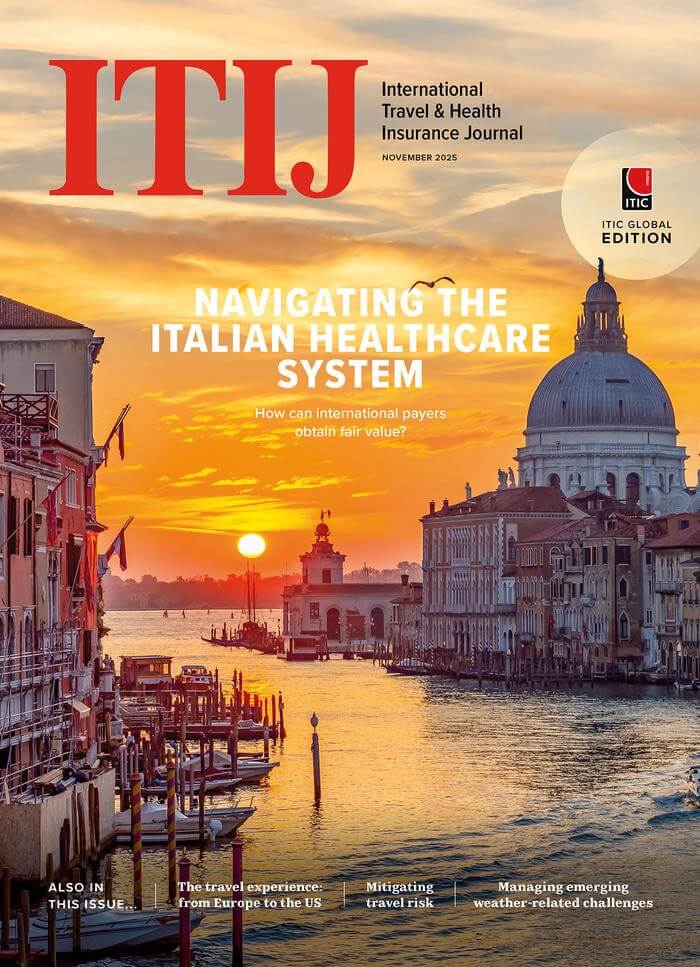
November 2025
Issue
In this issue of ITIJ we look at current travel patterns to and from the US and Europe, take a close look at the Italian healthcare system, and examine how insurers are adapting policies and coverage to manage weather-related challenges.
Dr Ian Paterson
Dr Paterson MD, FRCPC is a Cardiologist and Professor of Medicine at the University of Ottawa and has published hundreds of scientific abstracts, articles, and book chapters. He frequently presents his research on novel approaches to medical risk stratification nationally and internationally.
Dr Christian Lamarre
Dr Lamarre MD, FCFP, FACEP, FAAFM is an emergency room and family medicine physician with over 25 years’ clinical and medical management experience, both in the US and Canada. His entrepreneurial background led him to found several medical organisations, including Medtech Insurance, his most recent accomplishment, providing AI-enabled software solutions incorporating evidence-based medical data points for accurate risk assessment and dynamic insurance pricing.
Pierre Sadik
Pierre Saddik FCIA, FSA is President and Founder of Saddik International, an actuarial consulting firm. He has over 40 years of experience in the actuarial, insurance, and reinsurance space. One of the original pioneers who founded the Travel Health Insurance Association of Canada (THIA) in 1998, Pierre is recognised as a leader on the topic by his peers. In addition, he has successfully organised numerous seminars on travel insurance for Optimum Reassurance as part of an ongoing collaboration of more than 35 years.