
Industry Voice: The transformational power of AI in travel insurance

From data extraction to coverage determination, AI is reshaping how travel insurers serve customers at their most vulnerable moments, and the window for early advantage is narrowing, Roi Amir, CEO of Sprout.ai, tells ITIJ
When a traveller calls from a hospital overseas at 2am, or finds themselves stranded at a storm-hit airport with a missed connection and a stack of receipts, they want a single, confident answer: am I covered, and what happens next? Delivering that answer quickly, accurately, and consistently, has always been the promise of travel insurance. Artificial intelligence (AI) is finally giving the industry the tools to honour it.
But the transformation underway is broader than policy coverage checking alone. It spans the entire information chain that underpins a travel claim: extracting and interpreting data from unstructured documents, summarising complex medical reports and supplier correspondence, validating coverage against policy wording, and routing claims intelligently from the moment of first notice. Together, these capabilities are redefining what it means to process a travel claim and separating the insurers who will lead the next decade from those who will struggle to keep pace.
The data problem that precedes every coverage decision
Before a coverage decision can be made, a travel claim must first be understood. That sounds straightforward. In practice, it is anything but. A single complex travel claim may arrive with hospital discharge notes in a foreign language, a GP’s referral letter, airline delay certificates, hotel invoices, travel itineraries, and a pre-existing condition declaration all in different formats, from different sources, with varying degrees of completeness or legibility. Extracting the clinically and commercially relevant information from that documentation, and synthesising it into a coherent picture of the claim, is time-consuming, error-prone, and deeply inconsistent when done manually.
AI-driven data extraction and summarisation changes this fundamentally. Rather than relying on a handler to read through dozens of pages of unstructured documentation, AI can ingest, classify, and extract the relevant data points in seconds, flagging the diagnosis, the treatment dates, the costs incurred, and the relationship to the policy’s pre-existing condition exclusions. That structured summary becomes the foundation for every downstream decision: coverage validation, reserving, triage, and customer communication. Getting this right at the start of the claims life cycle reduces rework, improves indemnity accuracy, and frees handlers to focus on judgement rather than administration.
Coverage checking: still largely manual, still costly
Once the data is extracted and structured, coverage determination should follow swiftly. In most organisations, it does not. Sprout.ai’s The State of Policy Coverage Checking report, drawing on a survey of senior insurance professionals, found that 50% of organisations relied entirely on manual coverage checks, with the remainder only partially automated. Not a single respondent reported mostly or fully automated coverage determination. Nearly one in three organisations (31%) said coverage-related delays occurred frequently or very frequently. Only 21% described them as rare.
The scale of the challenge is compounded by policy complexity. A travel policy may carry provisions for medical emergency, trip cancellation, evacuation, baggage loss, travel delay, missed departure, and personal liability, each with its own conditions, sub-limits, and exclusions. The research identifies variability in policy wording as the second greatest challenge in coverage checking, cited by 55% of respondents. Incomplete documentation follows at 39%. Manual processes simply cannot keep pace with this level of complexity at the speed customers now expect.
The first notice of loss (FNOL) moment is where this bottleneck bites hardest. For straightforward claims, only 11% of organisations report instantaneous coverage validation. More than 40% take over two hours; 22% take more than 24 hours. For complex claims, half of organisations require weeks or months. In travel insurance, where a customer may be waiting in an emergency department for authorisation of treatment costs, that delay is not an inconvenience, it is a failure of duty.
Surge resilience: the test travel insurers cannot afford to fail
Travel insurance faces a surge challenge that most other lines of business do not. A volcanic eruption, a pandemic-era border closure, or a widespread airline collapse can generate thousands of simultaneous claims overnight, each requiring data extraction, document triage, coverage validation, and customer communication. Traditional operations respond by redeploying staff or hiring temporary handlers: an approach that is slow to scale, expensive to maintain, and inconsistent in output.
AI offers a structurally different answer. By automating document ingestion, data extraction, and initial coverage triage, insurers can absorb dramatic spikes in volume without expanding headcount. Capacity scales with demand, quality remains consistent, and experienced handlers are freed to focus on the complex, high-value cases that genuinely require their expertise. This is not a theoretical benefit, it is one of the clearest competitive differentiators available to travel insurers today.

From pilot to production: the adoption gap
The market is dividing. Today, 44% of insurers report zero AI or automation in coverage checks, and a further 32% report automation of just 1–10%. Meanwhile, 16% have set targets to improve coverage checking speed and accuracy by more than 50% over the next 12 months, while 28% report no improvement target at all. A two-tier market is forming, and the gap is compounding. Early adopters are building AI learning effects, data feedback loops, and growing automation confidence with every claim processed.
The most common barrier is not resistance, it is uncertainty about where to begin. Our practical AI adoption checklist for Chief Claims Officers offers a clear answer: start with the operational problem, not the technology. Before selecting a platform or commissioning a proof of concept, ask where coverage uncertainty is slowing claims today, how much handler time is consumed interpreting policy wording and unstructured documents, and how delays at FNOL are affecting indemnity accuracy and customer experience. AI pilots anchored in measurable outcomes – reduced cycle times, improved indemnity accuracy, lower cost per claim – deliver sustained value. AI deployed as an innovation exercise rarely does, and often fails to scale into production.
From there, the priority is to start at FNOL and design for complexity, not just speed. Many initiatives optimise for straight-through processing on straightforward claims and stall when they encounter layered policies, multi-document claims, or scenarios requiring interpretation across endorsements and exclusions. The greatest enterprise value from AI in travel insurance comes from handling the complex 80%, not just the straightforward 20%. Governance must be embedded from the outset: decisions should be traceable, clause-level reasoning visible, escalation paths defined, and accountability retained explicitly with claims leadership.

Handlers are partners, not obstacles
Perhaps the most important lesson from successful AI deployments in claims is that handler involvement is not a change management nicety, it is a technical necessity. Experienced claims professionals understand ambiguity, policy wording nuances, and edge cases better than any model trained in isolation. Involving them early to validate AI interpretations, identify where confidence drops, and refine escalation thresholds is what separates deployments that succeed from those that stall after the pilot phase. In most Sprout.ai implementations, measurable benefits appear within around 12 weeks, but only when integration with core systems and handler adoption are addressed from the start.
The fastest-moving organisations treat AI as a co-pilot. When handlers can see clause-level reasoning, structured document summaries, and clear decision logic, trust builds quickly. When AI removes the burden of document classification, data extraction, and initial triage, expertise is redirected to the cases that genuinely require it. The result is not just operational efficiency, it is a better experience for the customer waiting for an answer, and a more sustainable working environment for the people delivering it.
Travel insurance has always carried the promise of being there when it matters. AI, across data extraction, summarisation, coverage validation, and intelligent triage, is giving the industry the tools to deliver on that promise at scale.
In my view, the question is no longer whether AI has a role in travel insurance. It is whether your organisation can afford the cost of moving too slowly.
Roi Amir, CEO, Sprout.ai
Roi is CEO of Sprout.ai, an AI-powered claims automation software solution transforming claims decisioning and policy intelligence. He leads the company’s mission to enable insurers to deliver faster, fairer, and more transparent claims outcomes through AI. Trusted by leading carriers including AXA, MetLife, and AdvanceCare, Sprout.ai’s technology is used globally to improve claims handling efficiency, accelerate policy coverage checking, and improve loss ratio.
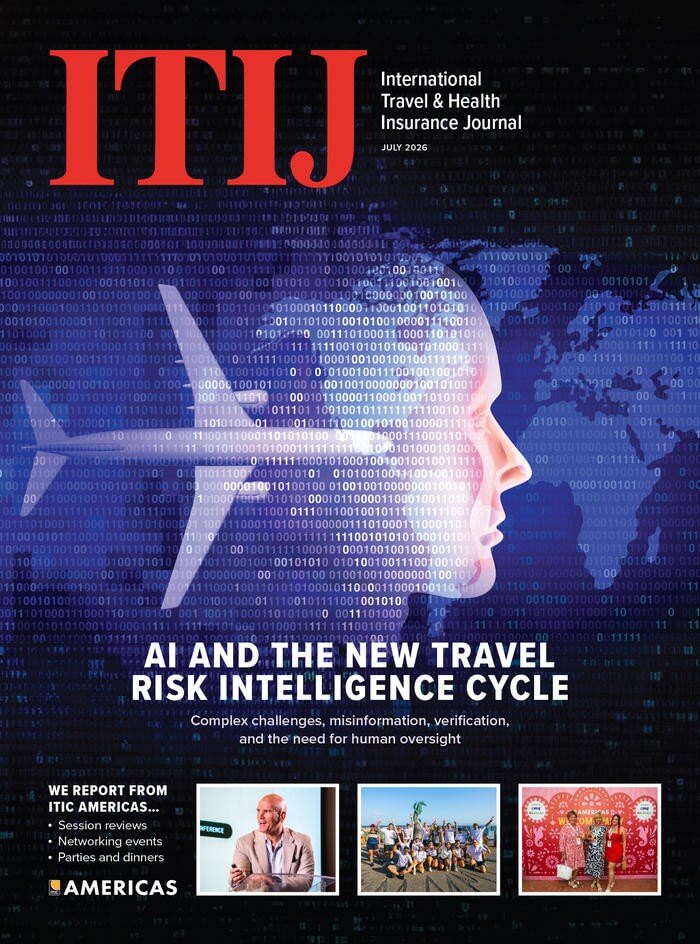
July 2026
Issue
Welcome to your July issue! This month we look at how artificial intelligence solutions are changing the way in which travel risk information is gathered and communicated, plus we ask whether providers should do more to educate their customers, ensuring they understand the products they are buying and using them appropriately.