
Industry Voice: Providing assistance to an ageing population

People are travelling later in life than ever before, but with age comes greater complexity. Julie Remmington, Director of Real Travel Assistance, explores the operational and insurance challenges facing a growing demographic of older travellers
Having worked in the industry for over 30 years, I have seen so many changes. Some of those changes have been good for the industry and customers alike (for example, more transparency at point of sale) and some not so good (more onerous regulation leading to less choice), but the constant has always been the customer’s desire to travel, no matter their age, health or financial situation. We should be thankful they do as well, as it is that desire which keeps our amazing and interesting industry thriving and growing. But how can we ensure we are evolving to provide the services needed, especially for our ageing population?
The ageing demographic
What do we mean by ageing population? There are official meanings, such as ‘demographic trend where the population of elderly people in a country’s population is increasing relative to other age groups’, but the definition I am going to use is ‘people of a certain age’. What age is ‘a certain age’? Retirement age? In the UK, that is currently 66 years and rising; in France it is 62, and in Turkey until recently, it was 60 (for men). The worrying aspect for me is how close I now am to one of those ages.
I am going to use the age of 65. In the UK, approximately 12.7 million people are 65 or over. That is 19% of the population. This figure is expected to increase to 15.5 million by 2030, and while most mainstream insurers will offer coverage, this can change at 74 years, with annual policies no longer being offered. Most ages can get a single-trip policy, but this can decrease depending on the customer’s health. There are also specialised insurers who offer policies for any age with serious health issues, which can lead to premiums in the thousands.
While the process for most assistance companies will be the same no matter the age of the patient, there are additional challenges we need to consider.
Older people generally have pre-existing medical conditions that can complicate the recovery from what might be a routine procedure. We see several people monthly who suffer a fall that results in a broken hip or similar, and their recovery is complicated by their age and multimorbidity.
Older people generally have pre-existing medical conditions that can complicate the recovery from what might be a routine procedure
This leads to not only an increase in medical costs in a private facility but also an expensive repatriation. We find that once a patient reaches that certain age, they often need some form of medical repatriation, whether that be with a nurse or doctor escort. As a result, we are seeing a rise in requests for air ambulance transfers for older people, to return them to the UK for treatment rather than having treatment locally and still having a good chance of needing an air ambulance or at least a doctor or nurse escort.


The challenges
Despite the rise in requests, we have actually seen the use of air ambulances reduce slightly due to the increase in fuel costs and the subsequent increase in prices due to the issues in the Middle East. It is still an option that is routinely considered, as our insurer clients expect us to present all options available, e.g. surgery locally and possible medical repatriation versus an air ambulance for treatment in the UK. To assist the insurer’s decision, we are now expected to give our opinion on potential recovery time, which adds a layer of difficulty as no two patients recover in the same way.
In Europe, we always try to utilise the public system through the Global Health Insurance Card (GHIC), but due to the pressures on the public health system in countries like Portugal and Greece, we are seeing long waits for surgery.
When a medical repatriation is needed, it is often not as straightforward as it used to be
The length of the potential wait is concerning and often unacceptable to assistance companies’ medical teams, which means we have no option but to consider an air ambulance back to the UK or transfer to a private facility, both of which have a cost implication.
When a medical repatriation is needed, it is often not as straightforward as it used to be. This is due to a patient’s baseline from a medical perspective or the needs of a travelling companion. While some insurers might enquire about an insured person’s mobility, or the question may be asked as part of a screening for a medical condition, it does not appear to
be routinely recorded.
It is only when the assistance provider gets a case that it becomes clear the patient has very limited mobility, a complication in addition to the medical condition they are being treated for. This is especially true for customers who go on cruises that start and end in the UK. These customers often cannot board an aeroplane to be repatriated, even with a medical escort, after they have been offloaded by the cruise ship.
The carers
We are also seeing an increase in cases where the patient is the carer for their spouse.
Again, this is not something that is generally considered at the point of sale for the policy. We end up with a patient admitted for a medical condition and then find out they are the sole carer for a spouse who might have a serious medical condition such as dementia. This leads to us having to consider the needs of the spouse as well as the patient. This can make medical repatriations more complex and expensive. We have had many cases where we have needed to upgrade the spouse to business class with a medical escort to keep them near the patient, so they remain calm on the flight.
The older generation do not seem to understand that if they take medication for a condition, they still have that condition and must declare it
Finally, in the UK, insurers are regulated by the Financial Conduct Authority (FCA) and must comply with the Consumer Insurance (Disclosure and Representations) Act 2012 (CIDRA). To comply with this, assistance providers have to get the patient’s medical records from their GP for the required period and check that the patient has declared all their medical conditions at the point of sale.
While this is applicable for all insureds no matter their age, we are finding a number of issues with the older generation. The number of retrospective screenings we are seeing in this sector has increased, with a sizeable percentage not declaring correctly. This means that only a proportion of the claim is payable. While the entire industry that underwrites the older sector is looking for a solution to get people to declare all their medical conditions, it is not a quick fix. The older generation does not seem to understand that if they take medication for a condition, they still have that condition and must declare it.
This is a sector of the market that is only going to grow, so we need to ensure, as an industry, that we learn and adapt to provide the assistance they need.

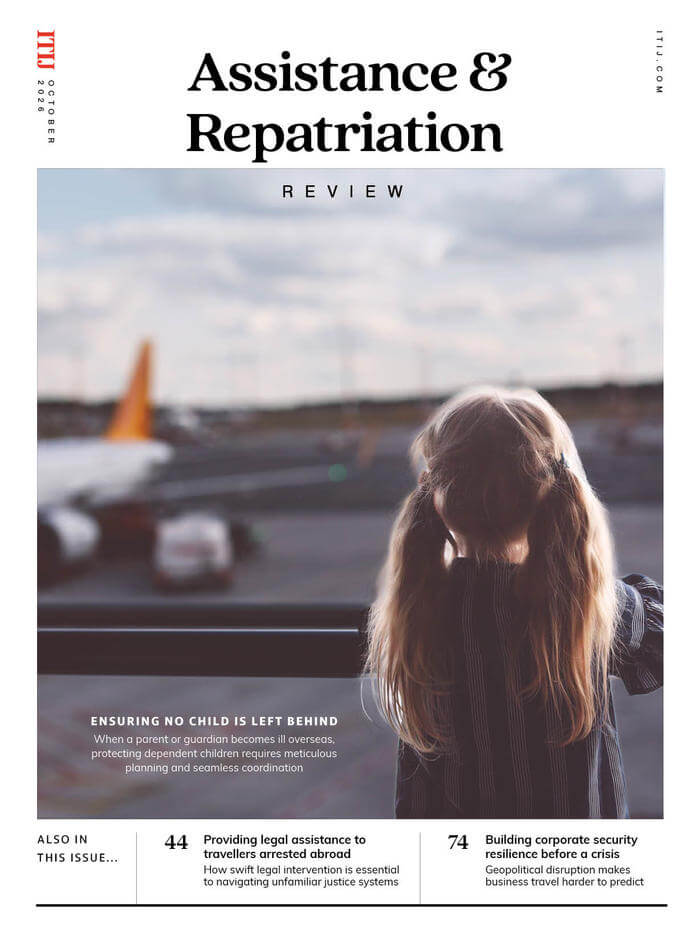
October 2026
Issue
When a parent or guardian becomes seriously ill overseas, assistance providers face a complex challenge that extends well beyond clinical care. Although these cases are relatively rare, in this issue we look at how safeguarding dependent children requires careful planning, legal awareness, and close international coordination.
Julie Remmington
Julie has worked in most aspects of travel insurance both in the UK and abroad, and set up her consultancy business after leaving AXA Insurance. Through her contacts, especially in the Lloyd’s market, she set up Real Travel Assistance to provide a more personal service for medical assistance around the world.