
Industry Voice: Funeral repatriation in APAC

Mark Mills, Managing Director of Ambrose Australia, explains the unique challenges and critical importance of managing international repatriations from one of the Pacific’s key transport hubs
Sydney, Australia, is one of the Pacific region’s most recognisable harbour cities and a major destination for international travellers.
It is also a key gateway for international repatriations across the Pacific, connecting families, service providers, airlines, embassies, consulates, and local communities at a time when coordination and care are essential.
Keeping in touch
Time sensitivity is critical when families are separated from their loved one by long distances, and continuous availability 24/7 helps ensure all parties remain informed, supported, and updated throughout the repatriation process.
Operating around the clock, our team delivers compassionate and professional assistance at each stage of the process. This often includes arranging non-direct flights to countries and islands across the Pacific region, including New Zealand, Fiji, Tonga, Samoa, and Vanuatu.
Through a global network of trusted relationships, we manage the practical requirements of international repatriation, from documentation and customs clearance to flights, transfers, and onward transport, helping ensure each case is handled smoothly and with dignity.
Domestic flights
Within Australia, domestic flights are often recommended over road transport because of the country’s vast distances. For example, the driving distance from Sydney to Brisbane, the neighbouring state capital, is approximately 923 kilometres, or 573 miles, which is comparable to travelling from London to Berlin. We are frequently engaged in Sydney to transfer deceased individuals from the international airport to a domestic carrier and to coordinate the required regional or interstate flights.
A strong local network is equally important. Just as international providers rely on global networks of funeral homes and repatriation specialists, local relationships with cultural and religious leaders can help support families at short notice and may assist in progressing a repatriation efficiently and respectfully.
Understanding the family’s requirements early is critical. In some cases, a family may send a relative or friend to be with their loved one and assist with cultural arrangements, including dressing or other rituals that require staff support. When this occurs, that person may also need to be booked on the same repatriation flights, making early communication and careful coordination essential.

Timing can vary significantly depending on the family’s wishes and the customs of the final destination.
Some families may request that flights be arranged as soon as possible, while others may need the process delayed to allow cultural or burial arrangements to be completed. For example, flights may need to be postponed for several days while local communities prepare a village burial or complete traditional requirements.
The importance of communication
Each Pacific country has its own requirements before a repatriation can proceed. We work with the relevant embassy or consulate staff, coordinating embalming where required, and managing the arrangements needed to meet local and international regulations.
One common challenge when repatriating to or from smaller Pacific Islands is that flights may involve smaller aircraft, where casket size can become an important operational consideration. These details require careful planning to avoid delays and ensure the repatriation is completed respectfully and efficiently.
In circumstances where timing, accuracy, and compassion all matter, the organisation provides more than logistical support; it offers a steady, informed, and responsive service for families and professional partners navigating one of the most sensitive cross-border processes.
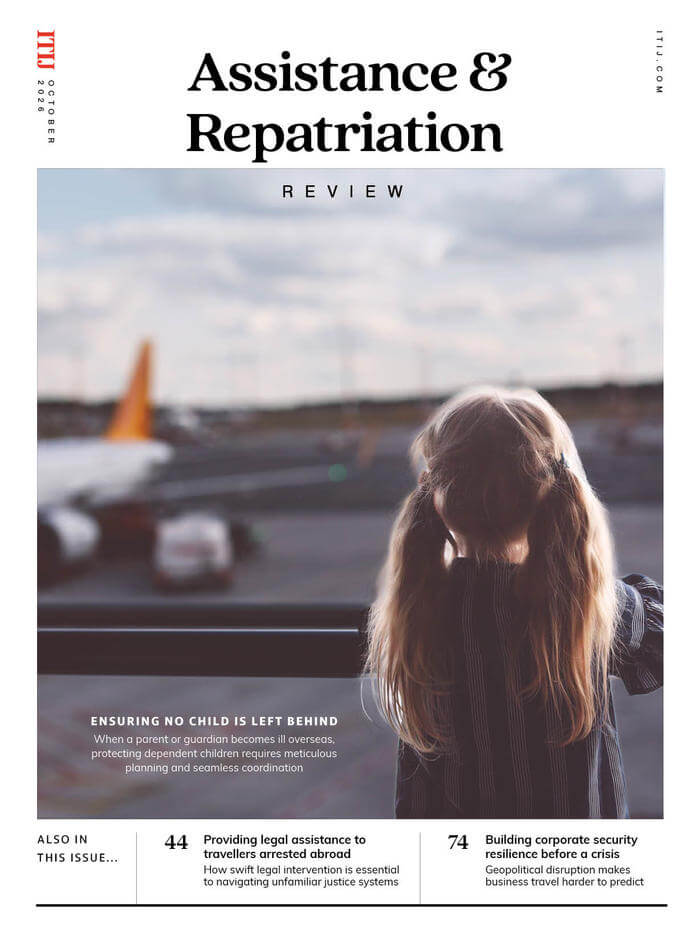
October 2026
Issue
When a parent or guardian becomes seriously ill overseas, assistance providers face a complex challenge that extends well beyond clinical care. Although these cases are relatively rare, in this issue we look at how safeguarding dependent children requires careful planning, legal awareness, and close international coordination.
Mark Mills
Mark is an accomplished and detail-oriented professional with two decades of experience across emergency communications, case management, and deceased travel assistance coordination in the global repatriation sector. With a background in the funeral industry in the culturally diverse city of Sydney, he has a proven record of managing complex and high-risk cases while supporting vulnerable clients with empathy, discretion, and sensitivity.