
Industry Voice: Finding fraud

Charles Taylor’s Group Head of Counter Fraud, Bobby Gracey, and Director of Investigation Services, Simon Cook, discuss trends, toolkits and technologies in travel fraud detection
The latest research from the Association of British Insurers (ABI) reveals that £1.1 billion worth of fraudulent insurance claims were detected across all lines in 2023, with exaggerated losses the most common type of fraud among the 84,400 dishonest claims unearthed.
Insurers, industry bodies and law enforcement agencies have been working hard to drive public awareness of the perils of committing fraud, not least a place on the Insurance Fraud Register and a criminal record for the fraudster. Since it was set up almost 20 years ago, the Insurance Fraud Bureau has also helped police secure over 1,300 arrests and 670 convictions for fraud. And this is helping in the drive to reduce the knock-on effects of fraud losses.
But it’s not the time to be complacent. And the travel fraud arena is no exception.
The travel fraud landscape today
Simon Cook (SC): According to the Insurance Fraud Bureau, opportunistic fraud makes up the lion’s share of travel insurance fraud (about 85% of UK cases). And we see this in our own investigations, where individuals may, for instance, try their hand at clawing back holiday costs by making an exaggerated claim. The 25% rise in the price of holidays since the pandemic could well be contributing to this.
At the same time, we’re seeing a rise in organised fraud. In the last 18 months alone, we’ve detected 13 organised scams; often involving fraudsters creating and claiming on multiple travel policies in different names and fabricating sophisticated claims evidence to do so. This ‘evidence’ frequently comes from far-flung global destinations, which fraudsters wrongly think will be out of insurers’ reach when it comes to validating claims.
The incidents in 2024 were not, sadly, an anomaly. Three British divers died aboard the MV Hurricane in June of 2023, and another vessel, the Carlton Queen, sank in April of the same year
Bobby Gracey (BG): As an industry, we need to be aware of constantly changing behaviours from travel fraudsters: fraud can be multifaceted, and trends do evolve from month to month. Unfortunately, because travel insurance is frequently a one-off purchase, it can be hard to drive brand loyalty, and fraudsters often adopt a ‘have a go’ approach. In this context, it’s vital for travel insurers to make fraud identification and investigation an embedded component of an effective claims validation process.
The counter-fraud toolkit
BG: The ultimate role of a counter-fraud toolkit is to protect honest customers from the increased policy costs related to fraud losses, to minimise disruption to genuine claims journeys and to safeguard insurers’ bottom lines. And insurers naturally expect a return on investment from their counter-fraud strategies. So it follows that counter-fraud capabilities need to offer a complete ecosystem that provides a solution to fraud prevention, detection and investigation.
Technology is playing an important part here, enabling the industry to move at pace and keep up with fraudsters. Advanced detection tools that run forensic checks on supporting claims evidence and digital search tools that quickly find impactful intelligence on open-source and social media are just some of the technologies supporting fraud strategies.
Others include machine learning and advanced data analytics, which are helping insurers to continually improve detection capabilities and keep up with fraud trends, especially when links to external sources are used to gather additional data. Others still include automated fraud capture points for digital claims journeys.
Liveaboard holidays introduce unique risks that standard dive accident insurance might not fully cover
SC: To bring some of this technology to life: advances in metadata analysis are enabling images, documents and other file types that may have been manipulated to be forensically scanned, and image creation dates or other specifics to be compared against reported claim event details. This is especially relevant now that fraudsters are submitting artificial intelligence (AI) generated claims evidence digitally (historically, physical documentation like invoices and receipts have been the mainstay of travel claims validation from customers).
There’s little doubt that a claims handler without this type of technology would struggle to recognise fraudulent AI-generated anomalies. And, crucially, technology like this can help reduce the number of false fraud positives (where genuine claims are wrongly highlighted as suspicious) by pinpointing specific areas of evidence that have been altered or fabricated and removing subjectivity around fraud identification. In turn, disruption to claims journeys for genuine customers can be minimised and insurers’ return on counter-fraud spend maximised, since investigators can concentrate their efforts on known fraud.
People power
BG: Advanced detection and digital search tools are just part of the counter-fraud toolkit and identification is just half the solution. Fraud intelligence will always need to be triaged and passed on to a skilled specialist for professional, legal and ethical investigation in view of the wider claim. Customer interviews, intelligence-led background checks, fraud awareness training for frontline claims teams and more all rely on the skills of human specialists. In other words, we need to draw on both technology (IT) and human expertise (IQ): one cannot function without the other.
Most of the liveaboard vessels currently in use by diving companies are small enough that they fall outside the scope of the International Convention for the Safety of Life at Sea
SC: As critical a component of the counter-fraud toolkit are global field investigations and surveillance services, which again draw on human resources. A suspicious travel claim, for instance, may involve supporting evidence from a hospital in Iraq, a retail outlet in Peru, or a local police station in the Democratic Republic of Congo.
A ‘boots on the ground’ approach will often be the best (or even only) way of uncovering the corrupt officer who has falsified a police report, or of interviewing the doctor behind a suspicious medical claim. And by drawing on trusted local investigators to visit the claims scene, insurers can bypass the often-considerable complexities of local governance, licensing regulations and language nuances, not to mention the delays and expense of flying in specialists from elsewhere.

Getting the message through
SC: Increasing public awareness of travel fraud and minimising fraudulent activity is best achieved through industry-wide effort. Going forward, it will be more important than ever for professional bodies, insurers, fraud investigation providers and the police to share intelligence for the greater good of the sector and to establish the industry’s wider exposure to losses. In this context, the sharing of data must be carried out compliantly and ethically.
BG: Recently, a man who forged a letter of redundancy to support two fraudulent travel insurance claims was given a suspended prison sentence, together with a community order and rehabilitation requirement. Despite the relatively low value of his claim (£304), the severity of his crime was not in any doubt. His sentencing wasn’t just a victory for the counter-fraud sector, but also testament to the power of collaboration. And, in this particular case, the intelligence shared within and beyond the travel sector was critical.
But we can’t stop there. We must carry on developing ever-more sophisticated counter-fraud strategies. And we must carry on spreading the message to travel insurance fraudsters that we’re going to hunt them down. They need to hear us loud and clear: there’s no barrier to insurers’ investigative capabilities, wherever or whenever fraud originates in the world.
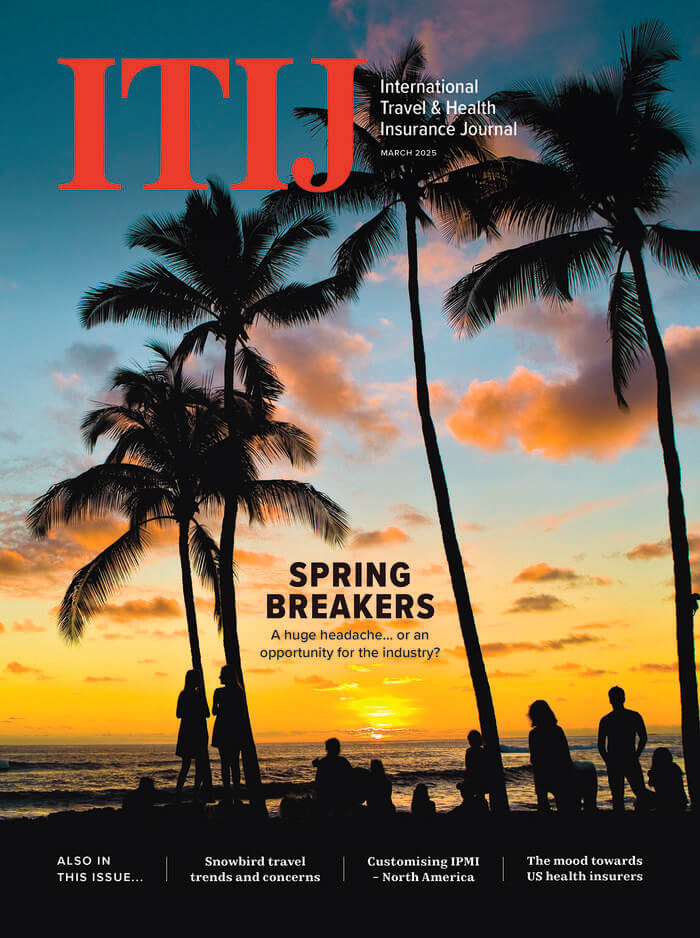
March 2025
Issue
In the March issue of ITIJ we examine spring break trends; look at the changing snowbird market; and investigate IPMI policies in North America. Included with this issue is the Air Ambulance Review, which has features on clinical care for ABIs; investing in fleet; the role of brokers in the air ambulance industry and an accreditation update.
Bobby Gracey
Bobby, who joined Charles Taylor in 2020, is a recognised thought leader in the insurance counter-fraud market who has taken the global debate on claims fraud to all six continents of the world and visited over 25 countries to raise industry awareness. During his 30-year career, Bobby has developed multiple claims fraud strategies for global loss adjusting businesses, as well as global and domestic insurers. He is also current Chairman of the Chartered Institute of Loss Adjusters’ Anti Fraud Committee, and an award-winning author of Fraud Investigation – A claims handler’s guide.
Simon Cook
Simon has worked in the insurance industry for 27 years, 20 of which have been in the counter-fraud arena. He is a Certified Professional Investigator and Director of Investigation Services for Charles Taylor. As a subject matter expert in international investigations and claims validation, Simon has managed complex cross-product insurance claims investigations in over 100 different countries. He is also a thought leader on insurance fraud, has twice held a board position as Director of the UK’s Insurance Fraud Investigators Group (IFIG) and is an active member of the International Association of Special Investigation Units (IASIU).