
Industry Voice: From discovery to booking: capturing the new wave of APAC travellers

As APAC travel evolves from spontaneous getaways to purposeful, value-driven journeys, Taranjeet Singh, Managing Director of Venture Markets, APAC at Criteo, outlines how shifting behaviours, AI adoption, and data-driven strategies are reshaping the path from discovery to booking
Travel across the Asia-Pacific (APAC) region is transforming. What used to be spontaneous getaways or seasonal holidays have evolved into something more intentional, anchored in value, personal enrichment, and purposeful exploration. Amid rising costs, shifting work patterns, and a growing appetite for meaningful experiences, travellers are rethinking where they go, how, and why they travel.
This renewed mindset is driving notable change across the region. People are planning further in advance, opting for longer stays, and favouring experiences that offer depth over novelty. For many, travel is no longer just ticking off destinations – it’s a lifestyle priority, a way to reconnect with culture, community, and self.
With the help of commerce data and artificial intelligence (AI) driven personalisation, brands can activate campaigns at the right time for the right audience
Despite economic uncertainty and geopolitical headwinds, the momentum is clear. Criteo’s Travel Pulse report points to a surge in mid-year bookings and earlier trip planning, with multi-day stays now searched an average of 52 days in advance. This signals a more deliberate approach to travel, shaped by personal values and practical considerations.
For brands, this evolving behaviour presents a timely opportunity. With the help of commerce data and artificial intelligence (AI) driven personalisation, brands can activate campaigns at the right time for the right audience. As we look ahead to the peak travel season, understanding these shifts and acting on them in real time will be key for brands to capture attention, drive conversions, and deliver value at every point of the customer journey.
Shifting travel behaviours: unlocking new pathways
Even as travel regains rhythm, rising costs are prompting travellers to rethink their plans – nearly half of global travellers say higher expenses are affecting them. Yet in Asia Pacific, travel remains non-negotiable, with 40% of consumers viewing it as an essential part of their lifestyle.
This blend of aspiration and pragmatism is reshaping behaviours, with travellers across the region booking earlier, favouring off-season travel, or opting for more budget-conscious stays. As a result, hotel bookings in APAC jumped 23% in Q1 2025, while online travel agencies (OTAs) saw a 13% increase. In contrast, air travel bookings dropped by 11%, indicating a pivot toward more flexible and accessible options.
This is a clear signal for brands’ need to align with changing expectations. Campaigns focusing on affordability, flexibility, and purposeful experiences are more likely to resonate in this climate. For example, food tourism remains a powerful draw, with 60% of APAC travellers prioritising food-related attractions as part of their travel planning. Meanwhile, affluent travellers in the region are reshaping premium travel categories. They’re twice as likely as their global counterparts to purchase luxury items and are leading the demand in categories like health and beauty.
By recognising these nuanced shifts and acting on real-time commerce signals, brands can effectively personalise their messaging, connect meaningfully with audiences, and unlock new pathways for growth in Asia Pacific’s dynamic travel ecosystem.

How AI is influencing travel choices and brand solutions
AI is quickly becoming a centrepiece o
f travel planning, with travellers across the region increasingly turning to AI tools not only for inspiration but also for planning entire itineraries, comparing prices, and even booking trips. The usage of these tools continued to grow steadily year on year in Q1 2025, marking an evident shift with major implications for how travel brands stay visible and relevant.
To influence travellers throughout their journey, marketers need to be present at every stage, with a full ‘funnel’ strategy to take consumers from inspiration through to conversion
Optimising content for AI-driven discovery is essential. This means structuring product data such as room availability, pricing, or cancellation policies into formats that AI can interpret and present as recommendations. It’s not just about what you say any more, but how easily AI can access and communicate it.
The influence of AI is only going to deepen even further as we look ahead. What currently functions as an assistant tool to offer curated options and smart suggestions will soon evolve into a more agentic role. These next-generation AI tools will be capable of taking action on behalf of consumers, from booking flights and accommodations to adjusting itineraries in real time. This progression raises the stakes for brands and platforms alike.
Commerce data will play a critical role in enabling and staying on top of this future. Real-time insights into inventory, dynamic pricing, availability, sourcing, and even sustainability attributes will be key inputs that power high-quality decisions made by AI agents. The more structured the data, the more accurately AI can represent the traveller.
Travel brands’ success in the AI era hinges on visibility and data readiness. Those who prepare now by aligning content, commerce signals, and customer needs will be best positioned to win in an increasingly automated, AI-shaped travel ecosystem.

Key considerations and winning tactics for travel brands
As consumers’ travel behaviour shifts and decisions become more deliberate, extended consideration cycles and greater price sensitivity are becoming common across the region, reflecting a cautious and value-driven approach. It’s no longer enough for travel brands to only look at conversions.
To influence travellers throughout their journey, marketers need to be present at every stage, with a full ‘funnel’ strategy to take consumers from inspiration through to conversion, offering value at every step. By meeting consumers where they are in the decision-making journey, brands can build stronger connections, reduce friction, and ultimately drive more confident, timely bookings and purchases.
Key tactics to implement
Run full-funnel campaigns
Capture attention early with inspirational travel content that fuels curiosity and sparks wanderlust, whether it’s showcasing new destinations, unique experiences, or trending itineraries. As travellers move into the research phase, sustain engagement with mid-funnel messaging that speaks to their preferences and needs. Finally, drive conversion with personalised, time-sensitive offers tailored to their intent, behaviour, and context.
Use dynamic retargeting
Bring back high-intent users with real-time, product-specific ads that reflect their browsing history. Whether a traveller viewed a particular hotel, explored a destination, or priced a flight, dynamic retargeting allows marketers to serve relevant content that aligns with where they left off, helping to close the gap between consideration and conversion.
Go omnichannel
Today’s travellers seamlessly switch between devices and platforms as they plan their trips. To keep up, brands must deliver a consistent and connected experience, from mobile discovery to desktop research to in-app booking. An omnichannel approach ensures that travellers can engage on their terms, increasing convenience, trust, and conversions.
Driving performance across the funnel
Around the world, travel brands looking to improve reach and efficiency across the funnel are increasingly turning to data-driven, AI-powered strategies to deliver measurable results.
Costa Cruzeiros, a Brazilian cruise line with a significant global presence, underwent a year-long test-and-learn strategy to refine its acquisition and retargeting approach ahead of Black Friday. Its retargeting campaign delivered a 70% increase in return on ad spend year on year. Online video also played a key role, achieving 74% viewability and contributing to 20% of Black Friday conversions, alongside an 87% increase in overall media investment.
Poland’s leading travel agency, ITAKA, launched a full-funnel strategy focused on acquisition and re-engagement. The campaign targeted high-intent users across web and app, delivering a five times return on ad spend and a 4.9 times boost in click-through rates, driven by effective cross-platform targeting and creative optimisation.
Staying relevant in a shifting market
The APAC travel landscape is not static; rather, it’s evolving with every search, swipe, and booking. Travellers aren’t holding back on their travel plans either in the face of uncertainty; they’re simply becoming more discerning, adjusting how, when, and where they book. For travel brands, the key takeaway is to evolve alongside them. This means embracing AI not just as a tool, but as a partner. It means grounding your strategy in real-time behaviour, not assumptions. And above all, it means showing up for APAC’s travellers at every moment that matters.
In a market as diverse, dynamic, and rich in opportunity as Asia Pacific, those who understand the journey from discovery to booking and show up with relevance every step of the way will be the ones who see true success.
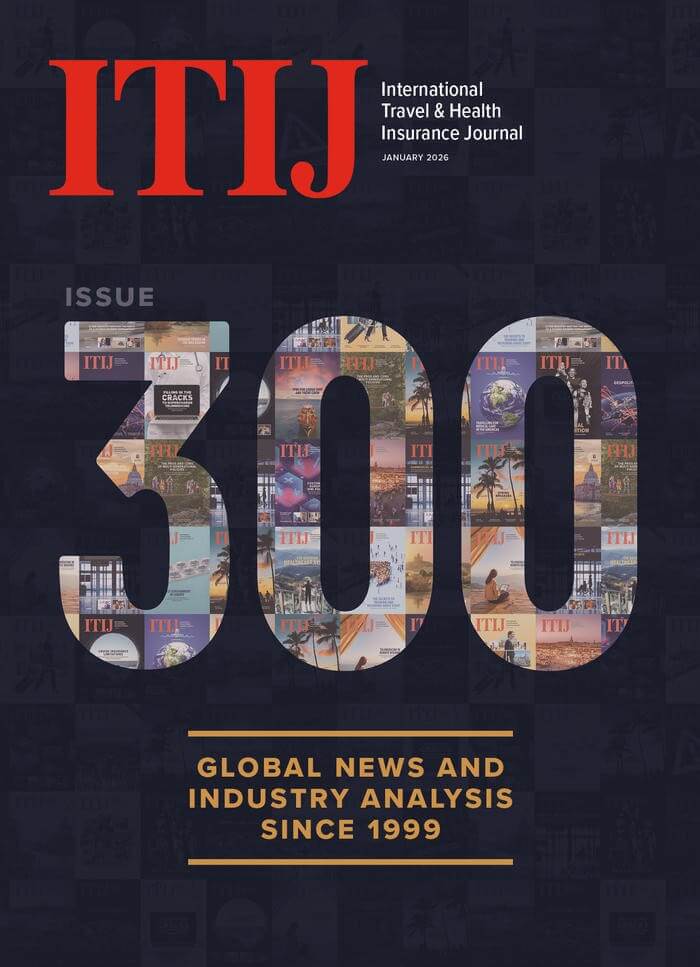
January 2026
Issue
In this issue of ITIJ we ask whether insurance companies up to date with IPMI benefits; examine how insurers are using automation and AI to streamline claims; and consider whether specialist reputation consultancies can help destinations restore their reputations after a crisis.