
Industry Voice: Decline, recovery, and transformation: travel insurance post-pandemic

Finaccord Manager David Bowles and Associate Grace Cuddihy share their insights into the travel insurance and assistance landscape in Europe, and how it was impacted by Covid-19
At the time of writing, four and a half years on from the pandemic’s arrival, it looks like travel is back. Airports and planes are full, holidays are in full swing – but it wasn’t long ago that Covid-19 hit the global travel industry with an unprecedented blow, bringing much of it to a halt.
With the pandemic’s worst impacts thankfully behind us, we at Finaccord thought this would be a good opportunity to take stock, and review how an unprecedented, global-level disaster impacted travel and transformed the insurance and assistance industry that has developed to protect it.
To understand this impact, Finaccord reviewed 14 key markets, including 10 in Europe; this allowed us to produce the Travel Insurance and Assistance in Europe 2024 report, covering Austria, Belgium, France, Germany, Italy, the Netherlands, Poland, Spain, Switzerland and the UK.
Travel: collapse and revival, but not yet for all
Looking at international trip numbers across these 10 countries for 2019 and 2023, the picture looks misleadingly flat: 2019 saw 347 million, with 2023 a little lower at 340 million.
Of course, the reality was anything but flat: as Covid-19 hit in 2020, outbound travel collapsed. The extent of the fall varied dramatically from country to country, depending on the severity of the pandemic’s early impacts and the associated government response. Italy’s foreign trips fell by as much as 80% between 2019 and 2020, whereas for Switzerland the drop was 52%: a less extreme fall in comparison, but still unimaginable in previous years.
Data from 2019 to 2023 therefore shows a story of decline and recovery unprecedented in recent times. Again, this broad picture of recovery conceals important differences: by 2023, travel from Spain, Switzerland and the UK had not yet recovered to its 2019 level, and for Italy it was still 35% below. In every other country 2023 saw marginally more travel than 2019, except for Austria, which saw unexpected, dramatic growth of 35%. What did this mean for travel insurers?

Insurance: fall, resilience, and growth
Naturally, premiums fell significantly. Trends in the market for travel insurance are, of course, closely tied to those for travel.
The extent of the fall varied dramatically from country to country, depending on the severity of the pandemic’s early impacts and the associated government response
But the relationship of premiums to trips is not a simple mathematical one. In European countries like Austria, the Netherlands, and Switzerland, for example, annual travel policies predominate; some customers in these countries had already renewed policies by the time the pandemic hit, while others may have renewed in the expectation that travel would return. Consequently, these markets proved less volatile than those where most policies are bought for individual trips, like Italy and Spain.
Based on the annual/single-trip distinction, more resilience might also be expected in the business travel insurance market. Business travel is typically covered by annual policies, and these can be bought for the company as a whole and thus not directly tied to the number of trips taken. However, the amount of travel undertaken will clearly affect premiums paid, and another trend evident in Finaccord’s data is that business trips have not recovered to nearly the same extent as leisure trips: in all countries except Poland, the 2023 business trip count remained below that of 2019. Here the pandemic seems to have exacerbated a long-term trend: companies were already cutting back on business travel due to cost pressures and the growth of teleconferencing as an alternative, and naturally Covid-19 heightened this trend.
At the macro level, there is a clear overall pattern. Across all the countries, travel insurance premiums had already marginally exceeded their 2019 level of €3.4 billion by 2022, when outbound trips were still 16% below. (Note: Finaccord’s market size is for standalone travel insurance only, excluding policies packaged with credit cards and other bank products.)
Price is a significant factor here: among the seismic changes in the wake of the pandemic was inflation, driving prices up across Europe, and travel insurance was no exception – especially as insurers responded to the pandemic by expanding their products to cover pandemic-related risks. But even after adjusting for inflation, the market saw real growth of 5% between 2019 and 2023, reaching €4.2 billion, while trip numbers were still 2% lower.

In European countries, around 40% of respondents said the pandemic had made them more likely to purchase travel insurance in future
This points to increased insurance uptake; this is not surprising given that the pandemic increased public awareness of travel risks. Finaccord’s own research for its 2022 Travel Metrics consumer survey series captured this: in European countries, around 40% of respondents said the pandemic had made them more likely to purchase travel insurance in future. The increase does not, however, appear to have been a dramatic one: this may be because travel insurance uptake is already high in many European countries. One major exception here is Italy, where, despite the lack of recovery in international trips, travel insurance premiums have shown remarkable real growth of 40% between 2019 and 2023; this market, where uptake had typically been lower than other European countries, appears to have been transformed in the pandemic’s aftermath.
Competitors old and new in the post-pandemic market
Finaccord’s Travel Insurance and Assistance reports focus on distribution as well as market sizing, tracking partnerships with hundreds of travel companies, airlines, banks and other organisations. This is, of course, another area where the pandemic caused major shake-ups, as airlines and travel companies disappeared, banks withdrew travel insurance offerings, and new competitors and partnerships emerged.
The result, when looking at Finaccord’s estimates for insurer market shares, is a picture that can look very different from the landscape when Finaccord last researched these travel insurance markets in 2018 and 2019. Examples are the withdrawal from the UK market of both MAPFRE Asistencia and Union Reiseversicherung, or the rise of Cowen Insurance Company through pan-European partnerships with Ryanair and other airlines. One thing that remains true, however, is that the European travel insurance market is a closely contested one: major players like Allianz, AXA, ERGO and Europ Assistance vie with each other and claim significant shares across multiple countries, but in each they face strong competition from local insurers.
As the market comes back transformed, and customers seek reassurance in a post-pandemic world, it’s clear that insurers need to respond to a new set of challenges and opportunities.
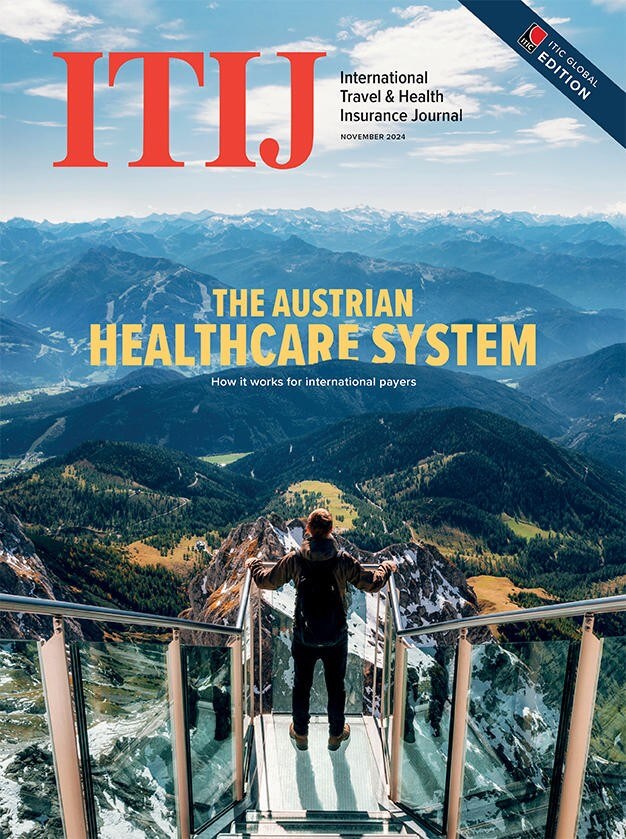
November 2024
Issue
This month we look at affinity partnerships and ask if online travel agencies are the perfect partners for insurers; we cover the trends around cruising in the Mediterranean; we delve into the specifics of the Austrian healthcare system; plus we examine international healthcare and technology, asking how far can technology go.
David Bowles
David Bowles joined Finaccord in 2014, and manages its international research into travel insurance, international health insurance and other services related to global mobility.
Grace Cuddihy
Grace Cuddihy joined the business in 2021, and has worked on a wide range of subjects, including travel insurance, expatriates, health services, and Finaccord’s consumer surveys.