If it’s raining, take an umbrella: rethinking risk management

Michael O’Halloran, Head of Risk Strategy at Compass Point Assist, talks to ITIJ about avoiding crises
When ITIJ invited Compass Point Assist to contribute an article, the natural temptation was to dive into the usual talking points: niche products, digital innovations, or complex case studies of medical and security rescues.
These stories, often accompanied by tales of complex coordination in hostile or remote locations, have long been used to demonstrate the value of travel insurance. They highlight the necessity of response solutions, the ingenuity of providers, and the navigation of various operational challenges.
Yet, at Compass Point Assist, our philosophy is simple: prevention is better than cure.
This principle, first advocated by Hippocrates, resonates far beyond its original medicine connotations. For insurers, brokers, and travellers alike, the real value lies in reducing the likelihood of a crisis in the first place. Claims avoided are just as important as claims resolved – and often far less costly.
Prevention versus delegation
Well over a decade ago I retired from the military and ventured into the assistance sector where my corporate education began. At that time it was explained to me that clients typically fall into two categories: those who seek to actively mitigate risk, and those who prefer to delegate it.
That simple truth has stayed with me. Prevention reduces exposure, protects consumers, and upholds reputational values. Delegation, by contrast, often means abdicating control – until a crisis lands in your inbox. Meaning clients, insurers and brokers who choose prevention, will consistently outperform those who treat risk as an afterthought.
At Compass Point Assist, we have built our approach around using intelligence and field experience to actively mitigate risks. Not just from behind a desk, but on the ground in the exact environments where claims and crises actually unfold.
Our philosophy is simple: prevention is better than cure
The cost of inaction
Consider Nepal. Fraudulent helicopter rescues and inflated hospital bills are welldocumented, yet some insurers still rely on claims processors who unwittingly fuel the problem by paying the inflated costs presented after the fact. The result? Loss ratios rise, holidays ruined, and consumer duty compromised.
Contrast this with insurers motivated to do more, including those we serve. Last November I sent a first notification of loss (FNOL) that conveyed the distress of an insured for a situation clearly not covered under their policy. Within nine minutes, the managing director responded: “Get her out of there. I’ll cover it if claims won’t.” Soon after, the senior claims manager approved the costs, citing the exceptional circumstances saying: “We will also contact the client to assure this will be reimbursed and offer any additional help she would need from us.” Both responses were sent before the claim was even live on their system!
No fanfare. No marketing angle (quite the reverse, in fact). Just consumer duty in its purest form.
Small actions, big results
Risk management does not always require sweeping reforms. Often, it’s the small, practical steps that make the difference. For example:
• Take anti malarials (when in risk areas), use mosquito repellent, and lose the shorts and t-shirts at dusk (malaria is not the only insect-borne disease and it is not confined to the tropics)
• Pay attention to surroundings – don’t walk glued to your phone
• Have a plan
• Don’t eat yellow snow.
For Himalayan trekkers:
• Avoid guesthouse chicken dishes in early spring
• Be wary of trekking companies offering below-market prices – they’re making profits elsewhere
• Never skip acclimatisation days, no matter the pressure.
Last season one couple learned this the hard way when a missed flight to Lukla led their trekking company to push them past a critical rest day, having forced them to sign a waiver. Within days, both were hospitalised with altitude sickness. Their experience underscores a wider truth: uninformed travellers create unnecessary risk – for themselves and their insurers
At Compass Point Assist, we have built our approach around using intelligence and field experience to actively mitigate risks
Risk management does not always require sweeping reforms
Emergencies versus crises
In the developed world, emergencies are often contained. But in high-risk, remote, or politically unstable environments, traveller emergencies can quickly escalate into crises.
That’s why Compass Point Assist developed Compass Shield, our integrated emergency response membership designed for short duration travel to high-risk regions. When a customer is keen to mitigate risks, integrating risk management will strengthen an insurance product with preventative intelligence and local knowledge applied before – not after – the event. By embedding proactive risk management into insurance products, we help insurers reduce exposure while protecting travellers from foreseeable harm.
Bridging the gap
Ultimately, the challenge is bridging the gap between what insurance promises on paper and what the insured’s experience is on the ground. Insurance alone cannot protect a traveller in the Himalayas, or a corporate team in a post-conflict zone. Equally, emergency response without insurance backing can leave both travellers and companies financially exposed.
What’s needed is integration: proactive risk management that reduces exposure, combined with responsive insurance that protects travellers against the unpredictable – proactive support before a crisis unfolds and effective response when it does.
That’s the philosophy behind our work at Compass Point Assist.
The way forward
There will always be claims. There will always be rescues. But the best measure of risk management is not how effectively you respond after the fact – it’s how many crises you help avoid altogether.
At Compass Point Assist, we aim to be that umbrella in the rain: an intelligent, proactive layer of protection that keeps travellers safe, insurers solvent, and duty of care intact.
If it’s raining, take an umbrella. Simple. Obvious. Effective. And that, at its heart, is what Compass Point Assist believes risk management should be.
About Compass Point Assist
Compass Point Assist provides integrated risk management, medical assistance, and crisis response services worldwide. Supporting insurers, corporates, and travellers in complex and high-risk environments, Compass Point delivers proactive protection, emergency medical evacuation, and tailored duty-of-care solutions, backed by Lloyd’s of London underwriters and decades of field-proven expertise.
Michael O’Halloran
Head of Risk Strategy, Compass Point Assist
With a background spanning military service and over a decade in international risk and emergency assistance, Michael specialises in integrating proactive risk management with insurer support and helping organisations, and travellers, navigate complex environments.
November 2025
Issue
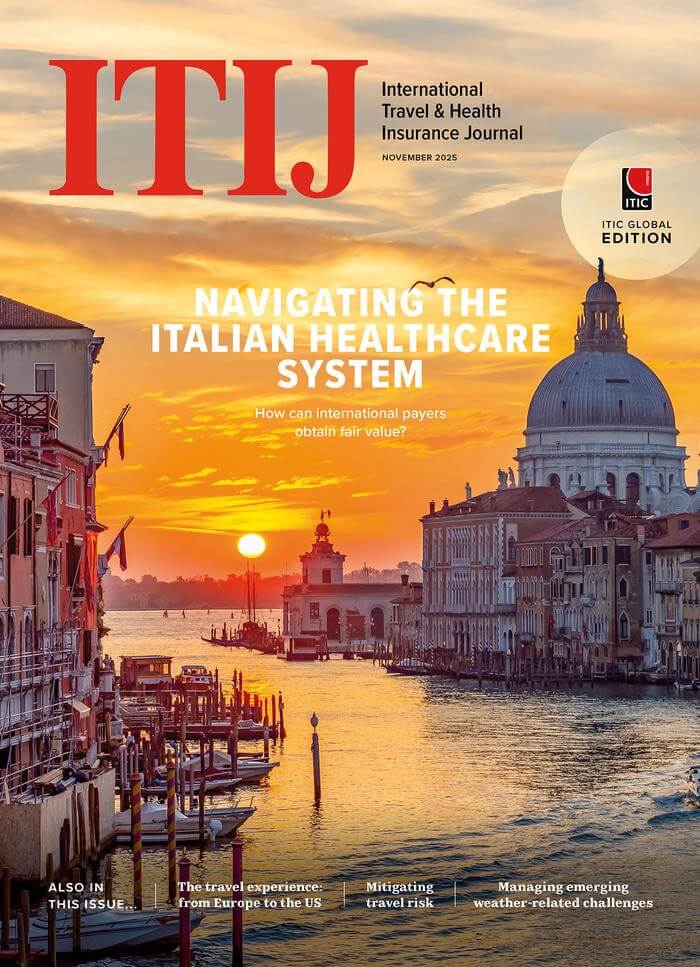
In this issue of ITIJ we look at current travel patterns to and from the US and Europe, take a close look at the Italian healthcare system, and examine how insurers are adapting policies and coverage to manage weather-related challenges.
Editorial Team
The Editorial Team updates the ITIJ website daily, and works on features for the print edition. With expert industry knowledge and years of experience in writing about complex travel insurance issues, the Editorial Team is ready to investigate and report on the topics that matter most to ITIJ's readers.