
How travel insurers are responding to a changing winter sports risk landscape

As climate volatility, transport disruption, and rising medical costs reshape winter travel, insurers are reassessing how ski risks are priced, covered, and communicated. Chloe Fox reports
Climate volatility is putting travel insurance pricing, underwriting, and product design under closer scrutiny, particularly for ski holidays, where injury is only one part of the potential claim. The experts contributing to this feature describe a risk landscape shaped by weather, transport disruption, medical costs, and changing traveller behaviour, while stressing that the data does not necessarily point to a single answer.
Pricing in a changing risk environment
Christina Tunnah, Head of the Americas for World Nomads Travel Insurance, told ITIJ: “The fundamentals of insurance pricing remain sound, but climate-related volatility reinforces the need for continuous review and refinement.”
She said insurers were increasingly examining how environmental conditions affected travel behaviour and claims, including the indirect consequences of disruption to infrastructure, utilities, and transport. “The ability to respond quickly to evolving risks will be an important factor in maintaining sustainable pricing over the long term.”
Patrick Corbett, Chief Underwriting Officer, Zurich Cover-More, similarly said insurers needed to look beyond historical claims data as climate-related events became more frequent. “Historically we have relied on hindsight, looking back at claims data, but recognise that climate-related events are happening more frequently and the need for foresight is critical.”
He said insurers investing in better data and more dynamic pricing models would be better placed to respond to changing conditions.
William Cooper, Director and Co-Owner of William Russell, said the issue looked different from the perspective of annual international health insurance, which was less exposed to seasonal conditions. “This is mostly a question for trip-based travel cover, which carries seasonal risk directly. Annual international health cover is far less exposed to a poor season, because we insure the person for the whole year, wherever they happen to be.”
Looking specifically at trip cover, Cooper said changing ski seasons could put pressure on traditional pricing models. “Shorter and less reliable seasons erode the historical data that pricing rests on. I’d expect pricing to become more dynamic – by resort, altitude, and date – rather than simply more expensive across the board.”
The fundamentals of insurance pricing remain sound, but climate-related volatility reinforces the need for continuous review and refinement
Carlos Cividanes, Managing Director of Anywhere Assurance, offered a different view of the apparent rise in weather-related travel disruption. He pointed to data from the Federal Aviation Administration (FAA), National Oceanic and Atmospheric Administration (NOAA), and Bureau of Transportation Statistics (BTS) suggesting that flight delays were flat or declining over four decades, even as the number of flights had increased.
“Our pricing models are sustainable and in fact bolstered by the fact that with the perception of increased volatility there is an increase by the travelling public in protecting their travel plans.”
For Carole Tokody, CEO of Southern Cross Travel Insurance (SCTI), ski claims illustrate how climate and weather exposure can extend beyond the activity itself. She said SCTI data showed disruption involving roads, flights, rail, baggage, and rental vehicles, alongside injuries on the slopes.
“A ski trip is a chain of risks, not a single event, which can include medical treatment, evacuation, changed flights, lost prepaid accommodation, missed transfers, rental vehicle exposure, and disruption caused by weather or transport infrastructure.”
Tokody said the data did not support a definitive conclusion on the long-term sustainability of pricing, but it did point to areas insurers should continue to monitor.
“The data SCTI has does not allow us to make a definitive actuarial judgement on whether current pricing models are sustainable long term.”
She added that medical and evacuation claims remained the dominant ski-related exposure for SCTI, with Japan accounting for around 40% of paid ski claims in its 2023–2026 (to date) data set. Across the same period, the data shows that injuries and falls remain the core ski risks, while weather and snow disruption are a strong second. In 2025, medical and evacuation paid value reached NZ$458,538 across 132 paid claims, with an average paid claim of $3,474. Tokody also pointed to unexpected examples, including icy-road rental incidents, and a snow-damaged train.
Distinguishing recreational skiers from higher-risk participants
The contributors highlighted the relevance of how policies define activities and participation levels. Tunnah said there was no uniform industry approach. “There is no single industry approach to activity cover and insurers assess these risks in different ways.”
She said factors could include the activity, environment, skill level, and degree of participation, while customers needed to understand how their insurer defines covered activities.
Corbett said the distinction between mainstream winter sports customers and higher-risk enthusiasts was increasingly important to underwriting. “The days of treating everyone the same are largely gone.”
He said standard winter sports extensions could cover most customers, while higher-risk participants may require specific adventure activity extensions or policies, with customers needing to check that their cover matches the activities they intend to undertake.
Cividanes added: “Optional upgrades are the preferred method Trawick and Anywhere Assurance use to provide higher-risk enthusiasts with the proper coverage.”
Cooper explained that the distinction between different levels of participation was often made through policy wording: “Activity lists, on-piste versus off-piste, and definitions of what counts as recreational. Most buyers don’t read those definitions until they come to claim, which is where the trouble starts.”
He said the distinction “gets drawn differently” in annual international health insurance. “For an expat living near the mountains, recreational skiing is part of ordinary life, and annual medical cover generally treats it that way. The line tends to sit at competitive or professional participation, and at specific named activities such as heli-skiing or off-piste without a guide.”
The more interesting path is better segmentation. The data now exists – resort conditions, activity tracking, claims patterns – to price the committed enthusiast differently from the once-a-year skier, rather than excluding either
Tokody added that SCTI draws a clear line in its policy wording. Skiing and snowboarding are not automatically covered, and customers need to select the relevant option and pay the additional premium. “Even then SCTI does not cover skiing or snowboarding off-piste, or outside a designated commercial ski area that is open for use.”
She also highlighted the safety component of recreational skiing, arguing that policy terms and traveller behaviour must be considered together.
The claims data, she said, demonstrates why distinctions matter even for recreational participants. Serious injuries can occur on green runs and groomed slopes, including fractures, ACL (knee ligament) injuries, and concussion, and can lead to patrol support and altered travel arrangements. Examples from January 2023 to June 2026 include a green-run knee injury in Japan at around $1,972, a groomed-run head injury in France at around $6,204, and a Canadian, green-run fracture claim above $9,000.
For customers, Tokody said understanding the conditions attached to cover was an important part of preparing for a ski trip.
Adjusting models for longer-term environmental change
The question of how insurers should account for environmental change returns the discussion to actuarial modelling. Tunnah said the industry was increasingly considering emerging indicators alongside historical claims data.
“As environmental conditions evolve, insurers are continually reviewing assumptions around claim frequency, severity, and geographic exposure to ensure pricing remains appropriate.”
She said the difficulty lay in forecasting the timing and scale of future changes, meaning modelling and scenario analysis must operate alongside observed experience. The objective, she said, was to balance responsiveness to changing risks with the need to provide cover that remains sustainable, affordable, and valuable for travellers.
Corbett also stressed the need for insurers to move beyond historical experience when modelling longer-term risk. “The biggest shift is that insurers can’t rely solely on historical experience anymore.”
He said climate trends, scenario testing, and predictive analytics were increasingly being incorporated into models, with insurers looking at how weather-related disruption, medical claims, and large-scale travel interruptions could evolve over the next decade.
Tokody told ITIJ that “SCTI data supports a watch-and-learn approach rather than a definitive actuarial conclusion”.
She said medical and evacuation costs remained the main exposure, while weather and access disruption were meaningful secondary risks. The claims data shows these types of claims rising year on year, although Tokody cautioned that claims volumes could also reflect travel patterns, destination mix, policy uptake, seasonality, and reporting periods.
“The actuarial challenge is likely to be less about a one-off adjustment and more about keeping pricing, underwriting, and customer communications responsive as winter travel risk changes.”

Innovation, product design, and the future of cover
The answer to rising risk on the slopes may not be to keep tightening the terms and conditions. Across the industry, there is a growing sense that technology, better data, and clearer communication could allow insurers to respond more precisely – and give customers cover that works when conditions change.
Tunnah expects technology, data, and modelling to become increasingly important. “While policy coverage will continue to evolve as risks change, we expect innovation to play an important role in supporting insurability.”
For Cividanes, the issue is not always what a policy covers, but whether customers understand it. “In some cases, coverage will have to be better explained instead of more restrictive, but innovation will be the real key to striking the balance between keeping coverage affordable and attractive.”
Tokody pointed to SCTI’s claims experience, which spans medical injuries and evacuation as well as travel interruption, baggage, personal liability, rental vehicle incidents, and weather disruption. “The claims data points to a need for clarity rather than blanket restriction.”
She highlighted practical problems such as delayed ski bags and travellers forced into expensive, last-minute decisions when snow closes roads, rail lines or airports. “For mainstream travellers, the bigger opportunity may be better education and clearer cover design rather than simply narrowing cover.”
Cooper expects both restriction and innovation but sees greater potential in insurers becoming better at distinguishing between different types of skier.
“Restriction is the easy first response, and some of it is already visible in tighter activity definitions and altitude limits.
“The more interesting path is better segmentation. The data now exists – resort conditions, activity tracking, claims patterns – to price the committed enthusiast differently from the once-a-year skier, rather than excluding either.”
He also pointed to annual health cover as an example of how insuring the person rather than the trip could help to reduce seasonal volatility.
“Annual health cover makes a version of the same point: if you insure the person rather than the trip, much of the seasonal volatility problem falls away. So, I don’t think the industry is anywhere near the limits of insurability yet.”
Corbett similarly expects insurers to adapt rather than retreat as risks become harder to price. “The industry has and will always adapt to changing risks, and travel insurance will continue to evolve rather than simply pull back from exposure.”
He sees opportunities in parametric solutions, real-time travel assistance, hyper-personalisation, and dynamic pricing – potentially making insurance more responsive to what is happening on the ground.
The role of cancellation cover on expensive ski trips
The cost of ski holidays adds another dimension to the insurance question, with travellers often carrying significant prepaid commitments. Tunnah said cancellation cover remained important but did not address every risk associated with skiing.
“Cancellation cover is one important consideration given the significant upfront costs often associated with ski holidays.”
She highlighted injury, mountain evacuation, and weather-related travel disruption as additional exposures, while noting that World Nomads USA was introducing travel inconvenience coverage for certain named events, such as a ski resort closure due to a lack of snow.
Corbett similarly urged travellers to consider whether their cancellation limit reflected the full cost of the trip. “The key question isn’t whether there is cancellation cover, but whether there is enough cancellation cover,” he said, adding that higher-value holidays may require increased or bespoke limits.
Cividanes said Anywhere Assurance took a different approach for travellers aged 60 and under, with a base price that was not linked to cost and specified cancellation limits. For ski holidays, he recommends an additional medical upgrade.
Cooper said the cost of ski holidays also made the adequacy of cancellation limits an important consideration.
“This one sits squarely with the travel insurers, but, as a consumer observation, the cost of a family ski holiday has risen a long way, and cancellation limits on many policies were set when a week in the Alps cost half what it does now. Anyone paying thousands upfront months in advance should check the limit against what they’ve committed.”
In some cases, coverage will have to be better explained instead of being more restrictive, but innovation will be the real key to striking the balance between keeping coverage affordable and attractive
Tokody’s claims examples illustrate how the financial impact of a ski incident can extend well beyond the initial booking. “Ski holidays can involve significant prepaid costs, including flights, accommodation, passes, gear hire, transfers, and tours.”
Paid claims have included unused lift passes and lessons, missed shuttles, replacement clothing following delayed baggage, and extra accommodation after snow disruption, with examples ranging from smaller claims to journey changes above $7,000 and a cancellation claim above $40,000.
The takeaway, Tokody said, was to ensure the policy reflected the true cost of the trip: “Travellers should consider the full cost of the holiday before they leave, including non-refundable bookings and the cost of changing plans after departure.”
Taken together, the responses underline the interconnected nature of winter travel risks. Whether the issue is injury, weather, transport disruption or a cancelled booking, the financial consequences can extend across the entire journey. As Tokody put it: “For customers, the practical message is simple: ski cover should be considered as part of the whole trip, not just the time spent on the mountain.”
October 2026
Issue
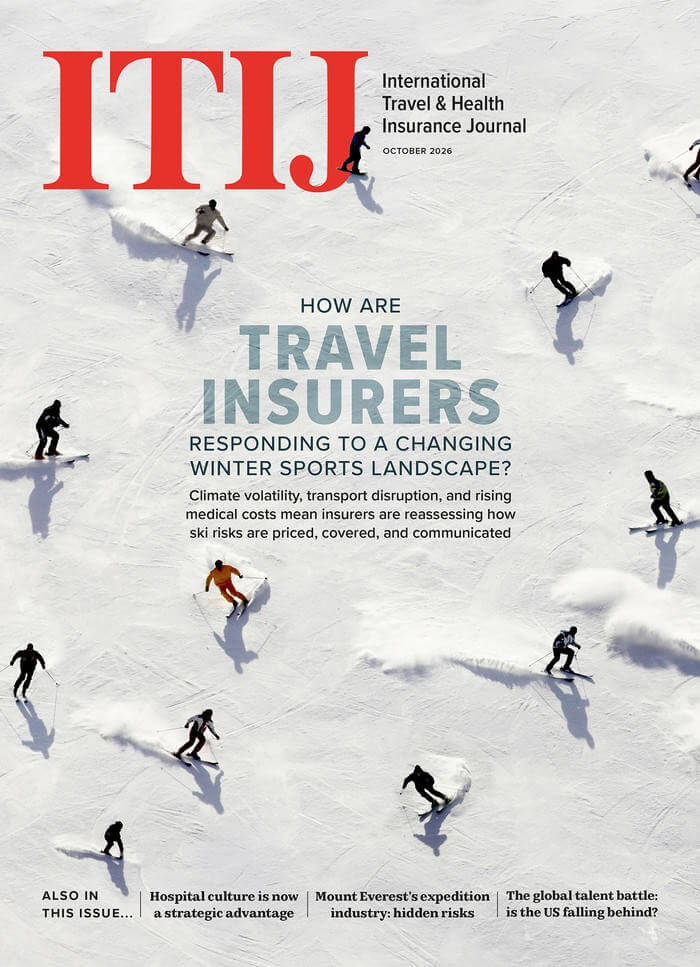
This month in ITIJ we take a close look at how travel insurers are responding to the changes in winter sports risk, and we ask how risk is priced, covered and communicated to policy holders.
How do international hospitals stand out from the crowd, and become the number one choice for insurers and assistance companies? Clinical excellence alone is no longer enough. We look at why hospital culture has become a strategic advantage, and how dedicated international departments are strengthening relationships between hospitals, insurers, and assistance companies.
Chloe Fox
Chloe Fox is an Editorial Assistant for Voyageur Group, joining in 2024. She writes for ITIJ and AirMed&Rescue, covering a range of topics including international travel and health insurance, medical assistance provision, and air medical transportation. Chloe holds a BA (Hons) in English and an MA in English Literature from the University of Bristol.