
How precisely can we assess the transport risk in peripartum interhospital transport?

An ITIC Medical Director Forum position paper by Dr Alex Veldman of UNICAIR and the Hudson Institute of Medical Research, Dr Susana de la Fuente Lumbreras of Iris Global, Dr Solenn Coz of Airlec, and Dr Joseph Lelo and Dr Bettina Vadera of AMREF Flying Doctors
International travel for leisure and business has regained pre-pandemic levels.1,2 Consequently, an increasing number of women are travelling during pregnancy. According to some studies, more than 50% of pregnant women travel abroad during pregnancy, with over a third of those embarking on long-distance, intercontinental journeys.3
Although a small study by Sammour et al did not show an increased risk for adverse pregnancy outcomes in pregnant travellers to developing countries, the general risk of premature labour, pre-eclampsia and other pregnancy-related complications remains in the travelling pregnant women.4
When complications arise, travel assistance and insurance companies are challenged with the question of whether to evacuate or repatriate the pregnant woman or risk delivery overseas where medical facilities or expertise may be limited. Likewise, medical service providers tasked to evacuate a woman with complications during pregnancy have to ensure
that transport is safe.
Case 1
A 38-year-old pregnant woman was on vacation at a campsite in the south of France, travelling in a camper van with her family. It was her second pregnancy.
The assistance centre received a call from the woman reporting that she had symptoms of mild abdominal pain and light vaginal bleeding. It was difficult for her to define the type of pain and its location. She was in the 29th week of gestation and previous assessments of her pregnancy had been normal. Her first pregnancy had been full-term and without complications.
The coordinating assistance doctor gave her instructions to go to the nearest hospital emergency room, which was in the country’s general hospital.
When complications arise, travel assistance and insurance companies are challenged with the question of whether to repatriate the pregnant woman or risk delivery overseas
Later, the assistance centre medical department received a call from the doctor in the emergency room to say that the woman had been diagnosed with mild premature detachment of the placenta. It was strongly recommended that she should be transferred to a hospital with more resources for better monitoring of mother and foetus.
It was further recommended that the receiving hospital should have a neonatal unit. Looking at the distances between the hospital in Spain where the woman lived and the hospital with the best resources including neonatal care in France, the coordinating doctor decided to transfer the patient to her reference hospital in Spain. The distances were practically the same.
The assistance centre medical department checked with the emergency room doctor that the woman was clinically stable and that there was no risk of imminent delivery.
An air ambulance with a specialized doctor and nurse onboard was sent to repatriate the woman. Taking into account the summer season with heavy traffic jams on the roads, an incubator was added to the transport equipment for greater safety.
Case 3
A patient encountered a complicated pregnancy marked by severe pre-eclampsia with intrauterine growth retardation (IUGR) and the development of haemolysis, elevated liver enzymes and low platelets (HELLP) syndrome in a remote town in Kenya. Due to the severity of the condition, an emergency air ambulance transfer to a tertiary facility with neonatal intensive care unit (ICU) capability in Nairobi was performed. The client underwent an emergency caesarean section at 29 weeks’ gestation due to worsening hypertension and deteriorating foetal status.
A live male infant weighing 960 grams was delivered. The neonate faced multiple challenges during his stay in the neonatal ICU, necessitating a prolonged admission of 95 days. Despite the hurdles, the infant showed remarkable resilience and was eventually discharged with a weight of 2,296 grams. The mother also suffered postpartum hypertensive emergency, which was managed by a multidisciplinary team.

Discussion
Much of the decision-making in transport medicine is focused on risk-benefit assessments that weigh the transport risk against the benefit of better care, and/or family support and social/cultural wellbeing when repatriated home.5 High-risk obstetric transports are unique in the fact that two patients are at significant risk of mortality and severe morbidity: the mother and the foetus. The Centers for Disease Control and Prevention (CDC) reported that even in the US, pregnancy-related deaths increased from 7.2 per 100,000 live births in 1987 to 17.2 per 100,000 live births in 2015.6 Furthermore, severe maternal morbidity increased by nearly 200% between 1993 and 2014, and as many as 60% of maternal deaths during 2013–17 were potentially preventable.7
There is an abundance of data supporting that in-utero transfer of high-risk pregnancies to a specialised centre does improve the outcome for mother and baby.8 A study by Gunnarsson et al showed that perinatal mortality of infants with unplanned out-of institution births (unplanned at home or during transport) was overall more than double that of all other births; in case of small preterm babies with a birth weight of 750–999 grams it was more than five times higher than reference births in the same birthweight group.9 A similar study from Finland showed an even higher difference (more than six times increased mortality for unplanned out-of-institution births), highlighting the critical importance to avoid delivery en route and work towards a planned delivery in an optimised environment, ideally in a centre of excellence.10 Therefore, in case of a pregnant patient with an obstetric emergency abroad, the precise assessment of the transport risk is of critical importance. Transport risks mainly evolve around delivery en route (unacceptable risk for foetus and mother due to limited monitoring of foetal wellbeing, no option to escalate to assisted or surgical delivery in case of need, difficult post-natal stabilisation of the (premature) infant, and limited capabilities to manage maternal postpartum complications such as haemorrhage, etc.). Additional maternal transport risks such as life-threating haemorrhage in placental abruption or seizures and stroke in women with (pre) eclampsia need to be carefully considered.
In addition to a non-viable foetus (less than 22 completed weeks of gestation, or fatal malformations), Watson et al do list the following contraindications for in-utero transfer to a specialised high-level perinatal centre:11
- Active labour where the cervix is more than 3 centimetres dilated
- Maternal condition that may require intervention during transfer, e.g. antepartum haemorrhage or uncontrolled hypertension
- Known maternal or foetal compromise requiring immediate delivery, including abnormal cardiotocograph.
Aeromedical transportation is essential in pregnancy emergencies in rural areas and abroad, bridging critical gaps between acute complications and necessary medical interventions.
It ensures swift access to medical facilities, provides specialised care en route, and facilitates transfer to centres equipped for specific care needs, such as neonatal or advanced obstetric services. Staffed with professionals trained in obstetric emergencies and equipped with advanced medical technologies, emergency air medical transport can perform lifesaving interventions during transit. In a large study of data from the Royal Flying Doctor Service in Western Australia, the most frequent conditions overall were threatened preterm labour and delivery, premature rupture of membranes, antepartum haemorrhage, and ectopic pregnancy.12
Delivery en route remains an extraordinarily rare event. In the 2023 Medical Director Forum at ITIC Global in Barcelona, a spontaneous poll among the approximately 150 attendees showed that only one session participant could recall an event of a delivery during aeromedical transfer. The medical literature reports several studies on high-risk obstetric transfers with no delivery en route in a combined total of 1,592 aeromedical transports,13-19 indicating a risk of in-flight delivery of less than 0.06%.
There are a couple of parameters that can be used to assess the risk of delivery in the next 48 hours, some of which are summarised in the table below:

High-risk obstetric transports are unique in the fact that two patients are at significant risk of mortality and severe morbidity: the mother and the foetus
The aim of tocolysis is definitely not to prevent preterm birth but to prolong pregnancy for at least for 48 hours to provide a complete course of antenatal steroids and to enable an in-utero transport into a perinatal centre. There is a clear recommendation for tocolysis between 22+0 and 33+6 weeks’ gestational age (GA) in case of spontaneous contractions (>4 contractions/20 mins) in combination with cervical dilatation and/or reduced cervical length and the absence of contraindications like foetal hypoxia, chorioamnionitis, pre-eclampsia, severe maternal bleeding or cervical dilatation above 4 centimetres. We have discussed the different available medications for tocolysis during transport extensively elsewhere, with nifedipine 10 milligrams per os being a favourable option for en route tocolysis in a women without haemodynamic compromise.
Conclusion
High-risk pregnancies with complications such as severe pre-eclampsia, IUGR, PROM and HELLP syndrome require intricate medical interventions and prolonged care. Such a high level of care and multidisciplinary teams are available in regional centres of excellence. The risk-benefit assessment of transport to such centres needs to be based on highly individual factors, such as level of care in the present location, transport distance, activation time of an experienced team and, most of all, acuity of (preterm) delivery or other maternal and/or foetal risks. While in case of threatened preterm delivery, tocolysis may create or prolong a window of opportunity for transport, delivery en route needs to be avoided with the highest priority.
Postnatal transport of the baby should be considered as an (albeit less desirable) alternative to in-utero transfer when the medical facility at the present location is adequate to provide the necessary obstetric support for the mother, as well as care for a preterm neonate. Understanding the associated costs and the pivotal role of medical insurance in supporting these clinical needs is paramount for informed policy development and patient care optimisation.

References
1. Forum WE. Charted: How international travel bounced back strongly in 2022. 2023. https://www.weforum.org/agenda/2023/03/international-travel-bounced-bac…- 2022/ (accessed 17.07.2024).
2. Stanley M. 2023 Outlook: Business Travel Bounces Back. https://www.morganstanley.com/ideas/business-travel-trends-2023-outlook (accessed 17.07.2024).
3. Kingman CE, Economides DL. Travel in pregnancy: pregnant women’s experiences and knowledge of health issues. J Travel Med 2003; 10(6): 330-3.
4. Sammour RN, Bahous R, Grupper M, et al. Pregnancy course and outcome in women traveling to developing countries. J Travel Med 2012; 19(5): 289-93.
5. Veldman A, Diefenbach M, Taymans L, Vadera B, Lelo J, Rouaud Y. Please get me out of here: The difficult decision making in fit-to-fly assessments for international fixed-wing air ambulance operations. Travel Med Infect Dis 2023; 54: 102613.
6. Vladutiu CJ, Minnaert JJ, Sosa S, Menard MK. Levels of Maternal Care in the United States: An Assessment of Publicly Available State Guidelines. J Womens Health (Larchmt) 2020; 29(3): 353-61.
7. Petersen EE, Davis NL, Goodman D, Cox S, Mayes N, Johnston E, et al. Vital signs: pregnancy-related deaths, United States, 2011-2015, and strategies for prevention, 13 states, 2013-2017. MMWR Morb Mortal Wkly Rep 2019; 68: 423-9.
8. Gage AD, Fink G, Ataguba JE, Kruk ME. Hospital delivery and neonatal mortality in 37 countries in sub-Saharan Africa and South Asia: An ecological study. PLoS Med 2021; 18(12): e1003843.
9. Gunnarsson B, Smarason AK, Skogvoll E, Fasting S. Characteristics and outcome of unplanned out-of-institution births in Norway from 1999 to 2013: a cross-sectional study. Acta Obstet Gynecol Scand 2014; 93(10): 1003-10.
10. Hemminki E, Heino A, Gissler M. Should births be centralised in higher level hospitals? Experiences from regionalised health care in Finland. BJOG 2011; 118(10): 1186- 95.
11. Watson H, McLaren J, Carlisle N, et al. All the right moves: why in utero transfer is both important for the baby and difficult to achieve and new strategies for change. F1000Res 2020; 9.
12. Gonzalez-Chica D, Gillam M, Williams S, et al. Pregnancy-related aeromedical retrievals in rural and remote Australia: national evidence from the Royal Flying Doctor Service. BMC Health Serv Res 2021; 21(1): 390.
13. Tsokos N, Newnham JP, Langford SA. Intravenous tocolytic therapy for long distance aeromedical transport of women in preterm labour in Western Australia. Asia Oceania J Obstet Gynaecol 1988; 14(1): 21-5.
14. Roberts CL, Henderson-Smart D, Ellwood DA. Antenatal transfer of rural women to perinatal centres. High Risk Obstetric and Perinatal Advisory Working Group. Aust N Z J Obstet Gynaecol 2000; 40(4): 377-84.
15. Akl N, Coghlan EA, Nathan EA, Langford SA, Newnham JP. Aeromedical transfer of women at risk of preterm delivery in remote and rural Western Australia: why are there no births in flight? Aust N Z J Obstet Gynaecol 2012; 52(4): 327-33.
16. Connor SB, Lyons TJ. U.S. Air Force aeromedical evacuation of obstetric patients in Europe. Aviat Space Environ Med 1995; 66(11): 1090-3.
17. Jony L, Baskett TF. Emergency air transport of obstetric patients. J Obstet Gynaecol Can 2007; 29(5): 406-8.
18. O’Brien DJ, Hooker EA, Hignite J, Maughan E. Long-distance fixed-wing transport of obstetrical patients. South Med J 2004; 97(9): 816-8.
19. Veldman A, Hodges R, Diefenbach M, et al. Long-distance aeromedical repatriation of women at risk for preterm labor and delivery. Clin Obstet Gynecol Reprod Med 2020; 6: 1-6.
Case 2
The patient was a 28-year-old woman, gravida 3 para 0, with a history of two pregnancy losses. The current pregnancy was achieved through in vitro fertilisation (IVF). A cervical cerclage was in place. She presented with preterm premature rupture of membranes (PPROM) at 16+3 weeks’ gestation while travelling in Western Africa.
Assessment at the local medical facility revealed:
- Mother: afebrile, normotensive, no signs of infection, acute bleeding or contractions
- Foetus: normal cardiac activity and movement, but with oligohydramnios
- Local facilities: unable to remove the cerclage or perform amnioinfusion.
PROM (preterm rupture of membranes) poses significant risks of prematurity and complications. Infection, either as a cause or consequence of PROM, is common. The presence of a cervical cerclage increases the risk of severe sepsis in case of an infection. Urgent transfer to a specialised hospital with expertise in pregnancy complications and neonatal care was crucial for optimal management. As local facilities were unable to remove the cerclage, an emergency transfer to a specialised hospital was necessary to mitigate risks and therefore requested. At 17 weeks’ gestation, the patient was transported by air ambulance with a specialist medical team to France and admitted to an obstetric ward. During the flight, the patient remained stable and afebrile. An ultrasound assessment showed normal foetal cardiac activity and movement. The pregnancy was completed without further complications.
Aeromedical transportation is essential in pregnancy emergencies in rural areas and abroad, bridging critical gaps between acute complications and necessary medical interventions
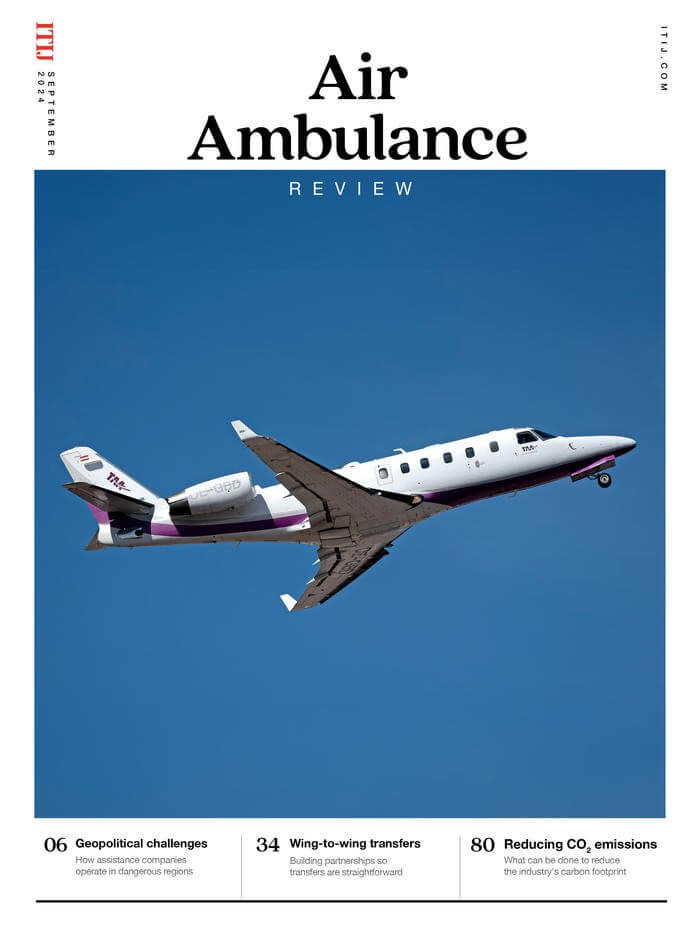
September 2024
Issue
In our second Air Ambulance Review of the year we examine how air ambulance crew work around geopolitical challenges; look at Asia-Pacific air ambulance provision; consider how to choose partnerships around the world to ensure wing-to-wing transfers go off without a hitch; and examine how the industry can reduce CO2 emissions.