
How mental health affects a repat

Dr Adrian Hyzler, Chief Medical Officer of Healix International, explores how the needs of a patient suffering from mental health issues can change the shape of a repatriation
Keep on reading

Mental health issues - no longer something to hide?

Easing the repatriation process
The protocols for medical repatriations when holidaymakers and business people working abroad have been involved in an accident or suffered a physical illness are well established. What is more challenging is assessing the suitability for repatriation of an individual suffering from mental health issues – and the actions that need to be put in place to ensure the repatriation goes as smoothly as possible. It is important to appreciate that mental health conditions require quite a different approach for repatriation.
Psychological implications of physical injuries
First and foremost, it’s essential for an insurer to understand whether a psychological condition is a consequence of physical injuries or a primary condition that is entirely unrelated to an individual’s physical condition. Data from Healix International shows that between five and 10 per cent of physical injury cases result in some form of psychological complications, and those complications must be taken into account when organising a repatriation for a physical injury.
When a patient is suffering from hypoxia (low oxygen concentration) or from septicaemia (widespread generalised infection), they will often become agitated or confused, and this may lead to a state of delirium. It is also important to always consider the potential psychological side-effects of drugs.
The added stress of being in a foreign country, perhaps with little understanding of the local language and without friends and family, can further the risk of psychological side-effects from physical injuries. While mental health issues resulting from a physical injury are, more often than not, fairly short-lived, usually resolving as the patient’s physical condition improves, they still need to be factored into the repatriation process.
A chief role of medical escorts must be to manage the care of the patient, taking into account their mental wellbeing
For individuals who are experiencing mental health issues that are unconnected to their physical condition, clearly the insurer will have insight from those treating the patient. But again, it’s important to recognise and plan for the unsettling impact of unfamiliar surroundings, foreign languages and a lack of family or friends for support, which could exacerbate the patient’s condition. Repatriating mental health patients who have previously been admitted to a mental health facility abroad while receiving their initial treatment will have been used to a fairly predictable routine, in a controlled and safe ward environment. Taking them out of that environment could immediately change their condition.
Understanding and recognising the symptoms is, therefore, crucial to help insurers manage the best outcome for their policyholder. It will help determine the type of repatriation necessary – from simply an escort on a standard flight to the arrangement of a medical air ambulance. It will also help determine the level of escort needed.

Avoiding the hurly burly
One of the first things to consider when planning a repatriation for a patient experiencing psychological symptoms is the airport environment. For even the calmest and most confident traveller, the hurly-burly of the departures process can, figuratively and physiologically, raise the blood pressure. Thousands of fellow travellers elbowing themselves through check-in, security and onto the plane can severely exacerbate the situation for someone already experiencing mental health issues.
It is vital, therefore, that the patient is provided with as calm an environment as possible during the repatriation, and this is where medical escorts are crucial. A chief role of medical escorts must be to manage the care of the patient, taking into account their mental wellbeing. Utilising airport lounges, avoiding large queues and using priority boarding can all help to reduce the likelihood of external factors causing additional stress. Such arrangements should therefore be factored into the repatriation arrangements.
A protective buffer
Medical escorts also provide a calm and capable presence on the plane itself. Patients experiencing psychological issues need to be protected from any potentially difficult interactions with air crew or fellow passengers. Medical escorts can act as a protective buffer, problem solving and taking responsibility away from what is often an anxiety-inducing and exhausting experience for those with mental health problems.
It’s essential for an insurer to understand whether a psychological condition is a consequence of physical injuries or a primary condition that is entirely unrelated to an individual’s physical condition
The time of day or night of the repatriation is another factor that can significantly impact on someone already experiencing psychological issues. In normal circumstances, night time is often associated with an increase in disorientation and confusion for those facing mental health issues. Unfortunately, the same feelings can occur when the lights go out during long-haul flights.
Someone who has, during the daytime, been stable and shown little signs of stress can become disturbed, or even refuse their medication, simply because they are disorientated. It therefore makes sense, when there is the potential for a patient with mental health issues to become agitated and even aggressive, to use two escorts when repatriating on long-haul flights – usually a doctor and a nurse.
Another good reason for two escorts is the time a repatriation takes, from door to door. With some lasting 30 hours or more, it is important that at least one of the escorts is fully awake at all times; it is also important that each escort gets a chance to rest so that they are alert and able to look after the patient when it is their shift. In the unlikely event that the patient becomes acutely disturbed during the flight, having two healthcare professionals on hand helps to defuse the situation as quickly as possible.
The need to create a calm and unpressured environment also justifies upgrading patients with mental health issues to business class for the repatriation. And it is important to consider the benefits, and possible drawbacks, of having the patient’s relative sitting alongside the patient and medical team. In a situation where the patient has been observed during their hospital stay getting agitated when the relative is not around, there is certainly a strong argument to have them nearby. However, it should always be noted that the relative may actually be one of the exacerbating factors and a ‘break’ from them during the flight could actually have a positive effect! Repatriation of patients with psychological symptoms is certainly challenging and requires close teamwork and co-operation among all involved, from the treating medical team to the transfer team, the airline crew and the medical escorts. Nevertheless, with careful planning and an in-depth consideration of the patient’s condition and needs, such repatriations can be highly rewarding.
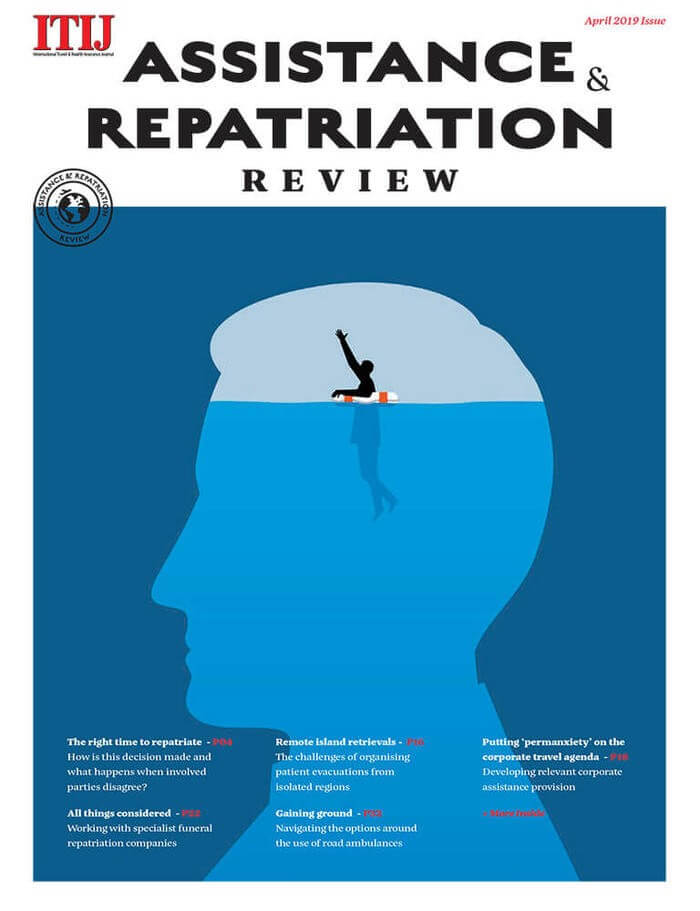
April 2019
Issue
This issue explores how decisions are made around the right time to repatriate a patient and how disagreements along the way are mitigated and overcome; we get to know more about the protocols and challenges involved in international funeral repatriations; and we navigate the options around the use of ground ambulances. We also have insights from industry professionals on a range of repatriation topics, and we talk to Carlos Hernandez of Tangiers International about his career and current industry issues.
Adrian Hyzler
Dr Adrian Hyzler is Chief Medical Officer of Healix International. He qualified as a doctor in 1990 from Sheffield University Medical School and pursued a career in emergency medicine, which led to an interest in travel medicine. Dr Hyzler joined Healix International in May 2001 as a flight doctor. He moved on to become a medical co-ordinating officer, then Senior Medical Officer, and is now Chief Medical Officer, with an additional responsibility as Director of Medical Communications.