
How embedded insurance is seamlessly entering the market

Alfie Jake Thomson examines how embedded insurance is disrupting traditional insurance models, and why personalised offerings are vital
Traditionally seen as a separate purchase after buying products or services, requiring consumers to seek out their coverage policy from external providers, insurance has been radically transformed in recent years by the developments made through embedded insurance. Through integration of insurance products directly into the purchasing process, this disruptive new model is challenging traditional insurance models and fundamentally reshaping how consumers access and purchase their necessary coverage. The new embedded insurance market is consequently creating many new and exciting opportunities for businesses spanning multiple different sectors.
Seen by many experts as the next logical step in insurance distribution, and a natural extension of the customer’s purchasing journey, it is a market brimming with possibility for those choosing to invest in it; recent market report analytics put the embedded insurance market at being worth over US$210.9 billion – a figure projected to rise.
For those working in the embedded insurance market, success depends on seamless integration, ensuring that the policy is offered at the right time, so coverage feels both natural and convenient
Seamless integration
For those working in the embedded insurance market, success depends on seamless integration, ensuring that the policy is offered at the right time, so coverage feels both natural and convenient. Discussing this with ITIJ, Ernesto Suarez, CEO of Gigasure, argued how the true value of offering embedded insurance came not from selling coverage, but in “removing friction from critical points in the customer journey”.
“The aim is to address problems as they arise,” he elaborated. “In most cases, it is the brand platforms that do this through the power of technology and data, using customer insights that allow them to provide what the customer needs, at the time they need it.” Citing the example of travel booking confirmations or when customers add a high-value activity to their trip, Suarez discussed how, in his experience within the sector, “you have to work in partnership with the platform to build a product that fits into the user experience seamlessly”, creating a process that feels like a natural extension of the booking, rather than an unwanted interruption.
Parker Crockford, Chief Revenue Officer at Qover, shared this view of making insurance a “natural” part of the core product purchasing journey, citing how Qover’s goal was “orchestration, not just integration”, with focus placed on identifying the precise and unique friction points of the customer journey where “risk is top of the mind” and devising solutions that help ease that anxiety instantly.
Qover has seen recent success in these areas too. Partnership with banking company Monzo has seen travel insurance seamlessly delivered alongside its card scheme, with customers getting coverage for factors ranging from delayed departures to medical expenses. Similar partnerships with Tesla to create ‘InsureMyTesla’ has seen prospective drivers get customised insurance quotes in less than a minute. Discussing the logistics of this personalised service, Crockford raised the role of robust application programming interfaces (APIs) that allow for real-time data exchanges that lead to “hyper-relevant solutions”. Through seamless integration at the API level, policies are presented that feel like native features of the product customers want, rather than third-party upsells, a seamlessness that converts insurance from “a grudge purchase into a value-add that enhances the core product experience”.
Personalisation is of equal importance for those in the embedded insurance market, with the leveraging of customer data to tailor offerings
Placing the discussion around seamless integration within the context of trip cancellation insurance, Bailey Foster, Senior Vice President of Travel Insurance at Trawick International, told ITIJ how relevance always starts with “timing”, and how coverage matters from “the moment a traveller commits financially to a trip”. Foster went on to explain how, at Trawick International, focus is placed on integrating trip cancellation coverage directly into partner booking flows, to enable protection to be offered at the moment a traveller is finalising deposits or confirming non-refundable arrangements. “By aligning coverage with real trip data, clear pricing, and straightforward plan options, customers immediately understand how their investment is protected.”
Foster argued this reframing of insurance within the wider context of the trip itself allowed for coverage that feels both “intuitive and purposeful, with the customer’s experience becoming one that is transparent, quick and easy to act upon. That is how insurance can become part of smart trip planning, instead of an afterthought.”
Personalising the customer experience
Personalisation is of equal importance for those in the embedded insurance market, with the leveraging of customer data to tailor offerings, recommend relevant add-ons, and provide real-time support all enhancing both the perceived value and the engagement of coverage.
To Andrew Tolman, Head of Travel Insurance at Allianz UK, personalisation was all about “understanding people and, ultimately, our customers”. Tolman described how Allianz UK leveraged the data available through its customer lab’s external insights, and through analysis of its current active customers. Valuable insights are drawn from destinations, trip lengths, and customer processes to help suggest those benefits and add-ons that matter most to each individual customer, from medical coverage to personal luggage protection.
This use of real-time data also powers smarter support, with “teams able to anticipate issues and step in with advice or assistance when it matters most”. Tolman elaborated on this further: “By combining data-driven insight with our human touch, we work with partners to provide a personalised product that fits the target customer base, and, after purchase, help to provide claims and assistance services when our customers need us most.”
For other companies, personalisation within embedded insurance was all about moving from “access to adequacy”. Crockford raised how it was no longer enough just to give someone access to insurance; rather, “we have to ensure now that coverage is adequate for their specific situation”.
By feeding real-time data into claim orchestration engines, simple claims can be settled instantly
Qover therefore leverages real-time data to understand the user-specific contexts at play: who the customer is, what they are buying, and how they are using it. Through the analysis of usage data and purchase history, “we can dynamically adjust coverage limits or suggest relevant add-ons that actually make sense for that individual, rather than a one-size-fits-all package”.
The use of artificial intelligence (AI) has similarly streamlined support and claims. By feeding real-time data into claim orchestration engines, simple claims can be settled instantly. Crockford argued that this level of responsiveness was therefore the “ultimate form” of personalisation, treating the customers’ time and their unique, specific context with urgency and respect.
In the travel insurance market, “personalisation is about relevance, not volume of choice”, argued Suarez. Highlighting how Gigasure works to offer a personalised service through offering the ability to customise policies, such as taking away or adding cover so you only pay for what you need, Suarez explained this was done in the spirit of the idea that “customers don’t want more options, they just want the right protections for their trip”.
Using parametric data through GigaShield, customers are given instant compensation in the event of a flight delay or luggage going missing. The use of such intuitive tools is helping to change perceptions of insurance, from a service only needed when making a claim, to more of an experience, something that comes along on the journey with you. “Through digital policy wallets, automated communications and contextual claims guidance, customers feel supported throughout their entire journey, not just at the checkout.”

Recent innovations in both digital tools and the user experience can further help insurers stand out by making coverage easier to understand, purchase, and use
Collaboration and partnerships
Collaboration and partnerships are central to differentiation in the market, and marketing efforts must work to emphasise simplicity, transparency, and trust for the customer, helping to turn embedded insurance from a mere transactional product into a meaningful part of the travel or healthcare experience.
While trust may be the currency of insurance, the industry has famously struggled with the issue of complexity. Crockford said that companies were “often borrowing the trust that the customer already has in a non-insurance brand”. Consequently, to honour this ‘borrowing’ of trust, marketing and communications surrounding embedded insurance must be “radically transparent”; there must be close discussions between partners and collaborators to ensure the often complex language of insurance is one that is translated into terms that are clear and easy to understand, while similarly aligning with the voice of the brand.
“At Qover, we shy away from fine print and focus on clear value propositions – showing exactly what is covered and, crucially, what isn’t,” said Crockford. Through marketing protections, and the peace of mind offered, rather than the policy itself, and by delivering on seamless claim experiences, insurance becomes transformed from a “hidden transaction” into a “tangible loyalty driver for the partner brand”.
This desire for transparency was echoed by Foster, who emphasised how any trust in brands and services was built through “clarity, not complexity”. Marketing approaches for trip cancellation are therefore rooted in education and honesty, ensuring travellers know exactly what they are purchasing and why it matters.
“We collaborate closely with our partners to ensure benefits are communicated in plain language, coverage scenarios are easy to understand, and expectations are set clearly at the point of sale,” she said. “Rather than positioning insurance as an add-on, we frame it as a practical safeguard that protects the traveller’s financial commitment.” Through consistent messaging and honest explanations, customer confidence is created, allowing embedded insurance to become a meaningful part of the travel experience and a trusted decision to feel good about.

Innovations in digital tools and technology
Recent innovations in both digital tools and the user experience can further help insurers stand out by making coverage easier to understand, purchase, and use. Such differentiation can be achieved through what Crockford described as “tech-forward orchestration with human-centric design”, like creating bespoke insurance programmes that evolve as the partner business does.
Crockford explained how using tech to remove administrative burdens – for example, through automated policy issuance and instant payouts – has resulted in the wow factor: “When a customer can make a claim in three clicks and get paid in minutes, that experience differentiates the brand far more than the price of the premium ever could. This is how insurance becomes a growth engine rather than just an ancillary revenue stream.”
Similar efforts in technological innovation have been made by Gigasure: Suarez cites its combination of customer-centric design and strategic partnerships to offer travellers policies that deliver what they need, along with add-ons that bring policy to life and help enhance their experience. Partnerships help provide tools that enhance conversion, retention and customer satisfaction, “not just margins”.
Concluding his discussion with ITIJ, Suarez discussed how, when done well, “embedded insurance helps build trust within the wider travel experience”. Customers associate protections with the platform they booked through, strengthening loyalty and increasing lifetime value, not because their insurance was the cheapest, but because it felt reliable, relevant, and effortless. All positive connotations for the travel and embedded insurance markets, as they move closer to another peak season.
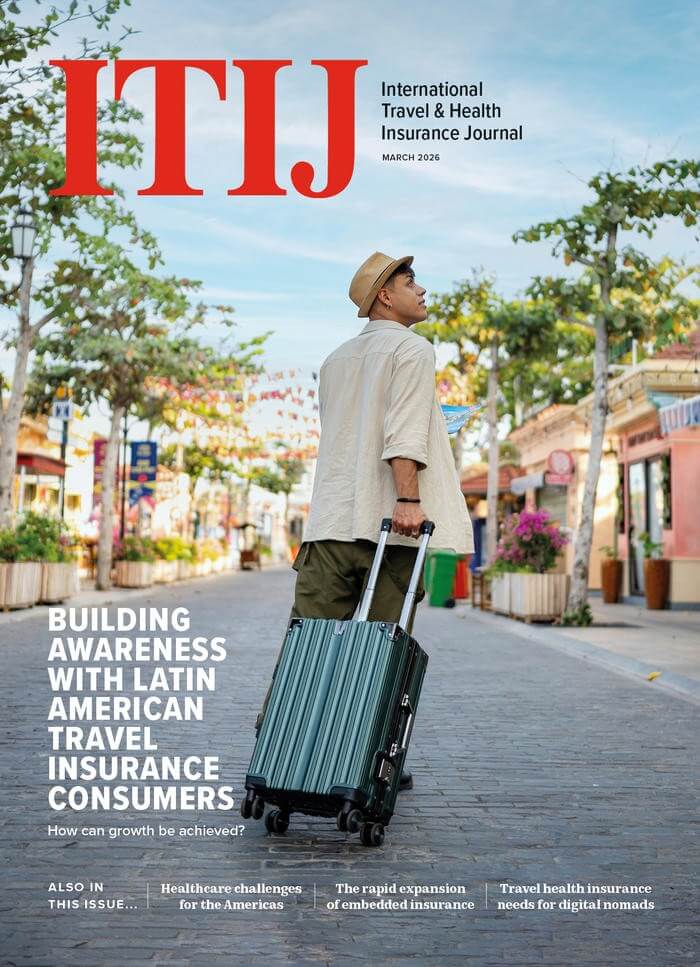
March 2026
Issue
In this month’s ITIJ we examine the digitisation of healthcare across the Americas, plus we look at how embedded insurance is disrupting the traditional insurance market. We also investigate Latin American medical assistance provision and ask how can the industry build awareness and engagement among consumers.