
How an app can save your life

Dr Tyler DeLange, medical advisor to LanguageMAPS, gives his take on how the right smartphone app can positively affect patient care if they become ill abroad
Dr Tyler DeLange, medical advisor to LanguageMAPS, gives his take on how the right smartphone app can positively affect patient care if they become ill abroad
While none of us ever plan to have a medical emergency, it’s too late to plan for one once it happens, especially when travelling abroad. Most of us know someone with a story to tell. It just might be you. There are enough challenges to obtaining medical care while overseas without even talking about the problem of a language barrier. Fact: if you are unprepared to deal with the language barrier when your medical emergency comes, it can change your crisis into a complete disaster.
How can one be prepared and plan ahead in addition to buying travel insurance? A smartphone, with the right apps and pre-loaded personal health information, can save a life. At a minimum, it can communicate accurate medical history – heaven forbid you know that your right lower torso pain is a kidney stone based on your past experience, but the local hospital wants to operate on you immediately for appendicitis.
Personal experience
In 2009, while leading a humanitarian expedition to Northern Guatemala, I became severely ill, with fevers up to 1060F, vomiting, dysentery and severe dehydration. This was later confirmed to be dengue fever and malaria vivax – both at the same time. I was in the best shape of my life, having recently run a half-marathon in one hour and 34 minutes, so I never thought I could get that sick.
If I hadn’t been fluent in Spanish, I would have been in big trouble when it came to conveying what was wrong with me to the clinic physician, and the right tests and therapy might not have been ordered. Or, if I was too sick to communicate effectively, my travel companions would not have had any way to convey in Spanish what was going on. Fortunately, I received the care I needed with just one survivable problem – I left the country with the best vein in my left arm completely destroyed due to a medication pushed too fast via needle injection.
Luckily, there were no major communication barriers in this situation. However, had I been an elderly American with multiple medical problems, on multiple medications, including insulin for example, and no way to communicate my medical history effectively, there could have been some big problems.
Power in your hand
As a result of this personal story and as an ER doctor, I believe that everyone with a smartphone should pre-load their health history, medications and medication allergies into their phones prior to travelling abroad. Furthermore, it would be ideal to have this data translated into the local language. There are apps for this, so the task is not too daunting. A traveller can also find an app with the capability to input their current medical problem and symptoms and have it translated to the local language. Then they can show their translated ‘intake form’ to the local nurse, physician, or pharmacist. This will aid their ability to obtain the right care. They could also check with their travel insurance provider to ask about its personal health management capabilities.
We get spoiled when it comes to medical care in the US, where comprehension of the English language is ubiquitous. Even for foreign tourists and immigrants, the language barrier at hospitals can be solved. Almost every healthcare facility in the US has access to translators 24/7 for any number of common and exotic languages. However, with increasing demand for services, immediate interpreter access is not always the norm.
A little planning before a trip could indeed save a life, and will at least give peace of mind that a traveller is fully prepared for their trip.
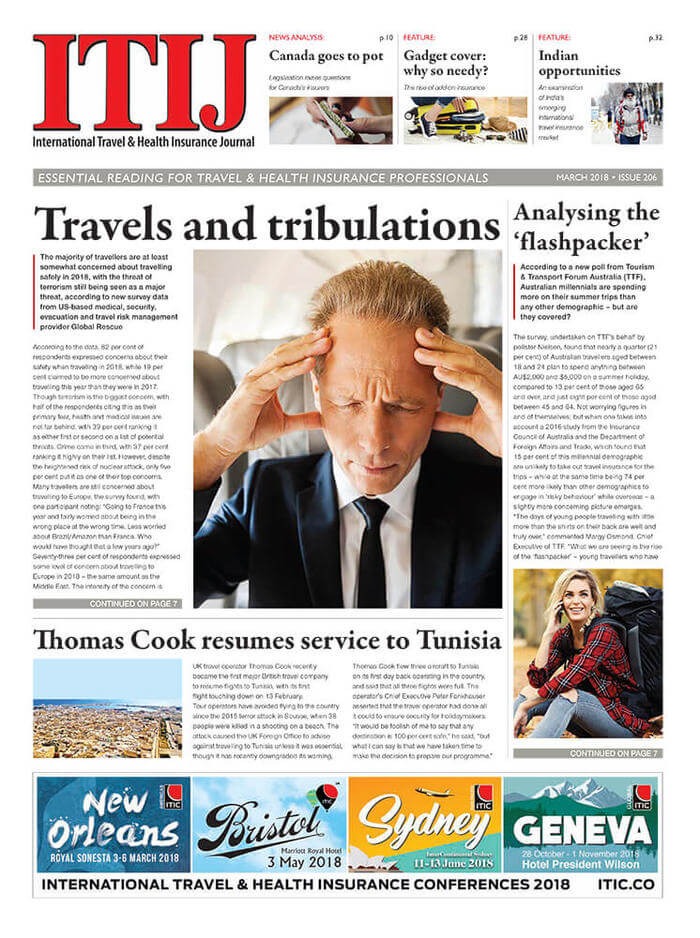
March 2018
Issue
Contents include:
Get smart
How the right app could save your life
The perfect storm
Adapt to survive?
2001: A Space Travel Insurance Odyssey
In space, no-one can hear you claim
Ah, Paris
French capital named top city for the fourth time
Instant payment for flight delays
New service from FlightDelayRepay
Aetna speaks out on antibiotic resistance
How can we defend against the bacterial apocalypse?
Editorial Team
The Editorial Team updates the ITIJ website daily, and works on features for the print edition. With expert industry knowledge and years of experience in writing about complex travel insurance issues, the Editorial Team is ready to investigate and report on the topics that matter most to ITIJ's readers.