
Hotspot Cover's George Dagnall on: Risk reality

In our regular column on security and travel risk, George Dagnall, COO of Hotspot Cover, shares his insights with ITIJ. This month he says that when politics stays hot, so does risk
Across the UK, the US, and parts of Europe, we’re seeing the same pattern: governments tighten controls in response to protests, geopolitical spillover or online tension, and then they don’t fully loosen them again. Powers that used to be ‘just for now’ are staying in play. It’s not dramatic enough to call it authoritarian, but it is a clear shift from temporary to sustained. For security, assistance, and insurance, that’s a risk signal.
The UK is a good example, but the logic travels. Recent public order laws and policing practice make it easier to limit, condition or charge for protest, and to act earlier if something is judged likely to become disruptive.
Recent public order laws and policing practice make it easier to limit, condition or charge for protest
In the past, that sort of posture followed a big trigger and then faded. Now it looks more like the new normal. You can see similar instincts in the US around campus protests and ‘misinformation’ in several European capitals after large pro-Palestine or far-right demonstrations. The justification is usually the same: security, cohesion, foreign influence.
Disruption to the industry
Why does this matter to our sector? Because a higher, longer posture creates more friction for ordinary activity. A media crew, NGO staff or business traveller working near a politically sensitive event now has a greater chance of encountering police-managed disruption, even if nothing violent has happened. For assistance providers, that could mean more of the awkward, grey-zone callouts, short detentions, access blocked, “Come back later” in places we used to treat as low-risk. For insurers, it raises the likelihood of civil commotion or denial-of-access clauses being tested in the West.
There is also a narrative layer. Authorities are becoming more willing to say an activity is risky not because it is violent, but because it could inflame tensions or spread misinformation. That’s a broad threshold.
At the same time, trust in institutions that used to stabilise the information space, even broadcasters like the BBC in the UK, is being challenged from multiple sides. Whether those criticisms are fair matters less than the effect: if the information space is seen as contested, information itself becomes a flashpoint.
As Orwell warned, once truth is contested, those who speak it attract pressure. In practice, that means the speaker – a journalist, activist or corporate representative – can become the operational risk, and that’s something policy wording doesn’t always anticipate.
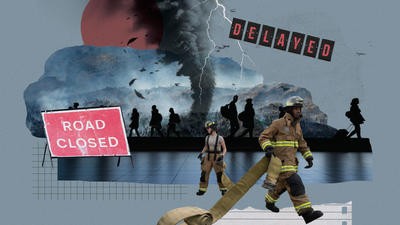
A media crew, NGO staff or business traveller working near a politically sensitive event now has a greater chance of encountering police-managed disruption, even if nothing violent has happened
Polarised staff
One more effect is internal. The same political heat outside is likely to show up inside organisations. Staff are more polarised on geopolitical issues, and that can bleed into travel and client decisions: should we go, should we work with them, should we be seen there? That internal pressure can slow duty-of-care calls or make incident response messier. It’s still a risk issue, just an inside one that should be considered.
Staff are more polarised on geopolitical issues, and that can bleed into travel and client decisions
The takeaway isn’t that the UK/US is unsafe now. It’s simpler: stop assuming authorities will drop back to a lighter touch after every flare-up. Build domestic political risk into pre-travel briefs, be clearer in wording about politically triggered disruption, and expect more low-level authority contact even in mature markets.
If London and Washington keep emergency settings close to ‘on’, other European capitals are likely to follow and we should plan on that basis.
George Dagnall, COO, Hotspot Cover
George is a risk management expert specialising in conflict zones. With a background in security strategy, a decade of military service, and senior consultancy experience, he ensures comprehensive protection in high-risk environments.
December 2025
Issue
In this issue of ITIJ we examine breaches of cyber security in the healthcare sector and ask what can be done to prevent them, share travel predictions, including risks and hotspots, for 2026, and look at the global implications of changes in international student travel.
George Dagnall
George is a risk management expert specialising in conflict zones. With a background in security strategy, a decade of military service, and senior consultancy experience, he ensures comprehensive protection in high-risk environments.