From hospital rejection to safe repatriation

Dr Olga Leyva from Redbridge tells us how they coordinated an advanced ALS case across three countries
In international medical assistance, success is often determined not only by clinical expertise but by the ability to navigate complex healthcare systems, mobilise global resources, and coordinate multiple stakeholders under significant time pressure. A recent case managed by Redbridge demonstrated how integrated medical oversight and cross-border coordination can overcome formidable obstacles and deliver a safe outcome for both patient and family.
The mission
The case involved a 51-year-old man with advanced amyotrophic lateral sclerosis (ALS) who experienced a rapid clinical deterioration while in Honduras. Upon admission to a local hospital, he presented with respiratory failure, severe bulbar dysfunction, aspiration pneumonia, and worsening neurological impairment. His condition required immediate intubation and mechanical ventilation. Although an acute stroke was initially suspected, advanced diagnostic imaging ultimately confirmed progression of end-stage ALS as the primary cause of his decline.
As the patient's condition stabilised, Redbridge's medical team conducted a comprehensive review of his care requirements and the capabilities available locally. While the treating facility was able to provide acute critical care, it lacked the specialised resources necessary for long-term neuromuscular respiratory management and advanced airway procedures. Based on this assessment, Redbridge determined that transfer to a higher-acuity centre was medically necessary.
The key difficulties
The next challenge involved securing acceptance at an appropriate facility. Although an air ambulance solution was arranged promptly, referral efforts to two major US tertiary-care institutions were unsuccessful. Rather than allowing these setbacks to delay treatment, Redbridge activated its regional provider network and expanded the search beyond traditional referral pathways.
Through persistent coordination, extensive communication with healthcare partners, and continuous advocacy on behalf of the patient, Redbridge successfully secured admission to a specialised medical center in Mexico City capable of providing advanced respiratory and neurological care.
Following transfer, the patient underwent tracheostomy placement and received comprehensive multidisciplinary treatment, including nutritional optimisation, pulmonary rehabilitation, infection management, respiratory support, and ongoing neurological monitoring.
These interventions stabilised his condition and improved his overall clinical status.
However, a new challenge soon emerged. Despite repeated attempts, the patient could not be successfully weaned from mechanical ventilation. At this stage, Redbridge's objective shifted from acute intervention toward creating a safe, sustainable long-term care plan centered on the patient's quality of life and family support system.
The repatriation
Repatriating a ventilator-dependent patient across international borders required meticulous planning and flawless execution. Redbridge coordinated every aspect of the operation, including air ambulance logistics, portable ventilation equipment, medical escorts, transitional hospital arrangements, caregiver education, home-care services, and continuity-of-care planning. Each component was carefully synchronised to ensure the patient's medical stability throughout transport and after arrival.
The patient was ultimately repatriated safely to his home country in Honduras and successfully transitioned to long-term care in a familiar environment surrounded by family support.
For Redbridge, this case reinforced a principle that defines modern assistance medicine: successful outcomes depend not only on clinical expertise but also on the ability to connect healthcare systems, coordinate international resources, and develop practical solutions when conventional pathways fail.
By combining medical oversight, provider-network expertise, operational coordination, and patient advocacy, Redbridge transformed a series of complex challenges into a safe and dignified outcome for the patient and family.
Dr Olga Leyva,Vice President of TPA Operations at Redbridge, is a physician and healthcare executive with expertise in Internal Medicine, behavioural health, and healthcare administration. She holds degrees in Medicine and Nursing, advanced training in Psychiatric and Mental Health, and certifications in Case Management, Leadership, Cost Containment, and HIPAA.
October 2026
Issue
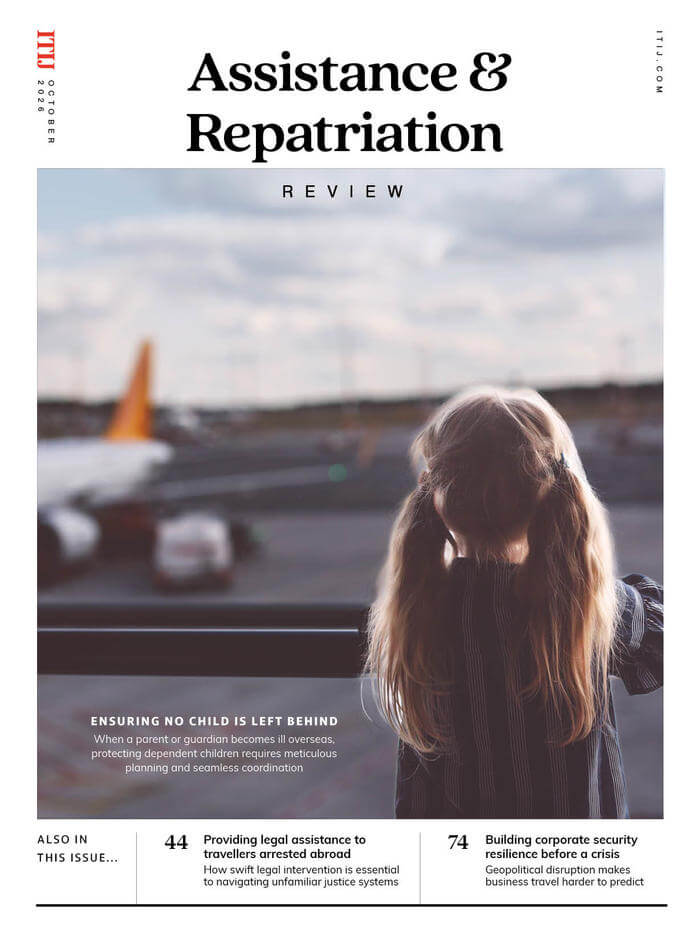
When a parent or guardian becomes seriously ill overseas, assistance providers face a complex challenge that extends well beyond clinical care. Although these cases are relatively rare, in this issue we look at how safeguarding dependent children requires careful planning, legal awareness, and close international coordination.
Editorial Team
The Editorial Team updates the ITIJ website daily, and works on features for the print edition. With expert industry knowledge and years of experience in writing about complex travel insurance issues, the Editorial Team is ready to investigate and report on the topics that matter most to ITIJ's readers.