Fuelling mission growth across the Asia Pacific

Tyson Smith from LifeFlight talks about how his business navigates the challenge of fuel costs
During the past decade, the fuel conversation in aeromedicine was about price. However, that has changed and across the Asia Pacific it has become a question of availability.
Securing fuel through remote ports now shapes routing, mission planning and acceptance, and the picture can change inside a four-to-five-day window.
On international retrievals across our region, roughly one tasking in five demands this kind of long-range planning. Over large land masses, options are plentiful, but they are far less abundant on long flights between the US and Asia, Asia and Australia, and out into the Pacific.
Nauru and Pohnpei are key examples of this contrast. Fuel at Nauru carries a premium and arrives by sea, so supply can be limited.
Pohnpei, a key tech stop in the Federated States of Micronesia, has restricted uplift at times while waiting on delayed Jet A-1 shipments, with part of its supply depending on commercial aviation services.
Challenger platform
Aircraft choice plays a key role in risk mitigation. We operate the Challenger 604 because its long range enables more options regarding refuelling.
While lighter aircraft can require marginal stops, the 604 can overfly them, hold alternates in different countries, and take fuel where there is a sensibly priced and available supply. That flexibility is a cost control as much as a safety margin.
For its size, the aircraft’s runway performance also opens up regional Australian airports and island strips where travellers are increasingly ending up.
Communication is key
Early communication also plays a pivotal role with LifeFlight’s operations team adept at running through options for clients while the airlift is in the planning phase.
Ground handlers and fuel agents get the first call when the enquiry lands, confirmations are rechecked as departure approaches, and network partners identify supply gaps in advance.
No stone is left unturned, because the people boarding the aircraft are our crew, a patient and often a family trusting that every option has been checked to ensure a smooth flight.
Planning for growth
Fuel availability and long-range planning is becoming more important as international tourism grows. Japan closed 2025 at a record 42.7 million visitors, and for the first time in recorded history more than a million of them were Australian.
Japan National Tourism Organization’s US office counted more than a million American arrivals by the end of April 2025 alone.
Indonesia cleared its national target with 15.4 million arrivals, with more travellers going farther, staying longer, and choosing places well beyond the traditional trunk routes.
Each of these numbers represents a traveller a long way from home tertiary care if something goes wrong.
We see the effect across government programme clients, travel and leisure cover, corporate and private policies, and self-funded patients. From that vantage point, commercial repatriation capacity is not keeping pace. Stretcher options on scheduled services in Asia are limited, and the fastest-growing routes are flown by fleets that never carried them.
Over the next one to five years, we expect the region to rely to a greater degree on dedicated air ambulance networks for patients in places without scheduled airline traffic.
The operators ready for that will be the ones doing the fuel and local connection work now.
Tyson Smith, Head of Business Development and Growth, Fixed Wing, at LifeFlight, leads one of the region’s most complex international jet retrieval operations. Overseeing more than 1,000 patient transports annually, he brings 14-plus years of aeromedical experience, driving global capability, operational excellence, and mission-critical outcomes under pressure.
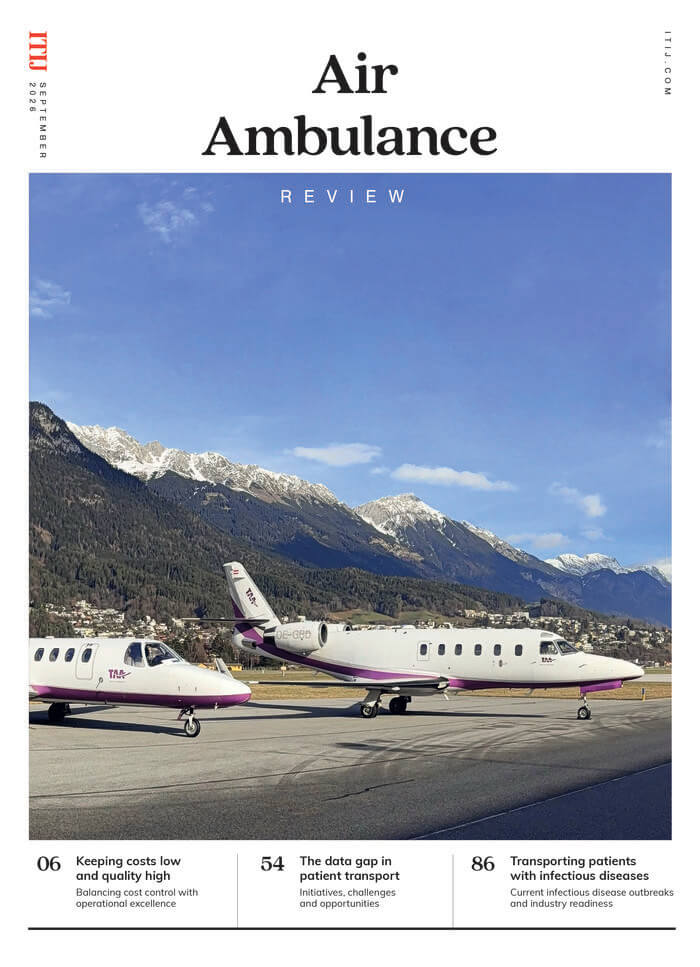
September 2026
Issue
This issue we focus on the problems that rising costs are having on the industry. Air ambulance providers are facing costs across fuel, aircraft maintenance, staffing, insurance, regulatory compliance, and specialist medical equipment. As if that wasn’t enough, delayed payments from insurers are adding further financial pressure. Despite these challenges, providers agree that patient safety and clinical quality must not be compromised.
Editorial Team
The Editorial Team updates the ITIJ website daily, and works on features for the print edition. With expert industry knowledge and years of experience in writing about complex travel insurance issues, the Editorial Team is ready to investigate and report on the topics that matter most to ITIJ's readers.