Flight for a life

Bluedot Air Ambulance tells us about the importance of operational precision and clinical vigilance during a high-risk burn repatriation from Malé to Bangkok
Aeromedical evacuation of critically burned patients represents one of the most complex challenges in transport medicine. Severe burns trigger profound physiological derangements, including haemodynamic instability, respiratory compromise, metabolic dysregulation, and high susceptibility to infection.
When compounded by geographical isolation and limited critical care infrastructure, timely and meticulously planned transfer becomes vital. This case study describes the emergency aeromedical transfer of a critically ill burn patient from Malé, Maldives, to Bangkok, Thailand, highlighting the role of proactive stabilisation, operational foresight, and multidisciplinary coordination in achieving a safe outcome.
The case
The patient sustained catastrophic thermal injuries involving approximately 60% of total body surface area, with nearly 90% of these being full-thickness burns. The clinical course was complicated by severe acute respiratory failure requiring invasive mechanical ventilation, refractory shock necessitating dual inotropic support, acute kidney injury requiring renal replacement therapy, and profound thrombocytopenia significantly increasing haemorrhagic risk. The overall physiological reserve was extremely limited, rendering the patient highly vulnerable to transportrelated stressors.
Given the complexity and instability, the mission was categorised as provisionally Fit to Fly with Hight Risk.
A proactive strategy was adopted whereby the aeromedical team was deployed ahead of the aircraft to the referring intensive care unit in Malé. This early clinical integration enabled advanced stabilisation, multidisciplinary coordination, and comprehensive contingency planning well in advance of patient transfer.
Pre-transfer stabilisation and critical care management
Upon arrival in Malé, the aeromedical team conducted a detailed bedside assessment and initiated joint management with the local critical care team. While preparations were underway, dialysis was commenced to address worsening renal failure. During treatment, the patient developed severe hypotension and bradycardia, requiring escalation to a third inotropic agent. Dialysis was immediately terminated, and aggressive haemodynamic stabilisation ensued.
Over several hours, meticulous optimisation was performed, including ventilator fine-tuning, targeted vasopressor titration, active temperature management, blood product preparation, and invasive line stabilisation. Continuous reassessment guided incremental adjustments aimed at achieving a narrow margin of transport stability. Given the escalating risk profile, detailed discussions were held with the family, and informed high-risk consent was obtained. By nightfall, the patient remained critically fragile but clinically stable enough to permit transfer.
Transfer and in-flight management
The aircraft arrived in Malé under challenging operational conditions, including a short runway requiring a steep climb gradient following departure. Final preparations involved exhaustive equipment checks, securing invasive lines, loading blood products, and confirming ventilatory parameters appropriate for altitude physiology.
Throughout the night flight, continuous high-acuity monitoring was maintained. Close surveillance of respiratory mechanics, haemodynamics, temperature, and metabolic parameters enabled rapid intervention when minor fluctuations occurred. Despite the complexity, physiological stability was preserved across all major systems, reflecting the effectiveness of pre-transfer optimisation and vigilant in-flight management.
Handover and outcome
The aircraft landed in Bangkok shortly before dawn. A pre-coordinated, policeescorted medical convoy facilitated rapid ground transfer to a tertiary burn and critical care centre. Handover was conducted using structured clinical communication, including detailed ventilator reports, infusion summaries, transfusion documentation, and procedural notes. The receiving team confirmed satisfactory physiological parameters and uninterrupted continuity of care.
Conclusion
This case highlights the critical importance of early clinical integration, proactive stabilisation, and meticulous operational planning in high-risk aeromedical transfers.
Dr Mohammed Afsal, Medical Director at Bluedot Air Ambulance, is an Emergency Flight Physician. With a Masters in Emergency Medicine and a Fellowship in Aeromedical Sciences, he has orchestrated 350+ interstate and global patient transfers spanning 25 countries, showcasing his expertise and commitment to critical care.
March 2026
Issue
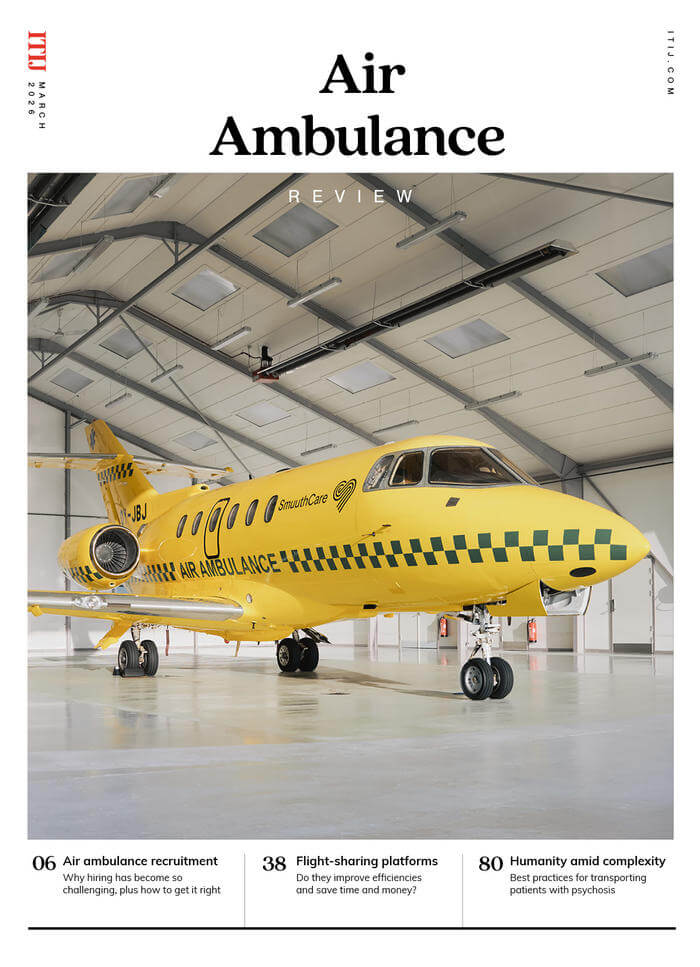
In this issue of Air Ambulance Review we examine the challenges facing air ambulance providers when it comes to recruitment; look at flight-sharing platforms and ask if they can improve efficiencies; and we delve into the latest medications, protocols and best practices for transferring vulnerable patients with psychosis.
Editorial Team
The Editorial Team updates the ITIJ website daily, and works on features for the print edition. With expert industry knowledge and years of experience in writing about complex travel insurance issues, the Editorial Team is ready to investigate and report on the topics that matter most to ITIJ's readers.