

Fit to fly: setting the standard for safe travel

As the number of older travellers continues to rise, evidence-based fitness-to-fly assessments are becoming essential to ensuring safe, consistent and defensible medical travel decisions, explains the International Assistance Group
By 2046, more than 1.5 billion people aged over 60 are expected to travel by air each year. As the global population ages, assistance providers are seeing a change in the complexity of travellers requiring support.
This raises an important question: how do we ensure safe, consistent and defensible decisions about fitness to fly for older travellers?
Travel can place significant stress on the brain, even for healthy older adults
The International Assistance Group (IAG) recently hosted a webinar led by Dr Terry Nash, Medical Director of Retrieval Medics International (an accredited service provider of IAG) and an emergency physician at Princess Alexandra Hospital in Queensland, Australia. His session on assessing fitness to fly in geriatric travellers and those living with dementia was a timely reminder of the clinical, operational and ethical considerations that underpin every repatriation decision.
A global trend
Dr Nash highlighted the proportion of the global population aged 80+ will rise from 1.3% to nearly 4% by 2046, while the 60+ cohort will more than double to 21%. That translates into 1.5 billion air passengers aged 60+ every year, a significant figure that brings with it a corresponding rise in multimorbidity, frailty and cognitive vulnerability.
Travel can place significant stress on the brain, even for healthy older adults. Long flights involve lower oxygen levels, fatigue, disrupted sleep, multiple time-zone changes and long periods navigating airports, all of which can overwhelm an older person’s ability to cope. For travellers with reduced physical or cognitive reserve, these factors can trigger sudden confusion or disorientation, known as delirium.
Dr Nash emphasised during the session that “frailty, not age, is the defining predictor of in-flight risk, and delirium is the single greatest threat to older travellers”. This reality demands a structured, evidence‑based approach to assessing fitness to fly, one that goes beyond chronological age and considers the interplay of comorbidities, cognition, resilience and functional capacity.
Clinical complexity
Dr Nash’s presentation raised several clinical considerations for medical assistance professionals:
• Frailty is multidimensional, encompassing multimorbidity, polypharmacy, fall risk, cognitive impairment and reduced resilience
• Delirium risk is central, and baseline cognitive capacity should shape repatriation planning
• Cabin altitude can trigger hypoxia, even in travellers with normal resting oxygen saturations
• Chronic conditions, including COPD, coronary artery disease, heart failure, renal disease and diabetes, require careful pre‑flight optimisation
• Medication timing errors, particularly for diabetes and Parkinson’s disease, are a major risk during long‑haul travel
• Hospital‑acquired deconditioning is strongly evidence‑based and significantly affects travel tolerance
• Transitions, not the aircraft itself, are often the highest‑risk moments for older travellers.
These insights align closely with the principles embedded in the IAG Fit‑to‑Fly Guidelines, which apply flight physiology to real‑world clinical scenarios and help clinicians determine safe departure timing, oxygen requirements, seating needs and escort level.
IAG Fit‑to‑Fly Guidelines
The webinar also reinforced why IAG’s Fit‑to‑Fly Guidelines, released in late 2025, are becoming an essential tool for assistance professionals worldwide.
They include the industry’s first dedicated guideline for geriatric travellers, reflecting the need for consistent, evidence‑based assessment.
IAG’s Fit‑to‑Fly Guidelines, released in late 2025, are becoming an essential tool for assistance professionals worldwide
Developed by medical directors and specialists across the IAG network and led by Dr Sharon Kay, IAG Medical Coordinator and Chief Medical Officer of MSO (Medical Services Organisation) International, the guidelines bring consistency and evidence to an area where practice has often varied.
“IAG’s goal with the Fit‑to‑Fly Guidelines is to give medical professionals a clear, evidence‑based framework for making safe, consistent decisions in a challenging environment,” she said.
“Air travel places unique physiological demands on the body, and we want clinicians to feel confident navigating those complexities.”
The IAG guidelines cover every major organ system, from cardiology and pulmonology to neurology, psychiatry, trauma, obstetrics, neonatology and infectious diseases. They provide condition‑ specific recommendations, delay intervals and escort requirements. They also outline the capabilities of commercial medical escorts, the impact of hypobaric hypoxia, and the importance of individualised assessment.
A well‑supported traveller who can fly home one or two days earlier represents a meaningful saving for funders
Dr Kay said they were created by partners, for partners, reflecting decades of collective experience across the IAG network.
“These guidelines were built by medical directors and specialists across the IAG network who volunteered their time and expertise,” she said. “They reflect not just published evidence, but the realities of aeromedical care. That collaboration is what makes them practical; they’re written for the real world.”
The value of getting it right
The conversation around fitness to fly is operational as well as financial. As one partner observed during the webinar, cost containment goes beyond discounts or negotiated rates. It is also about avoiding unnecessary hospital days and using commercial flights safely whenever possible.
Shared standards help ensure that decisions are consistent
A well‑supported traveller who can fly home one or two days earlier represents a meaningful saving for funders. And when commercial travel is appropriate, it is typically lower risk and lower cost than air ambulance transport. The guidelines help clinicians make defensible decisions about when commercial is safe and when air ambulance is the only viable option.
There are also regions where commercial stretcher options simply do not exist and creative solutions are rare. Shared standards help ensure that decisions are consistent, transparent and aligned with best practice, regardless of geography.
Global medical collaboration in real time
One of IAG’s greatest strengths is the depth of expertise within its global medical community. Across the network, medical directors collaborate daily to discuss cases, debate thresholds and refine decision‑making. This culture of shared learning is the backbone of the International Assistance Group.
As Dr Nash’s webinar demonstrated, the challenges facing older travellers are evolving, the evidence base is growing and our frameworks must evolve with them.
“The issues Dr Nash highlighted, such as frailty, delirium risk, hypoxia, medication timing and deconditioning, are exactly the challenges we designed the Fit‑to‑Fly Guidelines to address,” Dr Kay said. “The evidence is evolving and our frameworks must evolve with it.”
Fitness to fly is not fitness to cope
A participant closed the webinar with a line that has stayed with many of us: “Fitness to fly is not fitness to cope.”
For older travellers, particularly those living with frailty or cognitive impairment, being medically cleared to board an aircraft does not guarantee they can manage the demands of the journey itself. Navigating airports, coping with fatigue, managing medications and responding to unexpected changes all require cognitive and emotional reserve. When that reserve is limited, even a clinically “fit” traveller may struggle.
The IAG Fit-to-Fly Guidelines were developed with this reality in mind. They provide clear, practical support for clinicians and coordinators, reinforcing the importance of consistent, evidence-based decisionmaking for every traveller.
July 2026
Issue
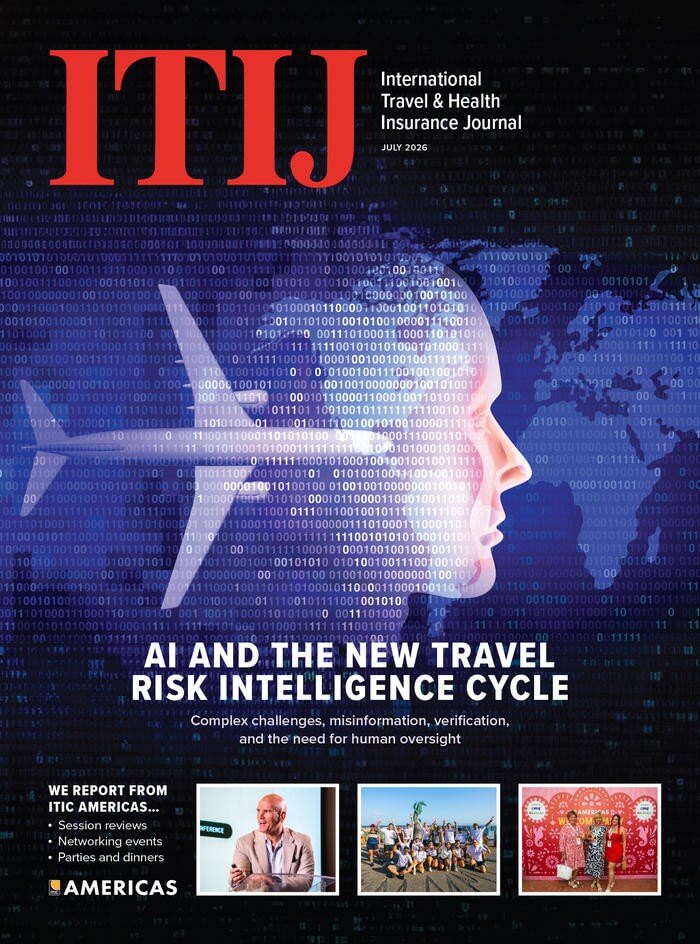
Welcome to your July issue! This month we look at how artificial intelligence solutions are changing the way in which travel risk information is gathered and communicated, plus we ask whether providers should do more to educate their customers, ensuring they understand the products they are buying and using them appropriately.
Editorial Team
The Editorial Team updates the ITIJ website daily, and works on features for the print edition. With expert industry knowledge and years of experience in writing about complex travel insurance issues, the Editorial Team is ready to investigate and report on the topics that matter most to ITIJ's readers.