
Exploring the possibilities of bancassurance

Oliver Cuenca investigates the potentially lucrative world of bancassurance, and finds out what makes such partnerships viable
Bancassurance is an increasingly popular way for insurance providers to offer their products to customers – but navigating the ins and outs of such a partnership can still be tricky, as it can be with any serious business relationship.
The benefits of bancassurance
“Forming a bancassurance relationship offers several key benefits for both banks and insurance companies, as well as their customers,” said Sian McIntyre, Head of Savings and Insurance at Barclays UK. “It can create a win-win situation by leveraging the strengths of both banks and insurance companies to provide comprehensive financial solutions.”
For the insurer, McIntyre said, core benefits include an expanded customer base – with the insurance firm now able to access the bank’s existing customer base without having to invest in the expansion of its own sales force – and by extension, increased sales.
For banks, McIntyre added, the overall picture is often just as beneficial. She explained that selling additional products such as insurance alongside their traditional banking services allows the banks to increase their income with comparatively little effort.
Expanding their product range also allows banks to increase customer satisfaction and loyalty, while also reducing their reliance on traditional banking income.
McIntyre noted that as well as offering potential opportunities for both businesses, bancassurance partnerships can also improve the offering to customers. It can allow banks to become a one-stop shop for financial services and advice, “simplifying their financial planning [while also] helping customers to make more informed decisions”.
David F Rueda, Head of Business Development, Bank Distribution at Zurich Insurance Group, agreed with McIntyre that bancassurance can be a “natural complement to a bank’s core activities”. He added that, from the bank’s perspective, a key draw is that “insurance propositions – aside from some savings and investment products – don’t compete with the bank offering”. Rather, they complement it.
Additionally, because they tend to align with the customers’ use of other services, “distribution can be driven based on fulfilling customer needs, rather than purely through targeted campaigns,” he said.
Rueda added that, from an insurer’s perspective, bank channels allow for efficient growth, “transforming existing local operations, or entering new markets”.
He explained that bancassurance is a “key channel” for a number of different product types, including “untapped potential in property and casualty (P&C) – e.g. home, motor, travel, pet, health, cyber, etc”.
Additionally, while the main focus of such partnerships is typically the retail market, insurers can also serve commercial customers – particularly micro, small, and medium-sized enterprises – through bancassurance.
Finding the right partner
However, while bancassurance has many benefits in theory, all of this is reliant on the right insurer finding the right bank.
When exploring potential banks to partner with, Rueda said that there are a number of aspects to consider in order to create a “valuable franchise”.
He explained that the ideal bancassurance partner will be one in a “privileged banking position – ideally a leading retail bank” that has strong local or regional ties, strong capital ratios, and a proven sense of financial discipline.
They should be customer-focused, serving a customer base that includes “retail, commercial, and corporate clients”, preferably with a “multichannel approach”.
From an insurer’s perspective, bank channels allow for efficient growth, transforming existing local operations, or entering new markets
This includes the use of digital solutions leveraging data, as well as a digital and mobile-first approach, Rueda said, adding that Zurich believes this approach “may become more relevant than the number of branches in the mid-term”.
He concluded that the ideal banking partner would “allow the insurer to reach high or full integration into client journeys and adviser tools”, as well as collaborate on “product development, service delivery, and channel management”.
A spokesperson from management consultancy Boston Consulting Group (BCG) added that, in order to succeed, a bancassurance partnership must “make the insurance business a strategic priority, [and] leverage the assets of both partners to develop a value proposition for each target customer group”.
Such partnerships can be extremely profitable. BCG reported that, according to its figures from between 2017 and 2022, insurers that made bancassurance their “primary distribution model” were roughly 40% more profitable than insurers that did not.
BCG, citing its report Unlocking the Benefits of Bancassurance, argued that to be successful in bancassurance, potential partners must focus on three key elements. These are: integration of the two businesses and building a collaborative relationship; leveraging the bank’s data and analytics to attract and retain customers; and the development of a customer-centric digital experience.
An attractive offering for previously uninsured customers
McIntyre argued that the higher level of convenience and accessibility offered by bancassurance makes it easier for customers who might have traditionally travelled abroad without coverage to purchase travel insurance as part of their travel planning.
“Banks can [also] educate their customers about the importance of travel insurance, raising awareness about the benefits of being insured while travelling,” she noted. “They can use customer data to offer various travel insurance products that meet specific needs, making insurance more appealing to those who might not have considered it before.”
Additionally: “Banks often have many routes where customers can get more information or discuss their products to make an informed decision,” she added, noting that customers often have “high levels of trust in their banks, and this trust can extend to the insurance products offered through bancassurance”.
Rueda noted that in general, but “especially in developing countries”, bancassurance has the potential to significantly improve the uptake of insurance by traditionally uninsured consumers.
“Banks can support access to insurance for individuals and businesses in many ways,” he noted. “Banking, even in developing countries, has reached higher levels of accessibility and convenience than the traditional insurance sector. This is true both in terms of the traditional brick and mortar model (the number of branches), and in terms of digital capabilities (online banking, banking apps, peer-to-peer platforms).”
Rueda echoed McIntyre in saying that banks garner a high level of trust from customers, and tend to be better recognised names than insurers.
Beyond this, he added: “There is a natural fit between financial needs and insurance solutions, with insurance helping customers reduce or mitigate some of the risks associated with their financial decisions.”
Likewise, the insurer will typically benefit from banks’ “deep knowledge of their customer base”, with such information and touch points being “used to better design, promote, and distribute insurance solutions to customers [and] achieve better customer service levels”.
Making sure that customers understand their policies
While the greater convenience of bancassurance is a significant draw for customers, it could be argued that there is a risk that those purchasing coverage may not take the time to understand their policy in the same way they would through a traditional channel.
McIntyre disagreed, arguing that from her perspective, there was no clear difference between the two options.
Instead, she argued that the same measures could be used to ensure customer understanding of benefits and limitations across both channels. Namely: clear communication, simplified policy documents, digital tools, and taking on board customer feedback.
“Banks and insurance companies [should] work together to provide clear, detailed and consistent information about the travel insurance policy, including its benefits, limitations, and exclusions,” she said. “This is carried out across a broad range of channels, such as brochures, websites, FAQs, customer service representatives, online support portals and bots, as well as in our insurance documentation – the quote, renewal letters, etc.”
Such communications should “use plain language and avoid jargon,” she noted.
Alongside this, the effective use of online tools and mobile apps can offer customers an easy way to access their policy details, information, and customer support, allowing them to better understand their coverage.
Additionally, customer feedback from new and existing customers is essential, McIntyre concluded, because it “helps us review and consider what changes we need to implement to make it easier for customers to understand the cover they do and do not have”.
Rueda agreed, adding that “in general, and not only for travel insurance, there is always a risk that the insurance company won’t meet the customer’s expectations when an event occurs”.
This, he said, may be due to overly complex product design, “with too many exclusions, limits, sublimits, or deductibles”, which may make the price attractive to the customer, but which provide poor value for money. It may also be due to an “inadequate sales process” that does not highlight the key features and limitations of the product successfully.
To mitigate such issues, Rueda concluded, insurers and banks should focus on offering “simpler products with a clear value proposition” or ones that are “configured as building blocks, where the customer can see how much the price varies depending on different levels of cover provided”.
Breaking into new markets
Rueda added that, globally speaking, the markets that are most receptive to successful bancassurance agreements tend to feature “favourable or non-restrictive regulation; an adequate level of ‘bancarisation’ (a measurement of access to banking services); [and] a positive customer perception of the banking system”.
However, there are exceptions. While in countries such as France, Spain, Hong Kong, India and Brazil, “bancassurance has the status of a dominant channel”, other markets, such as the US or Switzerland, remain resistant to bancassurance, despite the “highly developed” nature of both their insurance and banking sectors.
The spokesperson for BCG agreed, but added that while some banks “think that bancassurance does not have real potential in their market because the insurance distribution channel is dominated by agents or brokers”, an effective partnership can cause change in the market.
Insurers that made bancassurance their primary distribution model were roughly 40% more profitable than insurers that did not
BCG highlighted the Spanish insurance market, which was dominated by agents and brokers two decades ago, with banks only representing 9% of new business in non-life insurance products. Since then, driven by the formation of bancassurance partnerships, they now provide more than a quarter of all non-life insurance.

Conclusion
While bancassurance is undoubtedly an excellent way to expand the business of both the insurer and the bank, while also offering substantial benefits to customers, ultimately it requires careful consideration, not only of suitable partners, but also of how the two firms will approach the market.
Additionally, a bancassurance agreement ultimately succeeds or fails based on its ability to deliver for customers – offering the right products in the right way, and sharing data between the two businesses to refine the service.
July 2025
Issue
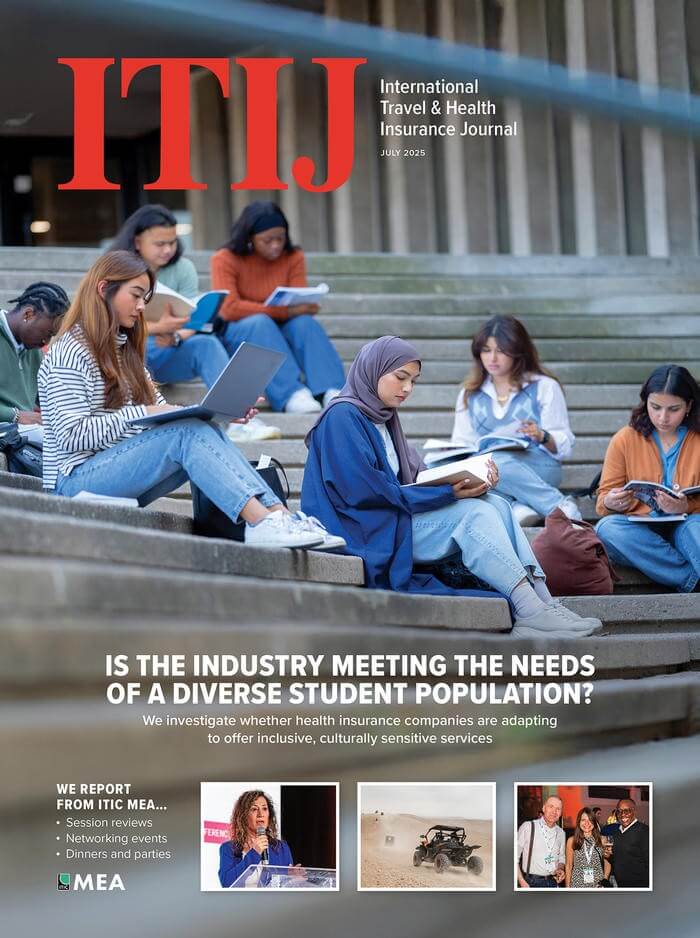
In this issue we look at health insurance for international students, and ask if the industry is adapting to offer inclusive, culturally sensitive policies. We also examine the potentially lucrative world of bancassurance, plus we investigate wait times in the American hospital system.