
Europe is burning in the summer

Will Europe become too hot for tourists in July and August? Mandy Langfield investigates
It’s becoming increasingly hard for even the most staunch climate denier to look at the mounting evidence of extreme summer heat and claim that there is no shift in climate. The European Environment Agency (EEA) stated: “Heatwaves that are dangerous to human health are getting more frequent, longer and more intense, and will continue to do so under all climate scenarios. In southern Europe, especially, there may be more than 60 summer days during which conditions are dangerous to human health, meaning [a] higher number of additional deaths and hospital admissions, especially among the elderly and the sick, unless adaptation measures are taken.”
The UN’s World Meteorological Organization and the European Union’s climate agency, Copernicus, said in a joint report that Europe was the fastest-warming continent and its temperatures were rising at roughly twice the global average.
Last year (2024) was Europe’s warmest year on record, with Southern and Eastern Europe particularly affected, and widespread heat stress recorded across the continent. At the time of writing (August 2025), wildfires were impacting nations from Turkey to Portugal, with thousands of locals and tourists being told to evacuate areas as fires took hold from May to now.
What’s ahead?
Well, according to the EEA, nothing good.
- More heatwaves
- More frequent, extreme flooding
- More frequent, severe droughts
- More wildfires
- A rise in climate-sensitive diseases based on the fact that mosquitoes will travel further north.
In southern Europe, especially, there may be more than 60 summer days during which conditions are dangerous to human health
Tourism trends and shifting patterns
Travellers are feeling the heat – literally. Some are avoiding traditionally popular Mediterranean destinations during peak summer heat, shifting to northern or cooler locales. So-called ‘coolcations’ are resulting in destinations like Scandinavia, the UK, Ireland, and Central Europe gaining popularity as tourists seek relief from scorching summers. The term was first popularised in late 2023 by Condé Nast Traveler, which predicted coolcations would be a major travel trend for 2024. Media and travel companies were quick to pick up on the trend, and by early 2024, Virtuoso, a network of high-end travel advisers, reported that 82% of its clients were interested in taking a coolcation. Virtuoso’s statistics showed a significant 27% increase in bookings to Scandinavia, along with a 47% increase in bookings to Sweden and a 49% increase in bookings to Iceland.
Jenny Southan, CEO of travel trend forecasting agency Globetrender, described the summer of 2025 as “a turning point for European tourism, underscoring that no destination is truly immune to climate volatility”.
Decades of habits, though, are hard to break for many. The European Travel Commission’s (ETC) latest research found that July and August remain the most popular summer holiday months, each chosen by 25% of Europeans. “However,” continued the report, “September is emerging as a strong contender, with 22% of Europeans planning trips that month. This strong preference for early autumn travel suggests that a significant share of travellers are open to off-peak options, motivated by milder weather, fewer crowds, and better value for money.”
And, while the peak summer season’s fire risk may be off-putting for some tourists, for others, it’s just that there are too many people in the same place. According to the ETC report, Europeans are becoming more aware of the uneven distribution of travel flows across some destinations and throughout seasonal peaks. Concern about ‘too many tourists’ at preferred locations has risen by 3% since summer 2024, alongside a growing emphasis on choosing less crowded destinations – now a priority for 11% of travellers, up 4% from last year.

So-called ‘coolcations’ are resulting in destinations like Scandinavia, the UK, Ireland, and Central Europe gaining popularity
In line with these preferences, 55% of Europeans plan to spend their 2025 summer holidays in less popular or off-the-beaten-track destinations, compared with 48% in spring 2025. Meanwhile, interest in traditional tourist hotspots has declined proportionally, now chosen by 45% of respondents.
Some tour operators have moved hiking trips out of July and August due to heat concerns, and many destinations are encouraging travel during milder shoulder seasons like May to June or September
to October.
Christina Brazier, Head of Industry Affairs at AITO, The Specialist Travel Association, spoke to ITIJ about the issue of tourist habits changing: “This has long been on the agenda for AITO members, not only in response to climate concerns, but also to ease the pressures of overtourism on local communities.
“Even those AITO members who began their businesses by featuring traditional summer hotspots are diversifying, drawing on their expertise to design alternatives that appeal to travellers seeking, perhaps, both cooler climes and a deeper connection with their holiday destination. Many in the industry are also seeing a trend towards booking outside the traditional summer peak season, with September, October, and – to a lesser degree – November now becoming significant travel months alongside July and August.”
For many travellers, however, it’s not as simple as being able to choose to go on their annual two-week holiday slightly later in the year. School holiday timings remain a key binding issue for families. Brazier noted: “If the education system were to modernise, and to allow greater flexibility, it would much better reflect changing travel habits, would spread demand more evenly, and would create a fairer, more sustainable approach to family travel.”

Business not as usual
Meanwhile, 62% of business travellers worry about natural disasters when they travel, according to a recent global survey of 2,000 respondents by World Travel Protection.
The survey, in collaboration with intelligence provider Riskline, reveals a sharp rise in wildfires globally. The company’s Travel Assist app, which delivers real-time alerts to travellers on the road, recorded an 84% increase in wildfire alerts from 2023 to 2024. In the first half of 2025 alone, the number of wildfire alerts was already nearly four times higher than during the same period in 2024.
As wildfires approach, air quality can deteriorate rapidly, and roads may close with little or no warning. These situations can escalate rapidly, often leaving travellers with limited time to react. According to Frank Harrison, Security Director, Americas, at World Travel Protection, wildfire-related assistance cases can range from managing travel disruptions and securing medical support to executing full-scale evacuations in extreme cases.
Regions once considered low risk are now seeing frequent and intense wildfire activity
“What we’re seeing with wildfires is that seasonality is breaking down,” said Harrison. “These fires are no longer confined to historically high-risk zones. Regions once considered low risk are now seeing frequent and intense wildfire activity. As the season grows longer, more severe, and less predictable, the need for proactive safety measures has never been more urgent.”
He added: “2025 may be the most extreme wildfire year yet, demanding immediate focus on emergency preparedness, and regional risk monitoring.”
Harrison advised some key steps for businesses to mitigate wildfire risk for employees on the move:
- Monitor and prepare: equip employees with travel risk management apps that deliver real-time, location-specific alerts, provide safety tips, and offer two-way communication in emergencies. Ensure employees are trained to use them
- Identify and support medical vulnerabilities: employees with respiratory conditions such as asthma or COPD are at greater risk in areas affected by wildfire smoke and poor air quality. Before travel, identify any underlying medical conditions that may require additional support or contingency planning. Ensure affected individuals have access to necessary medications, understand how to monitor air quality, and know when to seek medical help. Where appropriate, adjust travel plans to minimise exposure
- Create an emergency travel plan: establish a clear emergency protocol covering evacuation routes, communication channels and health guidance related to smoke and air quality. Communicate these plans before departure
- Develop a crisis communications strategy: be ready to manage business continuity and reputational risks if an employee is caught in a wildfire – this is especially important for high-profile or executive travellers.
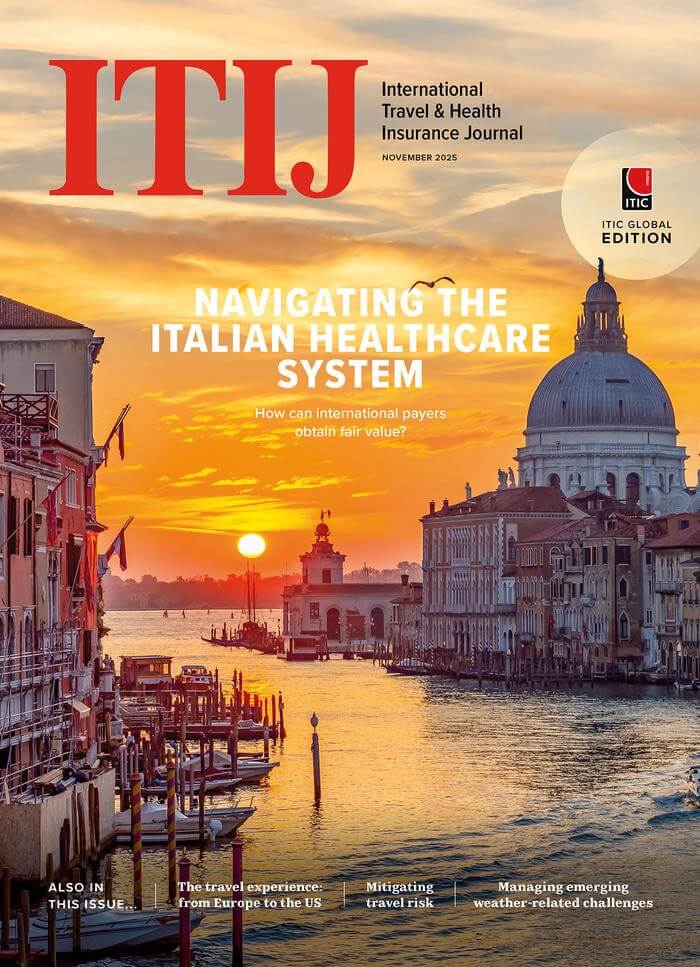
November 2025
Issue
In this issue of ITIJ we look at current travel patterns to and from the US and Europe, take a close look at the Italian healthcare system, and examine how insurers are adapting policies and coverage to manage weather-related challenges.
Mandy Langfield
Mandy Langfield is a Director of Palladium Media Partners and former Publishing Director at Voyageur Group. She has written extensively on international travel and health insurance, medical assistance provision, and air medical transportation.