
Engineering certainty in global repatriation

Liran Matityahu and Ariel Mauer of Medassis explain how assistance providers can build contingencies into their processes to avoid repatriation disruption
Every assistance company executive has lived through the 2am call: the ‘routine’ repatriation you approved yesterday just collapsed, your stretcher patient is burning through thousands in ICU costs daily, and the family is on the phone with your CEO.
After thousands of complex repatriations across six continents, we’ve learned something fundamental: smooth missions don’t happen because Plan A worked. They happen because Plans B through F were already built into the operation before wheels-up.
Pre-positioned networks, not contact lists
Most companies claim global partner networks. We’ve built what we call ‘safe haven architecture’: pre-vetted, pre-alerted facilities along every major corridor.
Before missions launch, we’ve already mapped partners, notified relevant facilities, confirmed capabilities for the specific patient profile, and established standby arrangements.
To the patient and family, it looked like a minor routing change – to the claims department, it was the difference between a contained file and an escalating crisis
The time between ‘We need to solve this problem’ and ‘The solution is already activated’ often represents tens of thousands of euros and the difference between a controlled delay and complete mission failure.

Airline relationships as infrastructure
We maintain direct relationships with airline medical departments and operational decision-makers. Not booking agents; the people who actually approve medical cases and control aircraft configurations. Our track record means cases get same-day clearance while other providers wait 48–72 hours.
More critically, the trust we’ve built over years allows airlines to approve operationally irregular solutions that they’d never accept from unfamiliar providers. When standard procedures break down, these relationships become the only path forward.
Clinical authority that opens doors
Our medical escorts are active-duty paramedics and nurses from Level I trauma centres and intensive care units (ICUs), plus senior specialist physicians including intensivists and cardiologists. When they consult with hesitant local physicians or airline medical departments, they speak peer-to-peer. This converts medical hesitations into confident clearances and prevents multi-day hospitalisation extensions.
Case study: when trust becomes currency
Recently, we managed a stretcher repatriation from Lima, Peru, to Tel Aviv, Israel. Original plan: single airline operating the entire journey through a major European hub, with ground transfer and medical clinic services provided by that carrier at the connection point.
Eighteen hours before departure, the airline cancelled the second leg from Europe to Tel Aviv. Not just that flight; the entire week’s daily service was suspended due to operational constraints.
The airline’s immediate response: they cancelled the first leg from Lima as well. Standard operational logic: why fly a stretcher patient to Europe when we can’t complete their journey? The risk of a stranded patient in a foreign airport, with mounting costs and regulatory complications, was simply unacceptable.
For most providers, this triggers a week-long delay while waiting for service to resume. The patient remains hospitalised at significant daily rates, medical escorts return home and need rescheduling, the mission requires complete restructuring, and clinical risks compound.

Here’s where relationship infrastructure changed everything
Within hours, we were in direct conversation with the airline’s operational leadership. The solution we proposed was operationally irregular: fly the patient on their stretcher configuration to the European hub, then hand off to a competitor airline for the second leg.
From the airline’s perspective, this was extraordinary. They would initiate a medical transport they couldn’t complete, transfer responsibility to another carrier, and assume liability for the first segment without control over what happened next.
They approved it.
More remarkably, they agreed to still provide ground transfer and medical clinic services at their hub airport, supporting a patient who would then board a competitor’s aircraft. This level of inter-airline cooperation is virtually impossible without years of demonstrated competence building operational trust.
Why did they say yes? Because they believed we had secured viable continuation with the second carrier, trusted our medical escort could manage the complex handoff, and knew their reputation wouldn’t be damaged by the transfer.
The patient remained hospitalised one additional day while we finalised the alternative routing. Mission launched on the revised timeline. Patient departed Lima, transferred through the European hub’s clinic with continuous monitoring provided by the original airline’s medical staff, connected seamlessly to the second carrier, and arrived in Tel Aviv clinically stable.
Total delay from original plan: 24 hours. Alternative without relationship infrastructure: week-long delay with cascading costs and compounding clinical risks.
To the patient and family, it looked like a minor routing change. To the claims department, it was the difference between a contained file and an escalating crisis.
The mission succeeded because an airline trusted us enough to support a patient transfer to their competitor, a level of confidence that only years of flawless execution can build.
Testing what others only document
Most providers write contingency plans. We actively test ours. We literally pull the plug on our Tel Aviv operations centre to verify how fast we reconnect to backups, confirm we haven’t lost data, and validate that our European ghost office can assume full operational control. We don’t just maintain a backup facility; we regularly send team members there to confirm all systems are live, all partner contacts are accessible, and operations can continue seamlessly if our primary hub faces disruption.
If you’re evaluating providers primarily on per-mission pricing, you’re measuring the wrong thing
When you operate from a region where geopolitical instability isn’t theoretical, this kind of operational redundancy isn’t optional. It’s the price of ensuring that active missions never lose support, regardless of what’s happening on the ground beneath your operations centre.

What this means when evaluating providers
If you’re evaluating providers primarily on per-mission pricing, you’re measuring the wrong thing. The critical question isn’t ‘What does Plan A cost?’. It's ‘When Plan A fails, what’s your provider’s actual contingency depth?’
Demand specifics:
- Network verification: not ‘We have global partners’, but specific safe haven facilities along your common routes with pre-notification protocols
- Airline relationship depth: can they reach operational decision-makers directly, or are they stuck with booking channels?
- Diversion statistics: actual rates over
the past five years with root cause analysis. If they can’t provide this data, that tells you everything about their operational discipline - Business continuity: what happens if their operations centre goes offline during one of your missions? Do they have a real answer, or just assurances?

Final word
The repatriation industry operates in inherent uncertainty. But uncertainty doesn’t mandate unpredictability.
When contingency planning is genuinely engineered into every mission’s foundation, when networks are pre-positioned, when airline relationships can unlock irregular solutions, when operations have tested geographic redundancy, you transform chaos into controlled outcomes.
At Medassis, we engineer certainty in an uncertain business. Because the only thing more expensive than robust contingency planning is discovering your provider only had a Plan A when you desperately needed their Plan F.
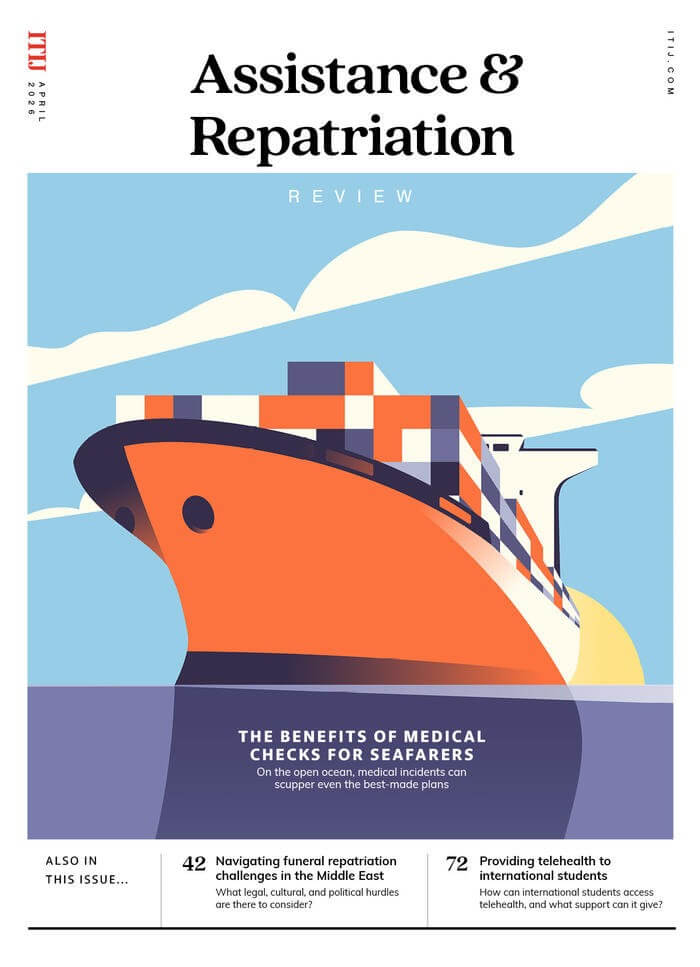
April 2026
Issue
In the first Assistance & Repatriation Review of 2026, we explore the cultural, legal, and logistical intricacies of funeral repatriation in, around, and out of the Middle East. We also consider how pre-deployment medical assessments can save lives and sea voyages. The burgeoning demand for telehealth among students is covered in our third feature, plus we look at how companies are delivering services that meet that need.
Ariel Mauer
Ariel Mauer is Clinical Manager at Medassis, managing the partner network and executing medical department policies.
Liran Matityahu
Liran Matityahu is Chief Operations Officer of Medassis, responsible for global repatriation operations and strategic growth.