
A drugged patient being held in Ghana against her will

Blake Yturralde, CEO of Commercial Medical Escorts, describes a transfer where the safety of both patient and escort were compromised by hostile staff at a medical facility in Ghana
In June 2024 we received a request for the transport of a patient in Ghana, West Africa, to her mother’s home in Ohio, US. The patient (38F) travelled to Ghana to do volunteer work at a farm in the Volta Region.
In late May, she presented to a local hospital with the claim that she had been drugged and nearly assaulted by members of her host family. Once she expressed her concerns to the host family, she claims the family members conspired with local law enforcement and even the Ghana Immigration Service to kidnap and detain her. She began behaving erratically and aggressively to those around her. This led to someone alerting the Ghana Immigration Service, who took her into custody and collaborated with the American Citizens Services (ACS) of the US Embassy to determine a plan of action.
Medical history
The local hospital treating her looked at her mental health history, which included a post traumatic stress disorder diagnosis (which the patient admitted to) and paranoid schizophrenia (which was revealed through a conversation with doctors and the patient’s mother). The hospital concurred with this diagnosis based on the behaviour they observed. However, it is notable that urine toxicology tested positive for tramadol. They treated the patient with antipsychotics while repatriation back to the US could be arranged.
Over the course of a month, they continued to work with her to understand what happened. While she did begin to have a different insight into what transpired, she remained steadfast in her belief that she was drugged, despite what the treating doctors described as “contrary evidence and logic.”
Mission challenges
There were several important aspects to consider when staffing this mission. The transport was urgent, so we needed to find someone who could enter Ghana without waiting for visa approval. We also needed a nurse with psychiatric care experience to ensure the patient’s safety. Importantly, we needed an escort who could gain the patient’s trust as she was anxious around new people. We ended up staffing this mission with one of our psychiatric registered nurse escorts and applied for an expedited Ghanian visa. Our client handled all arrangements for the transport, including airfare, ground transportation and hotel accommodation for our escort.
Once the escort arrived at the facility in Ghana to assess the patient, she immediately had concerns about the patient’s wellbeing. The facility’s condition was substandard, with poor ventilation and air conditioning. More worrying was the fact that the hospital staff would not let our escort visit or even see the patient. The attending physician had no knowledge of the planned repatriation and even expressed surprise that the patient would be leaving Ghana so soon. After this initial visit, the escort decided she would need to try again later to assess the patient.
The transport was urgent, so we needed to find someone who could enter Ghana without waiting for visa approval
The next day, our escort tried to arrange another visit to the hospital to repeat her assessment. However, her hired driver would not cooperate with her, saying that she was not authorised to visit the patient. The escort took matters into her own hands and found her own transportation to the hospital. There, she met with the charge nurse. The charge nurse was very reluctant to let the escort see the patient. After much persistence, he eventually brought the patient out to the nurses’ station. Our escort observed that the patient appeared to be heavily sedated. It was clear to her that this patient was being kept in this hospital against her will.
The escort then called us for guidance. During the call, our coordinators could hear her trying to reason with the charge nurse. She explained to him that the patient would need to be discharged the next day so we could proceed with repatriation The charge nurse reportedly became furious, twisted the escort’s hand, and took her phone. He refused to give the phone back and told the escort that she should not return to pick up the patient. After much negotiation with the charge nurse, the escort was able to get her (severely damaged) phone back and leave the hospital
Security issues
It was clear that we needed to reassess our transport plan for the security of all involved. Our escort no longer trusted her assigned driver and believed he was collaborating with the hospital, so we made new arrangements for a new driver. We also arranged for a law enforcement agent to accompany our escort for any interactions with the hospital. Our client arranged for a guarantee of payment to be sent to the hospital to avoid any hostilities during the discharge process. The remainder of the transport was uneventful. The escort was able to pick up the patient from the facility without any further difficulties. The patient was cooperative throughout transport and was grateful to be home after all that she endured.
We are grateful for our escort’s resilience during a dangerous situation
This case study demonstrates the importance of communication and collaboration during repatriation missions. Our team needed to respond immediately to our escort’s concerns and work with local resources to find solutions. We are grateful for our escort’s resilience during a dangerous situation.
We frequently review records of our more difficult cases (in addition to our usual data analysis) and try to determine how we can avoid problems like this in the future. For this case, most of the initial communication between the escort and facility occurred between intermediaries. We have since implemented an onboarding policy to better understand potential complications and be more proactive about conflicts.
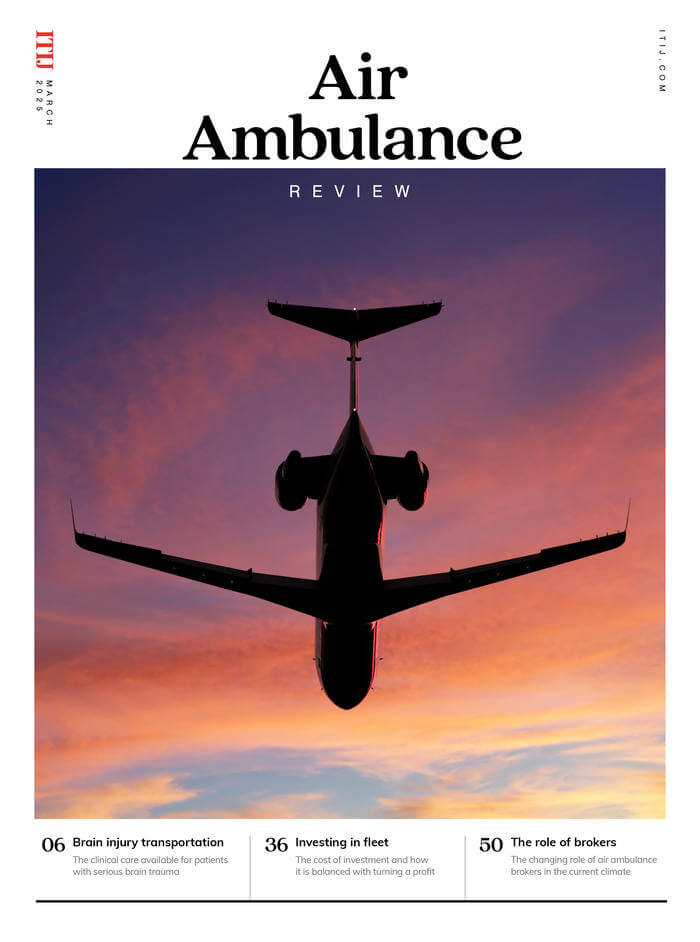
March 2025
Issue
The Air Ambulance Review includes features on clinical care for ABIs; investing in fleet; the role of brokers in the air ambulance industry; and an accreditation update.
Editorial Team
The Editorial Team updates the ITIJ website daily, and works on features for the print edition. With expert industry knowledge and years of experience in writing about complex travel insurance issues, the Editorial Team is ready to investigate and report on the topics that matter most to ITIJ's readers.