A dream interrupted by a storm

Jet Executive recounts how a lifelong passion project led to a traumatic medical evacuation
What began as a lifelong dream nearly ended in one violent second. A married German couple from Hamburg had set out to sail around the world aboard their catamaran – both had decades of sailing experience – fulfilling their lifelong dream. Years of planning had led to this moment: leaving familiar waters behind, heading north along the Scandinavian coastline, with the Norwegian fjords marking the symbolic start of a journey defined by freedom rather than deadlines. The sea, however, had its own plans.
Severe weather conditions
Off the rugged coast near the Lofoten Islands, weather conditions deteriorated rapidly. What had been manageable winds escalated into a severe storm system, with sudden gusts and heavy swell funnelled by the steep fjord walls. During a violent roll of the vessel, the mast struck the husband with full force. He collapsed immediately, sustaining a severe traumatic brain injury and loss of consciousness.
By chance, a local fishing vessel navigating the same stretch of coast spotted the distressed catamaran. The fishermen managed to bring both husband and wife aboard and transport them to shore. On land, the challenges continued. The patient showed signs of a severe closed head injury with compromised airway reflexes and fluctuating consciousness. Initial stabilisation was performed by a ground ambulance emergency medical team before a prolonged drive to a regional hospital. Clinical examination and images confirmed a severe traumatic brain injury with intracranial involvement, requiring higher-level neurocritical care than could be provided locally. After airway protection, haemodynamic stabilisation, and continuous neurological monitoring, the decision was made to transfer the patient by air to a more specialised clinic in Bodø for further treatment.
Off the rugged coast near the Lofoten Islands, weather conditions deteriorated rapidly
The medical evacuation
The patient’s German assistance company activated Jet Executive at their home base in Munich, initiating a medical evacuation under highly sensitive conditions. Continuous coordination with the treating physicians ensured medical suitability for transport, while logistics teams worked across borders to align hospital discharge, ground transport, and airport handling. The patient required close neurological monitoring, oxygen therapy, and careful management of intracranial pressure risks throughout the transfer phase. Every decision balanced urgency against safety.
The flight back to Germany was uneventful but tense, marked by constant monitoring until landing. The patient was admitted directly to a specialised neurological centre, where further treatment and rehabilitation began immediately.
During the flight, the patient’s wife, herself physically unharmed, required urgent emotional and psychological support. Confronted with the sudden possibility of losing her partner, she was exhausted and experiencing acute stress reactions during these days, before the German AA team provided continuous reassurance and psychological first aid in her familiar mother language, proving that caring for the accompanying person is often inseparable from caring for the patient.
The recovery
Recovery was gradual, but came. Months later, a message reached the Jet Executive team that resonated far beyond operational success. The patient wrote that their circumnavigation of the globe had been interrupted – but not abandoned. The catamaran still waits. The horizon is still there.
In air ambulance operations, outcomes are often measured in medical stability and safe transfers. Sometimes, however, success is measured in something less clinical: the preservation of a future that was nearly lost at sea.
Irena Dimitrijevic is the General Manager at Jet Executive, focusing on clients and network management. Her expertise lies in global sales, crisis management, and business transformation. Passionate about travelling, yoga, and personal growth, she has explored over 90 countries over the past 20 years, mainly with a backpack.
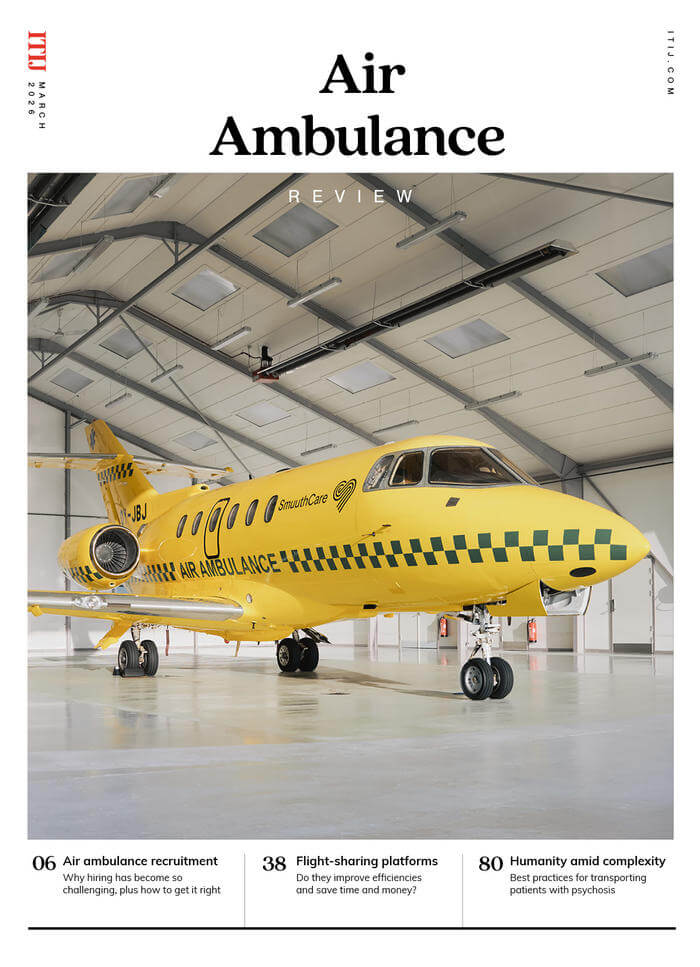
March 2026
Issue
In this issue of Air Ambulance Review we examine the challenges facing air ambulance providers when it comes to recruitment; look at flight-sharing platforms and ask if they can improve efficiencies; and we delve into the latest medications, protocols and best practices for transferring vulnerable patients with psychosis.
Editorial Team
The Editorial Team updates the ITIJ website daily, and works on features for the print edition. With expert industry knowledge and years of experience in writing about complex travel insurance issues, the Editorial Team is ready to investigate and report on the topics that matter most to ITIJ's readers.