
Dr Kimberley Chawla interview: Medical assistance in the Indian subcontinent

Dr Kimberley Chawla, Medical Director at East West Rescue, talks to Michelle Royle about her role, expansion plans, and challenges for the industry
East West Rescue (EWR) has been operating for over 50 years. Which regions do you operate in, and what services do you offer?
East West Rescue is proud to be the pioneer and leading force of medical assistance and medical repatriations in the Indian subcontinent. We have over 56 years of experience in providing air ambulances; ground ambulances; worldwide commercial medical escorts (CME); fraud investigation; first aid training; on-site medical teams for high-net-worth clients, VIPs and events; emergency cashless hospitalisation and outpatient appointments across our network; travel assistance; search and rescue; teleconsultations; site hospitals; and cost containment, amongst other things.
What is your position in the company, and what does your role involve on a day-to-day basis?
I am the Medical Director, an Internist in clinical practice, and a Senior Federal Aviation Administration (FAA) Aviation Medical Examiner (AME). I was formerly a Flight Physician and Program Director with EWR. My role extends beyond clinical supervision into actively leading the organisation’s medical vision, patient care strategy, operational response systems, and ethics. I remain directly involved in evaluating complex medical cases with our Medical & Ops team, discussing appropriate treatment, guiding evacuation decisions, whilst ensuring that every patient receives optimal treatment and that transfers are clinically justified, safe, and operationally efficient.
We ensure that every evacuation is carried out safely, efficiently, and with uncompromised patient care standards
My focus remains on maintaining a medically driven assistance platform that is empathetic, delivers timely intervention, is ethical, and provides individualised seamless medical assistance and coordination.
How do you see East West Rescue evolving over the next five to 10 years in the global medical assistance space?
We envision East West Rescue evolving into a more technology-driven and globally integrated medical assistance provider whilst maintaining our reputation of ethical conduct, professionalism, responsiveness, and empathy. We are positioning ourselves to lead this transformation within the region.
A key part of our long-term vision is to work closer with insurance and assistance companies, healthcare providers, adventure sport groups, and to increase our number of reciprocal international partnerships.
Our focus is to continue to improve and provide proactive, patient-centric assistance and operational excellence at every stage.

Are there new regions or markets you’re prioritising for expansion?
We are increasing our presence within the Indian subcontinent and Southeast Asia. Our expansion strategy is carefully aligned with building strong partnerships and ensuring we maintain the same high standards of service in every new market we enter.
We are also in the process of increasing accessibility to medical assistance for the underprivileged, especially in underserved and remote regions in the Indian subcontinent. Even though we have over 15,000 hospitals in our Indian network, we continue to expand our hospital and physician network so that our clients have more options available.
Our goal is to combine clinical expertise, operational excellence, and healthcare to deliver safer, rapid, and more accessible and coordinated patient care, especially for the local population.
Given your work across multiple countries, what are the biggest operational challenges in coordinating international evacuations?
Even though we operate 24/7, there may be challenges for cross-border evacuations in receiving timely overflight permissions and clearances for air ambulances and also visas for the patient during out-of-office hours of government authorities. To ensure uninterrupted service delivery, our medical and operations teams work through a centralised coordination model that manages flight permissions and clearances, hospital communication, ground ambulance logistics, and bedside-to-bedside repatriation planning in real time.
Our extensive experience allows us to anticipate challenges proactively and execute timely, rapid, safe, efficient, and coordinated evacuations with minimal disruption to patient care. Even so, weather constraints, airfield timing disruption at smaller airports and conflict zones in our flight path also are a challenge. Occasionally, even with the best planning, on arrival at a location, our team may find that the medical information shared by the hospital is inaccurate and the patient’s condition is not as portrayed.
In international evacuations and cross-border medical assistance cases, coordination with aviation authorities, embassies, immigration departments, and local governments is equally important. These relationships allow us to often secure timely clearances, [and] execute medevacs with minimal delays, even in operationally challenging environments.
How do you ensure patient safety and clinical consistency during complex transfers, especially from remote areas?
Patient and medical team safety and wellbeing are central to our operations. We have full-time in-house medical teams who are advanced cardiovascular life support (ACLS) certified, work in our hospital and ER where evidence-based medical protocols are followed, attend CMEs, bi-annual aviation physiology training/refreshers on aviation physiology, and thus are up to date on the most recent medical treatments. All medical flight crew also undergo safety and emergency procedures training as mandated by the Directorate General of Civil Aviation (DGCA).
We aim to create a more responsive, clinically driven, and accessible medical assistance framework
Each transfer is preceded by pre-transport medical assessments and continuous monitoring to ensure that patients remain stable and appropriately managed throughout their evacuation process.
Prior to transport, our experienced medical department conducts detailed evaluations to determine fitness for transfer, configuration of the medical team, level of care required, potential risks, and the most suitable mode or combination of modes. Based on the patient’s condition, we deploy the appropriate team, equipment, and medication to maintain continuity of care during transit. Our medical teams are debriefed prior to leaving base, medication rechecked, and equipment checked and charged.
This ensures that patients receive safe, clinically appropriate, and uncompromised care regardless of geography or logistical complexity.
What are the most critical risks in air medical transport, and how does the organisation mitigate them?
Air medical transport is a highly specialised field that combines critical care medicine, aviation medicine, and complex real-time operational coordination. Air medical transfers involve clinical and logistical factors such as weather constraints, high-altitude locations, weight restrictions, pilot flight time limits, limited in-flight space, infection control, and the possibility of deterioration of critically ill patients.
To mitigate risks, every mission involves an in-depth medical and logistical assessment. Our medical department evaluates the patient’s status, converses with the treating team, and confirms transfer suitability before transport is activated. Based on these details, we carry spine boards, vacuum mattresses, ventilators, defibrillators, infusion pumps, and lifesaving medication, etc., to maintain continuity of care during all modes of transfer. All equipment is owned and maintained by us to reduce the risk of any mishaps.
Our in-house medical department, flight physicians, and operations team work together and communicate throughout a mission to ensure seamless execution. We also integrate telemedicine support, real-time communication systems, and contingency planning protocols to address unexpected clinical or operational challenges without disrupting patient care. In cases involving adverse weather, or remote-area medevacs, our teams maintain backup routing, alternate airport planning, and ground support to ensure continuity and safety at every stage of transport.
We ensure that every evacuation is carried out safely, efficiently, and with uncompromised patient care standards.
Our flight crew safety is paramount and thus we have discontinued providing repatriations to/from areas that are in conflict or sanctioned, such as Afghanistan, Pakistan, Iran, Iraq.

How is technology shaping the future of medical evacuation and assistance services here?
We have come a long way from providing assistance via Telex machines and landline calls in the ’60s! Before the internet was available, our team would have to phone for tickets, ground ambulances, arrange hotel and taxi bookings!
Technology continues to play a transformative role in the industry. GPS tracking, WhatsApp messaging, and telemedicine are significantly improving access to healthcare, real-time coordination with treating physicians, hospitals, and improved and quicker access to patient care or repatriation.
We have actively invested in an international medevac case management system, and are actively investing in advanced digital assistance platforms, GPS-based ground ambulance (GA) tracking, and real-time communication to strengthen operational efficiency and clinical monitoring during both medical assistance and repatriations. These technologies will enable faster response times, [and] improved coordination between medical teams and hospitals, insurers, and families.
Our goal is to combine clinical expertise, operational excellence, and next-generation healthcare technology to deliver safer, rapid, individualised, and highly coordinated patient care, especially for the local population.
Patients are comforted with our team being available 24/7 to discuss any concerns. Hospital teams appreciate our 24/7 availability; GA teams are able to communicate via mobile phones or via Whatsapp 24/7.
As the medical assistance industry continues to evolve, our focus remains on strengthening these ecosystems through technology integration and collaborative healthcare networks. By connecting medical expertise, operational infrastructure, and partnerships, we aim to create a more responsive, clinically driven, and accessible medical assistance framework across the Indian subcontinent and international markets.
What role do partnerships (with hospitals, insurers, governments) play in your growth strategy?
Trust and relationships with insurers, assistance companies, hospitals, ground ambulance providers, and governments are integral for growth and efficiency.
Our close collaboration with the above enables admissions on priority basis, reduces the chances of unnecessary investigations, and helps with smoother interfacility or cross-border transfers. We have tremendous goodwill and a good reputation, especially as we do not collect any referral fees, cuts or commissions. We are prompt payees and thus hospitals readily provide discounts. Our healthcare providers and clients appreciate our transparency, ethics, and professionalism so much, that even when they transfer elsewhere, they often reach out to work with us for their
new company.
Over the past 56 years, we have built strong relationships with hospitals, physicians, ground ambulance providers, insurers, and government authorities across multiple regions.
Dr Kimberley Chawla, Medical Director, East West Rescue
Dr Chawla has over 30 years of experience. She is also a Medical Adviser for the United Nations, World Health Organization, NGOs, multinational corporations, airlines, and diplomatic missions. She was the designated ‘Expert on Mission’ for the UN during the Covid-19 pandemic. Dr Chawla has several medical publications on medical repatriation and MS, and has also authored books on travel health, first aid, and disaster medicine.
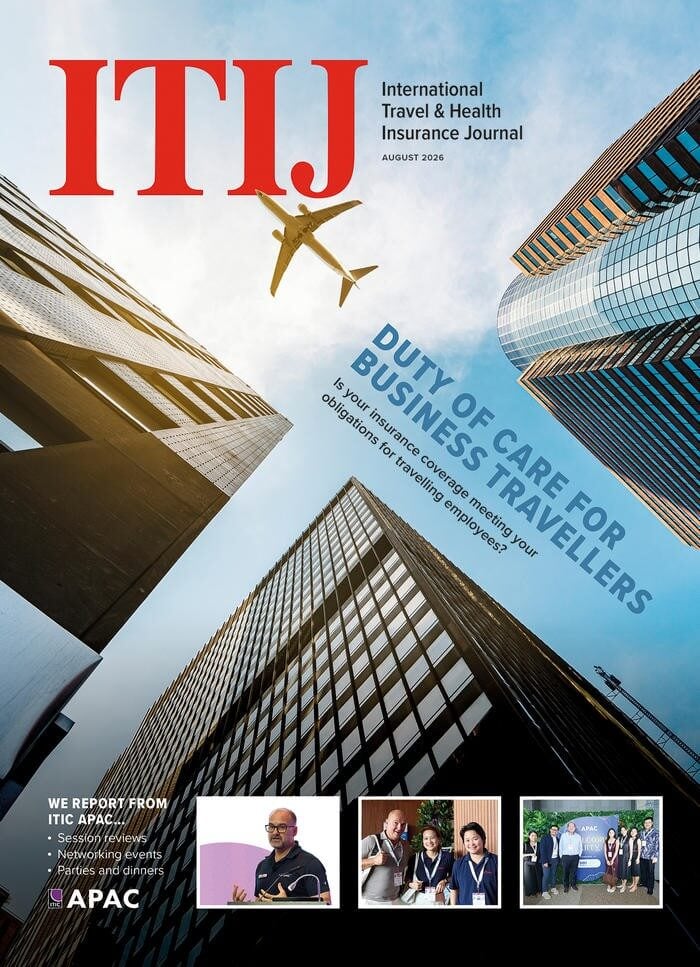
August 2026
Issue
This month we examine an issue important to many of us – the complexities of insuring business travellers. Employee travel exposes organisations to risks including medical emergencies, travel disruption, geopolitical instability and cyber threats. Adequate insurance coverage is more than a financial safeguard; it is a vital part of meeting an organisation’s duty of care obligations and responsibilities.
Michelle Royle
Michelle is Editor of ITIJ.