Defying the odds

Dr Manu Ashraf, Flight Phsyician at Bluedot Air Ambulance, tells us about a complex ECMO transfer and bird strike crisis across continents
In the high-stakes realm of aeromedical transport, few challenges rival the logistical and clinical nightmare of coordinating an intercontinental ECMO transfer. This mission – a 36-hour odyssey from the UAE to the US – became a testament to resilience when a critical bird strike mid-journey compounded an already precarious scenario. Blending cutting-edge medicine, rapid problem-solving, and unwavering teamwork, this operation redefined the boundaries of possibility.
The patient: a fight for survival
At the centre of this ordeal was a paediatric patient with a rare constellation of congenital heart defects: dextrocardia with situs inversus, severe pulmonary stenosis, and postoperative complications. Dependent on veno-arterial ECMO and 12 intravenous infusions, the child’s survival hinged on flawless execution.
The dream team: expertise under pressure
A specialised team was assembled: a flight physician, paediatric intensivist, a perfusionist, and flight nurse formed the core. Our Bombardier Challenger 604 aircraft was outfitted to sustain the ECMO circuit, medications, and monitoring systems. Ground physicians and support staff meticulously orchestrated the hospital-to-aircraft transfer, prioritising circuit stability and sterility.
Mid-flight crisis: bird strike and contingency mobilisation
The flight’s first leg proceeded smoothly, but disaster struck during take-off in Turkey. A bird strike damaged the aircraft’s engine, forcing an abrupt abort. With the clock ticking, the team activated emergency protocols. A backup ECMO-compatible aircraft was dispatched from Athens, while the medical team recalibrated oxygen reserves, adjusted ECMO settings, and maintained the child’s stability during the 12-hour delay. Logistical agility: weather, communication, and precision As freezing winds buffeted the tarmac, the crew safeguarded the ECMO equipment during the aircraft switch. Open communication with the family provided reassurance, while ground teams secured permits and prepared the replacement jet. The revised route included a stop in Iceland, where snow and northern lights underscored the mission’s surreal intensity.
Few challenges rival the logistical and clinical nightmare of coordinating an intercontinental ECMO transfer
Touchdown in New York: seamless handover
Upon arrival, the patient was transferred to an awaiting PICU, with meticulous handover of ECMO parameters and medications. The team’s exhaustive preparation ensured no lapse in care.
Lessons from the brink
This mission succeeded through:
• Preparation: simulated scenarios and redundant systems enabled adaptability
• Interdisciplinary synergy: pilots, medical staff, and ground teams operated as a unified force
• Relentless advocacy: every decision prioritised the patient’s fragile physiology and dignity.
More than a flight, this journey embodied medicine’s highest ideals: innovation, collaboration, and the refusal to surrender to chaos. In the face of mechanical failure, environmental extremes, and clinical complexity, human expertise triumphed – a beacon of hope for future challenges.
About Bluedot Air Ambulance
Bluedot Air Ambulance continues to provide critical care services, specialising in medical repatriations from high-risk regions that involve both complex security and logistical challenges. Our unwavering commitment to patient care, combined with advanced medical expertise and meticulous logistical coordination, ensures that each mission, no matter how challenging, results in a successful outcome.
Dr Manu Ashraf Flight Phsyician, Bluedot Air Ambulance
Dr Ashraf, MBBS, FICM, is an experienced Critical Care Specialist and Flight Physician with eight years of expertise. He has successfully managed over 150 international air transfers, including complex cases such as lung transplants with ECMO support and ventilatordependent neonatal, paediatric, and adult patients. His specialisation spans neurosurgery, cardiovascular, and paediatric intensive care, ensuring the highest standard of medical care during air ambulance transport.
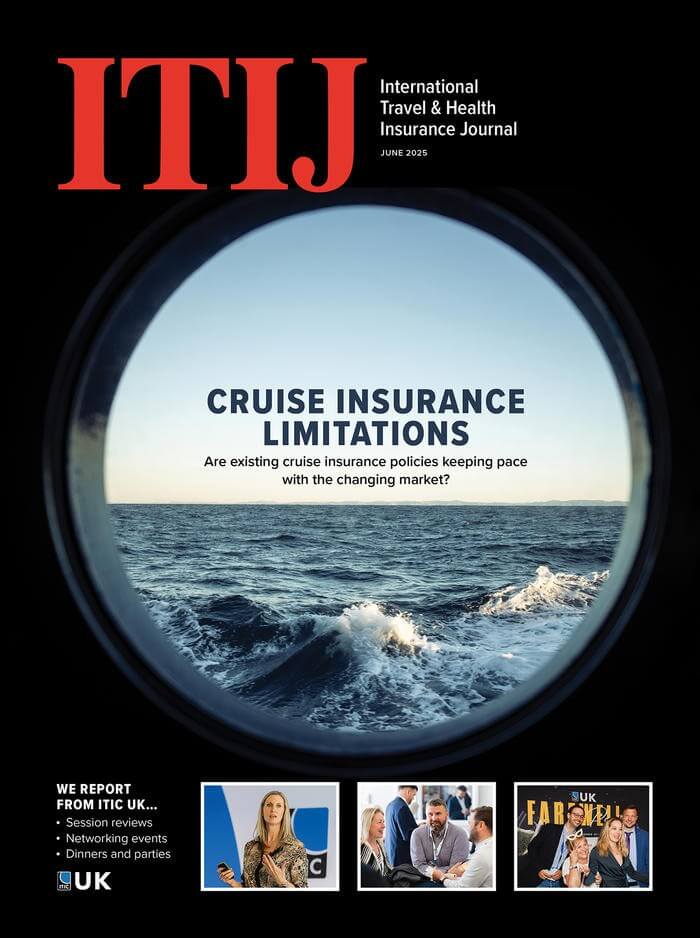
June 2025
Issue
In this issue of ITIJ we examine the repatriation of mortal remains, and look at the trends, challenges and local expertise required. We also consider cruise insurance limits and exclusions and ask whether the latest cruise insurance policies are keeping up with what the travel market is offering.
Editorial Team
The Editorial Team updates the ITIJ website daily, and works on features for the print edition. With expert industry knowledge and years of experience in writing about complex travel insurance issues, the Editorial Team is ready to investigate and report on the topics that matter most to ITIJ's readers.