
Cruising the Mediterranean: travel and assistance trends

The popularity of cruise travel has now surpassed pre-pandemic levels and the Mediterranean continues to be a top destination. Cathy Hudson looks at the current trends around cruising the Med
The historic buildings of Rome, the stunning beaches of Spain and the beauty of the Greek islands are just some of the sights you can experience on a Mediterranean cruise. It’s not hard to see why the Mediterranean is one of the most popular locations for cruising. According to industry body Cruise Lines International Association (CLIA), it was the second most visited region by cruise in 2023. The Caribbean had the lion’s share of cruise passengers, with 44% travelling there, but the Mediterranean came a firm second with 19% choosing to cruise to the region.
Research by AllClear Travel Insurance drew similar conclusions. It found that the Mediterranean was the second most searched for cruise destination worldwide after the Caribbean in the year to March 2024.
According to industry body Cruise Lines International Association (CLIA), the Mediterranean was the second most visited region by cruise in 2023
Cruises have become increasingly popular in recent years, with the Mediterranean being one of the winners. There were 31.7 million cruise passengers globally in 2023 – a 7% increase on the 2019 figure of 29.7 million. The Med was visited by 5.5 million in 2023 versus 4.4 million in 2019. This means there were an extra 1.1 million passengers travelling there, boosting the number by 23% over four years.
While the volume of cruise passengers has now surpassed pre-Covid-19 levels, the pandemic hit the cruise industry hard, and it took until 2023 for the sector to fully recover. There were just 5.8 million cruise passengers in 2020, when restrictions preventing travel were first put in place, 4.8 million in 2021, and 20.4 million in 2022.
However, CLIA says cruise travel has bounced back faster than other types of travel. It also forecasts that cruise tourism will grow to almost 40 million passengers by 2027. CLIA members, which include more than 50 cruise lines responsible for 95% of the world’s cruise capacity, had a fleet of 293 ships in 2023. This is set to grow to 303 by the end of 2024.

The draw of the Mediterranean endures
There are multiple reasons why cruises to the Mediterranean have such appeal.
The region clearly boasts great weather, beauty, culture, history and delicious food, but a major attraction is the variety it offers. “Even if you repeat a cruise to the Mediterranean, you can visit different ports each time. There’s a real mix of itineraries,” pointed out Andy Harmer, CLIA’s Managing Director for the UK and Ireland. “We see a real spread of sizes of cruise ship now, and there are smaller ships that can take passengers to smaller ports, such as Portofino and Valencia. The industry works hard at curating shoreside experiences in those ports too. You could do beach, city or a culinary tour, for example.”
A look at some of the Mediterranean cruises on offer reveals the sheer diversity of options. Travellers can choose to tour the Eastern or Western Mediterranean or both, or focus on specific areas such as the Greek islands, Spain and Portugal or Italy and France.
Cruise lengths range from less than a week to a month or more. Shorter cruises mean they can easily be included as part of a longer holiday. There’s the option of flying to the departure port, which could be a hub like Malaga, Barcelona, Rome or Athens, or going for a no-fly cruise.
A sizeable proportion of cruise passengers now travel as part of a multigenerational group, with a third travelling with at least two generations and 28% travelling with three to five generations. The Mediterranean is ideal for these groups as there’s something for everyone, whether that’s cultural opportunities or beaches.
Tourist taxes increase costs
As the number of tourists, including cruise travellers, in Europe has risen, some places have been increasingly struggling with the impact of tourism. Tourist taxes have been imposed in much of Europe for years but some cities have recently raised the amount of tourist tax they charge or introduced them as a result.
The levy is usually charged per person on top of each night’s accommodation. How much travellers pay tends to depend on the city or area they’re staying in and the type of accommodation.
Barcelona, which is often included in Western Mediterranean cruises, increased its tax for all types of accommodation from €2.75 to €3.25 in April 2024 and to €4 in October. Portimão and Albufeira in the Algarve region of Portugal are among those that have introduced tourist taxes this year.
Charges on accommodation don’t apply to cruise passengers unless a hotel stay is included in their trip. However, Barcelona also imposes a tax of €7 a day on cruise passengers stopping there for less than 12 hours and is set to increase the amount it charges.
There’s also a new tourist tax in Venice that will affect cruise travellers. The Venice Access Fee was imposed on visitors to the historic city not staying overnight on certain days this summer as a trial. It cost €5 per day. It’s likely to apply again in 2025 but could be charged on more days and at a higher amount in an attempt to reduce crowds further.
Despite these efforts to curb tourism, CLIA says there’s no evidence that they have affected the demand for Mediterranean cruises.

Medical facilities for cruise passengers grow
With many hundreds or thousands of passengers and crew on a cruise ship and potentially lengthy periods at sea, good medical facilities on board are essential. They’ve become increasingly sophisticated over the last 30 years and are well equipped to deal with most conditions. Critically ill patients can be stabilised on board. Telemedicine can also now be used by ships’ medical teams to consult specialists.
While the volume of cruise passengers has now surpassed pre-Covid-19 levels, the pandemic hit the cruise industry hard, and it took until 2023 for the sector to fully recover
For CLIA members, there are guidelines on what they need to have. For example, there must be at least one qualified medical professional available 24 hours a day, an intensive care room and a range of equipment, including for diagnosing conditions and monitoring patients.
“Nowadays, most cruise ships have labs where simple blood tests, including cardiac enzymes to detect a heart attack, are routinely taken with rapid results available,” said Dr Adrian Hyzler, Chief Medical Officer at risk management and crisis response firm Crisis24. “There are imaging facilities to rule out fractures, chest injuries or abdominal emergencies and a patient can be intubated and ventilated pending emergency evacuation.”
If patients can’t be fully treated on board within a day or two, need to be hospitalised for a longer period, or need urgent or emergency treatment, they’re sent ashore. Then they’re referred to a hospital facility at the next port of call. Patients also need to go on shore for more specialised investigations.
The region clearly boasts great weather, beauty, culture, history and delicious food, but a major attraction is the variety it offers
Mediterranean cruise itineraries often involve stopping at a port every day, so there are plenty of opportunities to disembark for treatment. As European coastlines are highly populated, there are plenty of facilities to choose from and the ports visited are generally able to provide good-quality medical care.
Outbreaks of contagious diseases on cruise ships can cause major issues. For example, in May 2024, it was reported that hundreds of people on board a P&O Cruises ship had become ill with norovirus. Cruise lines have detailed procedures in place for dealing with such incidents and bringing them under control.
Procedures and services that had to be developed as a result of Covid-19 have led to cruise ships becoming even better prepared. Dr Hyzler commented: “As with many organisations and governments, there is now a robust pandemic protocol that was, in many cases, non-existent prior to 2020.”
He added that the range of medical facilities on cruise ships also had to be bolstered because of the long periods of time passengers had to remain on board due to Covid-19.
Another reason for medical centres expanding is that cruise ships have got bigger – there need to be enough doctors, nurses and beds to cope with the number of people on board. The biggest cruise ships now sailing the Mediterranean can carry more than 6,000 passengers.
Medical centres also need to be able to deal with all age groups. The average age of a cruise traveller is 46, according to CLIA, but some cruises have more older people on board while others appeal to a younger demographic.
Assistance needed less often
As medical facilities on cruise ships are now so advanced, medical assistance companies only get involved when patients have needs that can’t adequately be dealt with on board. “Examples of this are a heart attack, stroke, emergency surgery and mental health conditions,” said Dr Hyzler. “Most medical emergencies can be stabilised on board ship, but transfer to a shoreside medical facility is usually the outcome.”
There are robust systems in place to facilitate this. Assistance companies have networks of medical providers in ports they can call on. They ensure the passenger is transferred to the most appropriate facility and agree the cost of the treatment with it upfront. Most cruise lines have on-shore care teams in certain ports that can help when passengers disembark for medical treatment there and pass information on to the assistance company.
Assistance companies get involved through a passenger’s travel insurance. Most cruise companies insist that passengers have it but if there’s no travel insurance there may be no assistance company. The passenger then has to pay for their treatment themselves and could end up paying over the odds. Medical costs have also increased significantly since the pandemic and medical inflation continues to be high.
“If there’s no assistance company involved, the ship’s doctor goes to a port agent,” explained Elena Donina Glukhman, Business Development Manager at assistance provider AP Companies. “The agent would have a medical facility they use but the provider might take advantage of the passenger as they don’t know what the pricing should be and they’re in a hurry so can’t wait. Port agents don’t necessarily care if the treatment is more expensive than it should be.”
Tourist taxes have been imposed in much of Europe for years but some cities have recently raised the amount of tourist tax they charge or introduced them
The main challenge of assisting passengers on cruise ships is the time pressure involved if they’re going to continue on the trip after they’ve been treated.
“It’s not the responsibility of the ship to wait so we need to know the schedules and we need to be on time,” said Glukhman. “If the passenger needs to go to a specialist, we may only know about it the day before, so the time frame we have to set up the appointment is very short. They also have to get there and back.”
Mediterranean cruise travellers will continue to grow in number and have never had it so good when it comes to the medical facilities available to them. However, with medical costs continuing to rise, it’s essential that they have travel insurance to cover them.
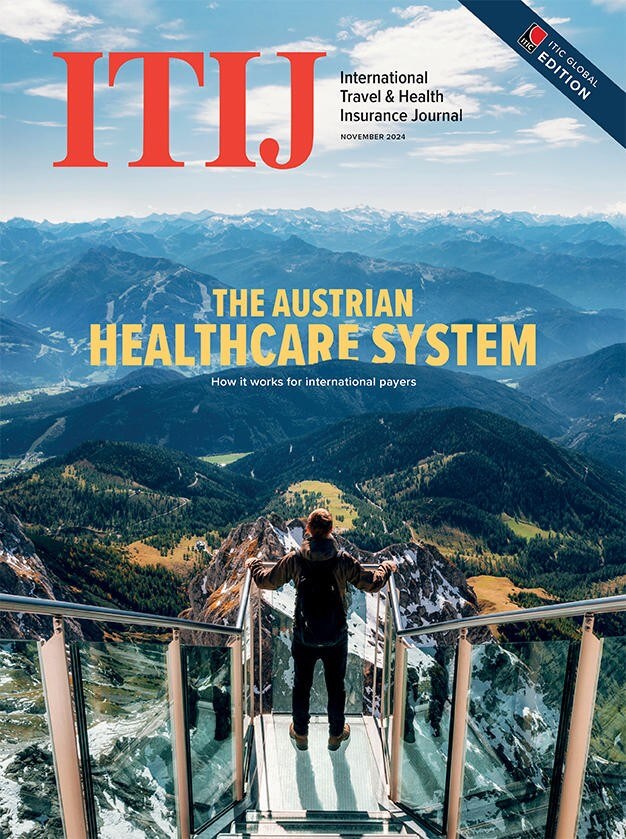
November 2024
Issue
This month we look at affinity partnerships and ask if online travel agencies are the perfect partners for insurers; we cover the trends around cruising in the Mediterranean; we delve into the specifics of the Austrian healthcare system; plus we examine international healthcare and technology, asking how far can technology go.
Cathy Hudson
Cathy Hudson is a freelance journalist specialising in money, property and technology. She has been a journalist since 2001, starting her career writing about mortgages and property then becoming editor of a mortgage and home buying magazine.
Before going freelance in 2018 she worked at Which? for 12 years, first as a money researcher and writer then as an editor in the money, home, tech and cars teams on the magazines and website.
As a freelancer she has written for a wide range of publications, including The Money Edit, Ideal Home, Loveproperty.com, Lovemoney.com, Expert Reviews, Which?, Which? Computing, Which.co.uk, The i Paper, the London Evening Standard, Finder.com, Money.co.uk and Bankrate UK.