
Crucial planning for the transfer of a premature baby

FAI Air Ambulance recount a complex long-distance transport of a premature infant from China to the USA
The intercontinental transport of premature infants via air ambulance presents significant challenges, requiring precise coordination of medical, technical, and logistical factors. These include temperature regulation, oxygen management, infection risk minimisation, and specialised transport equipment. Careful flight route planning and coordinated crew changes are also crucial. FAI Air Ambulance recently completed a complex transport of a premature infant from Xi’An in China, to Tampa in the US.
Medical background
The patient, born at 25+6 weeks of gestation with a birth weight of 1020g, suffered from multiple neonatal complications, including respiratory distress syndrome (RDS), bronchopulmonary dysplasia (BPD), sepsis, neonatal cholestasis, and hyperbilirubinemia. Following 76 days of intensive care in a Chinese hospital, she was deemed ‘fit-to-fly.’
Handover in Xi’An
Due to Chinese entry regulations, the handover took place at Xi’An airport. Despite language barriers and the absence of English-speaking staff, the medical team was able to take over a well-cared-for, stable infant after a thorough examination.
Transport process
Before departure, the baby was secured in a BabyPod transport incubator with integrated heat regulation, and connected to continuous monitoring of cardiovascular and respiratory functions. To enhance comfort and reduce noise exposure, she was also given hearing protection.
The medical team maintained her medication regimen and administered electrolytes and fluids throughout the transport, monitoring vital signs such as blood pressure, blood glucose, and temperature.
Due to exhaustion and aspiration risk, oral feeding was avoided, and the infant received parenteral glucose infusions. Despite the long journey, she remained stable, requiring minimal oxygen.
Psychological support for the mother
Beyond medical care, psychological support for the mother was essential. The unexpected premature birth in a foreign country, coupled with language barriers and cultural differences, caused considerable emotional distress. One of the most difficult aspects was the prolonged separation from her child – she was only able to hold her baby once in 76 days and received only weekly photo updates.
To strengthen the mother-child bond, a special measure was taken during a refuelling stop in Japan: the baby was briefly removed from the incubator and placed in her mother’s arms for the second time since birth – an emotional moment for all involved. Handover in Tampa In Tampa, a specialised neonatal intensive care team welcomed the infant with two adjacent beds prepared for the mother and child, allowing immediate maternal involvement in the baby’s care. This thoughtful gesture left a lasting impression on both the mother and the medical crew.
Operational aspects of the longdistance transport
The transport was conducted using a Challenger 604 aircraft, covering 7,523 nautical miles with a flight time of 17 hours and 10 minutes. The route included stops in Sapporo (Japan) and Anchorage (US).
Such a complex transport required extensive logistical planning and continuous medical care.
• Flight crew: a heavy flight crew of three pilots managed the Xi’an– Anchorage leg, while a standard twopilot crew took over from Anchorage to Tampa
• Medical crew: two specialised teams, each consisting of a paediatric intensive care physician and a paediatric nurse, were exchanged in Anchorage.
Conclusion
This case highlights the high medical, logistical, and personnel demands of intercontinental neonatal intensive care transports. The successful mission by FAI Air Ambulance demonstrates that with meticulous planning, specialised expertise, and patient-centred care, even highly challenging transports can be conducted safely and to the highest medical standards.
Nico Raab, Head of Medical Department, FAI Air Ambulance
Nico has been with FAI rent-a-jet GmbH since 2016, and brings not only an impressive 20 years of experience as a Flight Paramedic but also a background as a merchant, auditor, and extensive training in quality management. His relentless pursuit of the highest quality and continuous improvement defines his professional dedication to air ambulance.
FAI Air Ambulance
FAI's Air Ambulance Jets operate 24/7, boasting cutting-edge medical technology and expert staff for swift evacuations. Our service offers seamless bedside-to-bedside support at no additional cost. Elevate your medical transport expectations with FAI, delivering excellence in line with the highest global standards.
March 2025
Issue
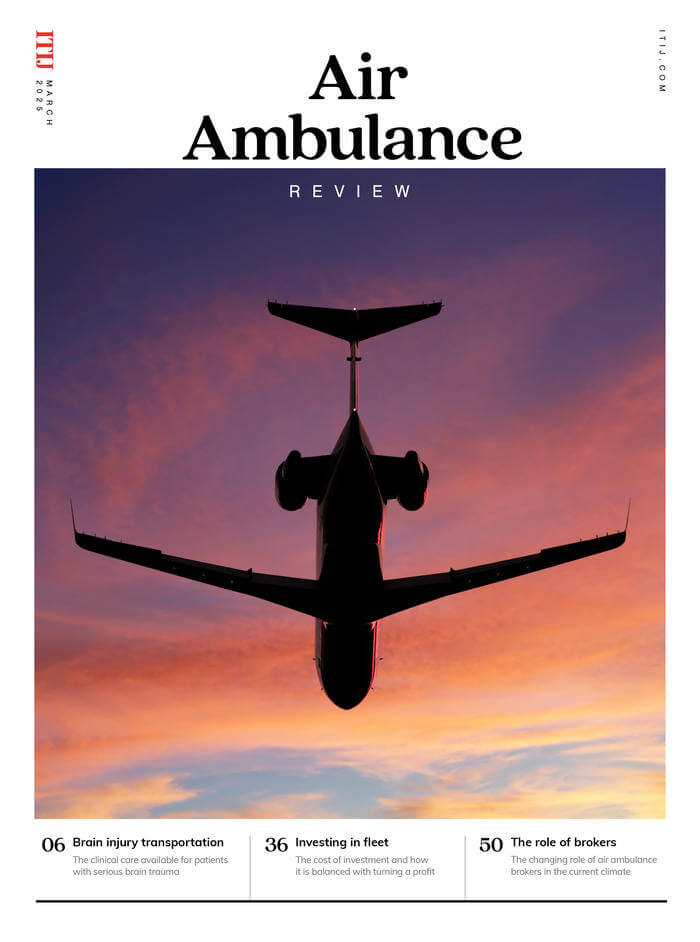
The Air Ambulance Review includes features on clinical care for ABIs; investing in fleet; the role of brokers in the air ambulance industry; and an accreditation update.
Editorial Team
The Editorial Team updates the ITIJ website daily, and works on features for the print edition. With expert industry knowledge and years of experience in writing about complex travel insurance issues, the Editorial Team is ready to investigate and report on the topics that matter most to ITIJ's readers.