Crossing borders under pressure

Irena Dimitrijevic from Jet Executive tells us that in international air ambulance operations, some missions are remembered because of the patient's condition. Others stand out because of the operational environment. Occasionally, both challenges converge into a single mission
In July 2026, Jet Executive was tasked by a German assistance company to repatriate an 18-year-old female patient from Sialkot, Pakistan, to Germany. While the medical urgency alone demanded an immediate response, the mission also required careful operational planning due to the evolving security situation and conflicts across parts of the Middle East.
The patient
What was intended to be a short family visit in Pakistan, changed dramatically when the young women developed recurrent status epilepticus, a neurological emergency associated with prolonged seizure activity and a significant risk of permanent brain injury. She required endotracheal intubation and mechanical ventilation. The condition remained uncontrolled and with each passing day, the need for advanced neurological management became increasingly urgent.
Jet Executive’s medical team had to determine whether an international transfer was medically feasible. As is often the case in complex overseas missions, the available documentation raised as many questions as it answered. Several medical reports contained contradictory information regarding sedation levels and ventilation parameters.
The medical team established direct communication with the treating physicians while the assistance company's local representative visited the hospitalto independently verify the patient's condition. At the same time, the patient's father provided photographs of monitoring screens and laboratory results directly from the intensive care unit, allowing Jet Executive's physicians to reconstruct a more accurate clinical picture.
A complex mission
Operationally, the mission presented another layer of complexity. The destination airport, Sialkot International (ICAO: OPST), had never before been operated by the Jet Executive team. Every aspect of the airport’s suitability, including runway performance, ground handling capability, fuel availability, customs procedures and medical access, had to be verified before departure.
In this case, crossing international borders safely was only part of the challenge
Adding to the planning effort was the regional geopolitical environment. Located only a short distance from the Indian border, Sialkot lies close to the disputed region of Jammu and Kashmir, an area that has experienced decades of political and military tension. Although civilian aviation continued to operate safely, current regional developments required continuous assessment of available airspace, applicable flight restrictions, overflight permissions and possible war-risk insurance.
After a last fit-to-fly call by our flight physician, the aircraft departed Jet Executive's home base at Oberpfaffenhofen Airport (EDMO), routing via fuel stops in Hurghada and Muscat before arriving in Sialkot with an overnight for all crew members. The airport staff were very organised and the handling agents provided constant updates to Jet Executive’s dispatch team.
Once airborne the next day, the mission shifted from logistical precision to intensive critical care. Throughout the flight, the patient remained mechanically ventilated and sedated while receiving continuous monitoring and prescribed medication.
The return routing aimed for the same stops but included an additional fuel stop in Heraklion due to wind conditions. An intensive care bed had been secured in Bremen, the final destination, ensuring immediate continuation of specialised neurological treatment.
In this case, crossing international borders safely was only part of the challenge. Delivering a critically ill young woman from a region of operational uncertainty into the specialised care she urgently required was the mission's true objective, and one achieved through the combined expertise of medical, operational and assistance teams working as one.
Irena Dimitrijevic is the General Manager at Jet Executive, focusing on clients and network management. Her expertise lies in global sales, crisis management, and business transformation. Passionate about travelling, yoga, and personal growth, she has explored over 90 countries over the past 20 years, mainly with a backpack.
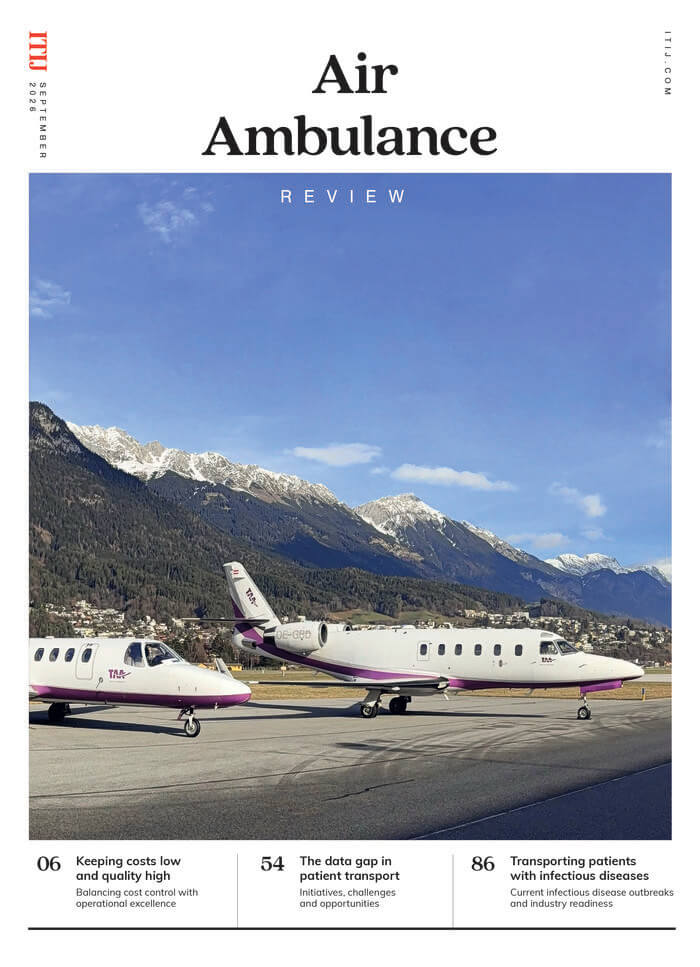
September 2026
Issue
This issue we focus on the problems that rising costs are having on the industry. Air ambulance providers are facing costs across fuel, aircraft maintenance, staffing, insurance, regulatory compliance, and specialist medical equipment. As if that wasn’t enough, delayed payments from insurers are adding further financial pressure. Despite these challenges, providers agree that patient safety and clinical quality must not be compromised.
Editorial Team
The Editorial Team updates the ITIJ website daily, and works on features for the print edition. With expert industry knowledge and years of experience in writing about complex travel insurance issues, the Editorial Team is ready to investigate and report on the topics that matter most to ITIJ's readers.