Coordinating an intercontinental ECMO repatriation

Dr Luana Moura from Brasil Vida Air Ambulance explains how her company came to the rescue of a Brazilian who fell ill while in Paris, France
A Brazilian tennis coach developed progressive respiratory symptoms shortly after arriving in Paris for a wedding-anniversary trip. He was admitted to Hôpital Européen Georges-Pompidou, where Pneumocystis jirovecii pneumonia progressed to severe acute respiratory distress syndrome.
Within less than 24 hours, the medical transport team had been assembled
Despite intensive treatment, he required invasive mechanical ventilation and ultimately veno-venous extracorporeal membrane oxygenation (VV-ECMO). As his prolonged admission created growing emotional and financial pressure for his family, discussions between French and Brazilian teams led to his acceptance for continued ECMO care at Hospital das Clínicas, University of São Paulo.
From referral to international operation
Brasil Vida Air Ambulance was then asked to assess the feasibility of repatriating the patient from Paris to São Paulo.
The request quickly became a complex international operation rather than simply an aircraft assignment. Within less than 24 hours, the medical transport team had been assembled, while operational planning continued over the following 48 hours. Flight permissions, aircraft configuration, medical equipment, oxygen logistics, ground handling, hospital coordination and international communications all had to be aligned.
A mobile intensive care unit
The mission used a Gulfstream G100 configured as a long-range mobile intensive care unit. The cabin had to accommodate the ECMO console, heater unit, transport ventilator, multiparameter monitor, infusion pumps and emergency equipment while preserving safe access to the patient.
Three large oxygen cylinders and two portable cylinders were loaded, with consumption calculated conservatively and replenishment options considered for technical stops. Redundancy was treated as a core safety principle because once airborne, additional equipment could not simply be requested.
Multidisciplinary team and departure
The multidisciplinary transport team included two experienced Gulfstream captains, a Brasil Vida senior flight nurse, the transport intensivist, two ECMO physicians from Hospital das Clínicas and an ECMO perfusion nurse.
Before departure, the patient underwent a detailed multidisciplinary review covering ventilator settings, ECMO parameters, anticoagulation, vascular access, laboratory findings and imaging. Direct communication with the French hospital, ambulance providers and airport personnel reduced delays and helped solve practical issues. One example was an incompatibility between French ambulance oxygen connectors and the aircraft system, which was identified shortly before departure and resolved through local coordination.
Crossing the Atlantic
At takeoff, the patient remained critically ill but stable for long-range transport. He was deeply sedated and pharmacologically paralysed, receiving continuous infusions including midazolam, fentanyl, neuromuscular blockade, unfractionated heparin and norepinephrine. Mechanical ventilation followed a lung-protective strategy, while VV-ECMO provided the primary means of gas exchange. The planned route included technical stops in Sal Island, Cabo Verde, and Salvador before continuing to São Paulo, covering approximately 9,438km.
By the end of the flight, approximately half of the onboard oxygen reserve remained
Throughout the Atlantic crossing, the patient remained under continuous invasive blood pressure monitoring, electrocardiography, pulse oximetry, urine output surveillance, ventilatory monitoring and full ECMO observation. Serial arterial and venous blood gas analyses guided adjustments in sweep gas flow, ventilation and metabolic management.
The team worked in a confined cabin where roles were clearly defined but frequently overlapped, requiring constant coordination and repositioning around the patient and equipment.
Managing oxygen, fuel and uncertainty
Oxygen management was one of the mission’s major operational considerations. Conservative planning had ensured a large reserve, but serial blood gases showed stable gas exchange and allowed gradual optimisation of oxygen use. By the end of the flight, approximately half of the onboard oxygen reserve remained. At the same time, aircraft performance had to be continuously reassessed because of the combined weight of the patient, equipment and team, together with stronger-thanforecast headwinds. An additional stop in Tenerife was considered, but adjustments to altitude and speed allowed the original schedule to be maintained.
Arrival and continuity of care
The patient’s condition remained remarkably stable throughout the mission. ECMO functioned reliably, haemodynamics were maintained with low-dose norepinephrine, and the transport ventilator, pumps and monitoring systems performed as expected. The absence of dramatic clinical events was itself a measure of success: maintaining uninterrupted advanced life support across almost 10,000km required vigilance, teamwork and constant small adjustments.
On arrival in São Paulo, an advanced life support ambulance received the patient directly from the aircraft. Monitoring, ECMO, mechanical ventilation and infusions continued without interruption during transfer to Hospital das Clínicas. A detailed bedside handover covered the patient’s clinical course in France, ventilatory strategy, ECMO settings, anticoagulation, vasoactive support, laboratory trends, medications and all interventions performed in-flight. The mission was considered complete only after formal transfer of responsibility to the receiving intensivists.
Key lessons
The mission reinforced three central lessons. First, successful international retrieval begins well before departure: detailed planning and contingency preparation are as important as inflight clinical decisions. Second, aviation and medicine must function as complementary disciplines, with aircraft performance, fuel strategy and flight profile continuously discussed alongside clinical priorities. Third, communication is a critical safety tool. Direct coordination among hospitals, ambulance services, airports, operational teams and clinicians reduces complexity and protects continuity of care.
Ultimately, the defining achievement was not simply the distance flown or the complexity of ECMO support, but the ability of professionals from multiple institutions, disciplines and countries to operate as one team. The patient was not merely transported across the Atlantic; his intensive care continued without interruption, demonstrating how modern aeromedical operations can connect healthcare systems and ensure that geography does not become a barrier to specialised treatment.
Key takeaway
The success of the mission resulted from meticulous preparation, redundancy, multidisciplinary teamwork, constant reassessment and uninterrupted communication between aviation and medical teams.
Dr Luana Moura, International Medical Director at Brasil Vida Air Ambulance, is dual board-certified in General Surgery and Intensive Care Medicine. An intensivist at Hospital Albert Einstein Goiânia, she completed an Intensive Care fellowship at Hôpital Erasme, Belgium, and brings extensive expertise in high-acuity care and complex international aeromedical missions.
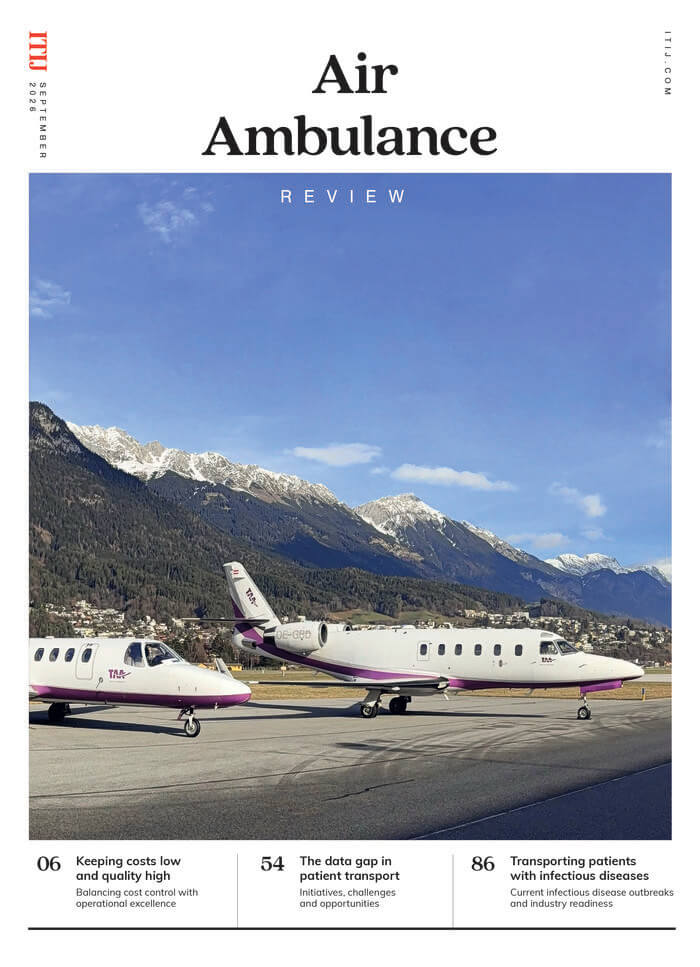
September 2026
Issue
This issue we focus on the problems that rising costs are having on the industry. Air ambulance providers are facing costs across fuel, aircraft maintenance, staffing, insurance, regulatory compliance, and specialist medical equipment. As if that wasn’t enough, delayed payments from insurers are adding further financial pressure. Despite these challenges, providers agree that patient safety and clinical quality must not be compromised.
Editorial Team
The Editorial Team updates the ITIJ website daily, and works on features for the print edition. With expert industry knowledge and years of experience in writing about complex travel insurance issues, the Editorial Team is ready to investigate and report on the topics that matter most to ITIJ's readers.