
Cash is King

Jason C. Davis explores the associated risks and opportunities of the emerging transparent cash economy for the travel insurance market.
Jason C. Davis explores the associated risks and opportunities of the emerging transparent cash economy for the travel insurance market
It is estimated that in 2022, US healthcare spending will reach over five trillion dollars, or nearly $15,000 per person. Simply put, this is not sustainable, and something has to be done; but what? In a continued effort to try to control rampant costs, one of the biggest trends in US healthcare is the rapid increase of out-of-pocket (OOP) costs being shifted to American consumers in the form of higher deductibles, co-pays, co-insurance, and the like. Among other things, this means that hordes of consumers (for the first time, perhaps) are asking, ‘What does this stuff cost, anyway?’ In response, healthcare providers now have to re-examine how they bill and collect for their services. In a bizarre twist, providers are also doing something they apparently have never done before – looking at their costs (which casts suspicion on the whole ‘cost-shifting’ dialogue we have been having). Consider this statement from PWC’s Top health industry issues of 2016: “Health systems command billions of dollars in revenue and yet few can do what other billion-dollar companies consider table stakes – identify the cost of the services they provide. Now insurers, consumers and other major healthcare buyers are demanding better value for their spending, and healthcare providers are scrambling to calculate these costs.”
The influx of more consumers in this market has revolutionary potential for transparency and competition for valueIt is 2016, and providers are only now ‘scrambling’ to calculate their costs? It seems that way. The influx of more consumers in this market has revolutionary potential for transparency and competition for value. Not surprisingly, most providers are desperately clinging to the network-controlled post-service payment reconciliation status quo, but some ambitious players are taking advantage of this trend and see an opportunity to offer transparent and favourable cash prices to try and redefine the traditional claims process. Can the travel insurance industry benefit from this market disruption?
Rise of high deductible health plans
Employer-sponsored insurance covers over 50 per cent of the non-elderly population in the US, representing over 147 million Americans. It is therefore no exaggeration to say that employer-based coverage represents the very foundation of so called ‘free market’ payment for US healthcare. As we know only too well, costs have been on a steady rise for many years, and right now, a family of four’s average healthcare spending per year is $25,826. In spite of the efforts of case management, networks and other fancy cost containment mechanisms, nothing has put a dent in spending and utilisation, so employers are feeling forced to shift costs to their employees in the form of higher deductibles. But what, strictly speaking, is a high deductible health plan (HDHP)? The Internal Revenue Service (IRS) defines it as ‘a health plan with an annual deductible that is not less than $1,300 for self-only coverage or $2,600 for family coverage, and the annual out-of-pocket expenses (deductibles, co-payments, and other amounts, but not premiums) do not exceed $6,550 for self-only coverage or $13,100 for family coverage.’ Overall, the current average deductible is $1,318 and rising, whereas the average 10 years ago was $584, and in 2015, Americans spent an estimated $345 billion in co-payments, co-insurance and other cost sharing provisions (up from $250 billion in 2009). HDHPs growing? In 2015, 24 per cent of all workers were registered in a high deductible health plan with a savings option (up from just eight per cent in 2009), and the PWC Health Research Institute predictings that 44 per cent of employers are expected to offer HDHPs as the only benefit option in the next three years. It is worth noting that it took over 15 years for the HDHP concept to catch on (this is why I always say trends in the market move at a glacial pace), but the data more than suggests that we are truly entering the era of the HDHP.Higher deductibles = transparency and savings?
Depending on what you read, HDHP immediate savings can range from 10 to 20 per cent. At a high level, supporters of higher patient OOP costs say that this ‘skin in the game’ will help engage consumers towards more efficient, higher quality and lower cost care, but this is not well understood. They also believe (rightly) that this will bring much-needed price transparency to this market. No longer will the consumer be shielded from seeing medical charges that are wasteful, expensive, inconsistent and virtually incoherent. And guess what – when they see it, they won’t like it; and the average smartphone-toting American will be very verbal about it (think reviews on the Internet). For a long time, industry wonks have believed that transparency will help reduce costs, but to date virtually none of these so-called initiatives have had any effect on spending. Why? It has to do with having ‘skin in the game’. If I give my kids my credit card (God help us!) and send them to the snack bar at a baseball game (where they charge too much, if you ask me), the fact that the prices are transparent won’t stop my kids from running up a huge tab, because they aren’t paying – I am. I am their Dad and, amongst other roles, I am also their financial surrogate. They are spending my money, not their own. In the US, transparency initiatives have largely failed to control costs because insurers are surrogates for their members – the members ultimately don’t care about prices (beyond their co-pay or deductible, if they have one). No amount of transparency has done much to change this dynamic so far. And this is not to mention that the transparency we have seen to date has been for billed charges that nobody pays. However, the Patient Protection and Affordable Care Act (PPACA) passed new laws (see IRS 501 r) regarding how much a provider can bill someone who is qualified for financial assistance for emergency services. The law rightly disregards billed charges entirely and invents yet another new term: amounts generally billed, or AGB. That is, not-for-profit providers may only bill qualified patients at the ‘best’ (meaning lowest) negotiated commercial rate, the average >> of the three ‘best’ (lowest) negotiated commercial rates, or the applicable Medicare payable rate. Now, providers have to publish their AGB ratios on the Internet and make sure that qualified patients understand their rights. Right now, if you Google ‘hospital AGB’ you will be able to see the amounts hospitals generally bill, as published by the hospitals themselves. I found one hospital and their AGB was nine per cent of their billed charges (i.e. on average, they offer 91-per-cent discounts). Again, true transparency cannot be achieved in a world where standard billed charges and amounts generally billed are so radically different. As you will see, American consumers will narrow this gap – and quickly, I suspect.Does skin in the game create better medical shoppers?
Do higher deductibles (coupled with transparency) actually make consumers better shoppers for care? Early indications, unfortunately, suggest not. An interesting JAMA study concluded that patients with higher deductibles were no more likely to shop around for care than those with lower deductibles.
the data more than suggests that we are truly entering the era of the HDHP [high deductible health plan]Another study from the National Bureau of Economic Research has shown that the average consumer with a high deductible reacts by cutting back on all care, even ‘free’ preventive care (where deductibles and cost-sharing do not apply) because they are scared of the expense and confused about how their benefits work. Because of this (though it is hard to prove) some argue that the short-term savings of consumer OOP responsibility will be lost in long-term costs of diseases that could have been treated earlier. The realisation so far (and it is early) seems to be that the average American is not preoccupied with getting healthcare services when it is their money on the line, but they are more open to spending on healthcare when someone else is paying (and this may include unnecessary or needlessly overpriced services).
In God we trust; all others pay cash
With the steady emergence of more consumers responsible for paying for their medical care, and perhaps continued provider frustrations from dealing with insurers or other outside third parties, more providers are now offering cash discounts. Consider these examples: •Patmos Emergiclinic (in Tennessee) does not accept any third-party payment and makes no apologies for this. In order to keep costs down for the uninsured and the increasing number of patients who have high co-pays and deductibles, we choose to not assume the massive overhead involved in billing third-party payers. This has the added benefit of eliminating bureaucratic hassles and intrusions into the doctor-patient relationship, ensuring confidentiality of patient information and keeping our typical charges usually between the costs of an oil change and a brake job. •UCLA Health offers cash pricing for selected services. Cash-pricing packages must be paid in advance of receiving services. Insurance will not be billed and claim forms will not be provided. •Does El Camino Hospital (in California) offer a discount if I self-pay for services? El Camino Hospital offers a 75-per-cent discount on eligible services to patients who pay out of pocket for medical services – whether it’s because you don’t have insurance, your insurance doesn’t cover the services, or you’d prefer not to bill through your insurance provider. Swedish Health Services may have seen the writing on the wall when they decided to lower their charges for certain outpatient services (bear in mind these are charges, not cash rates). On their old billing platform, an MRI of the brain was billed at $6,143; the new billing is $1,810 (70 per cent less). In many ways, cash rates are a type of network unto themselves. Providers are basically saying: “If you can pay cash at the time of service, these are the rates, and they are good. If you want us to bill an insurer, have the claim re-priced, pended, denied, re-coded, covered, denied, covered, we will bill you our much maligned chargemaster rates, and the claim will be paid with our equally maligned network rates.” We are truly only at the beginning of this trend, and it is difficult to accurately assess how many providers are offering cash rates (or at least publicising it), which is a form of direct-to-consumer ‘contracting’. The American Academy of Private Physicians estimates there are about 6,000 physicians in the US who contract directly with their patients (without an intermediary). That is roughly one per cent of physicians in the US but this number has been growing at a rate of 25 per cent per year for the last four years, and the trend is likely to continue.The dark side of higher OOPs
Most healthcare providers are probably less than excited about higher deductibles, as they seem to be struggling to actually collect consumer OOP dollars. In a McKinsey survey, 74 per cent of respondents were willing and able to pay if their payments were under $1,000 annually in out-of-pocket expenses. Sixty-two per cent of survey respondents were willing and able to pay more than $1,000 annually in out-of-pocket costs. The other third or so were willing, but not able. Overall, the data suggests that the higher the OOP cost, the less likely the provider will be able to collect. The net effect is that approximately 50 per cent of overall patient responsibility goes uncollected. Specifically, once a claim drops to collections, the recovery rate drops to 15.3 per cent for hospitals, and 21.8 per cent for non-hospitals. Forty-three million Americans have medical debt on their credit reports. One third of these have otherwise perfect credit, suggesting that consumers either do not see medical debt in the same way as other expenses, or that even otherwise good credit consumers are unprepared to shoulder medical expenses. Finally, and sadly, 60 per cent of personal bankruptcies involve significant financial exposure for medical services. As the OOP trend continues to increase, American consumers will need to change their financial management strategies to meet these obligations.Spoiler alert: providers will get better at collecting upfront
Most travel insurers do not want their members to be encumbered with paying directly for their services; they would prefer the member not to pay anything and that the insurer be billed directly. This, rightly or wrongly, is seen as a better customer experience. However, in all honesty, this can be argued to be against the best interests of the provider. If the claim is covered and the provider is paid in a reasonable period of time, they may be fine with direct billing the insurer; but what if the claim is denied or it takes several months before they get paid? By agreeing to bill the insurer (who retroactively confirms coverage), the provider has essentially waived the opportunity to collect from an international patient directly. Can US providers bill members on emergency claims? Under the Emergency Medical Treatment and Labor Act (EMTALA), providers cannot require a monetary deposit as a condition to treat or stabilise a patient; that would be illegal. However, one could argue that the provider could request payment or a deposit after care is rendered, but for emergency claims it would certainly be frowned upon. The way healthcare currently works, the practice is simply not prevalent enough – though I have seen it – but this could change with providers looking to collect more at the time of service.An odd twist
There are some early indications that consumers are starting to understand that they may get better deals on healthcare services if they say they are uninsured or simply state that they plan to ‘self-pay’; in other words, that they will pay cash for healthcare: •Morris Pineda of Alameda, California, says that learning it was cheaper for him to pay out-of-pocket for his prescription medications instead of putting in a claim with his insurance company came as a ‘slap in the face’. •Todd Craghead, Intermountain Healthcare’s vice president of revenue cycle, said he is seeing more insured patients ask to be treated as if they are uninsured so that they can access automatic self-pay discounts for services with costs that will fall short of their deductibles. •Los Alamitos Medical Center, for instance, lists a CT scan of the abdomen on a state website for $4,423. Blue Shield says its negotiated rate at the hospital is about $2,400. When The Times called for a cash price, the hospital said it was $250. One of my clients recently asked me to set up direct billing for a complex intestinal procedure. I was told that the facility was going to bill $60,000 and the in-network case rate (through a larger carrier) was approximately $30,000 (a 50-per-cent ‘discount’). I called the facility to inquire about the procedure and discovered that the cash case rate was $10,000, for the same facility and same surgeon. I set it up immediately; dare I say a triple win?
there are emerging opportunities to save a lot of money by managing a process to try and pay providers at the time they supply the serviceI have also personally experimented with paying cash for healthcare in the US. I had sustained a rather nasty cyst/lesion on my chin (basketball accident) and was on the waiting list in Canada to see a plastic surgeon. I had already waited two uncomfortable months when I decided to take matters into my own hands. As I was speaking at a conference nearby, I called Surgery Center of Oklahoma (SCO), which had recently made the national news for shunning networks and offering transparent pricing, which they post online (what a concept). I will admit that I was a little nervous about the price because I had a claim on my desk from New York City for a similar procedure and it was billed at $24,000. I did some research and estimated that the average charges for my procedure would be about $8,000. Finally, I spoke with SCO, and my cash price was $800. I paid for the procedure, had no claim to worry about, and the care was excellent.
What’s in it for me? It’s as easy as 1,2,3!
In spite of the fact that I did not use insurance, we can still take my personal experience as a case study about the benefits of real-time payment for medical care. As I see it, there are three major wins to reflect on: 1) no complicated claims process (for anyone); 2) peace of mind that I settled my ‘financial responsibility’ immediately; and 3) I saved money. I suppose in a parallel universe, and we all know this old racket, I could have presented with a health insurance card and the hospital would have agreed to bill my insurer directly, and the claim would have been paid and processed eventually, but how would I know? What if there was an issue of coverage? A coding problem? Request for medical records? Error with repricing? What if I got invoices in the mail? How would I make sure my claim was paid? What does my policy say again? Oh yeah, I didn’t read it. As one observer put it, in describing our current claim process ‘a horse-and-buggy in a world contemplating driverless cars, the healthcare industry’s consumer billing and payment system is an inefficient antique.’ Back to the ‘ideal’ world of real-time adjudication and payment: firstly, with no claim, there are no additional forms, no pink pieces of paper, no over-engineered codes. Did you know that there is an ICD-10 code for ‘burn due to water skis on fire, initial encounter’? V91.07XA, look it up. Without question, the claims process and its coding are unnecessarily complex, which adds to the cost and dysfunction in the market. To summon my inner Steve Jobs, ‘there must be a better way’. The second point is that paying for goods and services immediately is very natural, and your customers will like it. Frankly, I believe the standard insurance process is completely unnatural and somewhat nerve-racking. Perhaps the superior member experience is knowing that they can get the care they need and that it will be paid for right away by their insurer – with no ‘zombie claims’ (claims that don’t die; patent pending) to haunt them. Thirdly, and lastly, there are emerging opportunities to save a lot of money by managing a process to try and pay providers at the time they supply the service. The migration to real-time adjudication and payment will certainly not be easy, and, unlike American health insurance, you do not need a high deductible to achieve it, but with the opportunity to simplify billing, improve member experience and save money, it seems like the juice is very much worth the squeeze. ⬛ This article does not purport on any level to offer legal advice or guidance on claim coverage in any situation. About the Author Jason Davis is an independent consultant with 15 years’ experience in US health insurance and cost containment. He specialises in US medical claim review/negotiations, Medicare pricing software, reference based pricing, patient advocacy and general cost containment programme development including but not limited to vendor, network, and provider contracting. Jason is also a member of the Healthcare committee for the Self-Insurance Institute of America (SIIA) and serves on the Claims Committee for the Travel Health Insurance Association (THIA). References 1. White Paper: “Why It’s Time for a Health Care Marketplace”, www.vitals.com (July 2014) 2. 2016 Milliman Medical Index, http://www.milliman.com/uploadedFiles/insight/Periodicals/mmi/2016-milli... 3. 26 CFR 601.602: Tax forms and instructions, https://www.irs.gov/pub/irs-drop/rp-15-30.pdf 4. The annual Kaiser Family Foundation/Health Research and Educational Trust Employer Health Benefits Survey 5. PWC, “Money Matters, Billing and Payment for a New Health Economy”, http://pwchealth.com/cgi-local/hregister.cgi/reg/pwc-hri-healthcare-bill... (May 2015) 6. Ifrad Islam, “Trouble Ahead For High Deductible Health Plans?” http://healthaffairs.org/blog/2015/10/07/trouble-ahead-for-high-deductib... (October 7, 2015) 7. Donna Rosato, “The Downside of High Deductible Health Insurance”, Consumer Reports http://www.consumerreports.org/health-insurance/downside-of-high-deducti... (February 19, 2016) 8. Brot-Goldberg et al., “What Does a Deductible Do? The Impact of Cost-Sharing on Health Care Prices, Quantities, and Spending Dynamics”, NBER Working Paper No. 21632 (October 2015) 9. Sean Parnell, “The Self-Pay Patient”, January 2014, pg. 28 10. https://www.uclahealth.org/pages/patients/patient-services/cash-pricing.... 11. https://www.elcaminohospital.org/patients-visitors-guide/billing/faq 12. Sara Rosenbaum, “Additional Requirement for Charitable Hospitals: Final Rules on Community Health Needs Assessments and Financial Assistance”, http://healthaffairs.org/blog/2015/01/23/additional-requirements-for-cha... (January 23, 2015) 13. McKinsey Retail Healthcare Consumer Survey, 2009, as cited in McKinsey & Company, “Revisiting Healthcare Payments: An Industry Still in Need of Overhaul”, http://healthcare.mckinsey.com/sites/default/files/776489_Revisiting_Hea... (March 2010) 14. Tom Stampiglia, “Maintaining Profitability in the Era of Consumer-Directed Health Care”, Group Practice Journal, May 2009, as stated in, “Getting more from Self-Pay: 7 tips for improving patient payments” http://www.athenahealth.com/~/media/athenaweb/files/whitepapers/self-pay... 15. Healthcare Collection Statistics, http://www.acainternational.org/products-healthcare-collection-statistic... 16. Kara Brandeisky, “It Just Got Harder for Debt Collectors to Destroy Your Credit”, http://time.com/money/3737140/credit-score-medical-debt/ (March 9, 2015) 17. PWC report, “Money Matters, Billing and Payment for a New Health Economy” (May 2015) 18. Ann Brenoff, “Got Health Insurance? Why You May Want To Pay Cash Anyway?” http://www.huffingtonpost.com/2012/06/18/pay-cash-to-your-doctor-s_n_157... (February 27, 2013) 19. PWC report, “Money Matters, Billing and Payment for a New Health Economy” (May 2015) 20. Chad Terhune, “Many Hospitals, doctors offer cash discount for medical bills”, LA Times, http://www.latimes.com/business/healthcare/la-fi-medical-prices-20120527... (March 27, 2012) 21. PWC report, “Money Matters, Billing and Payment for a New Health Economy”, (March 2015)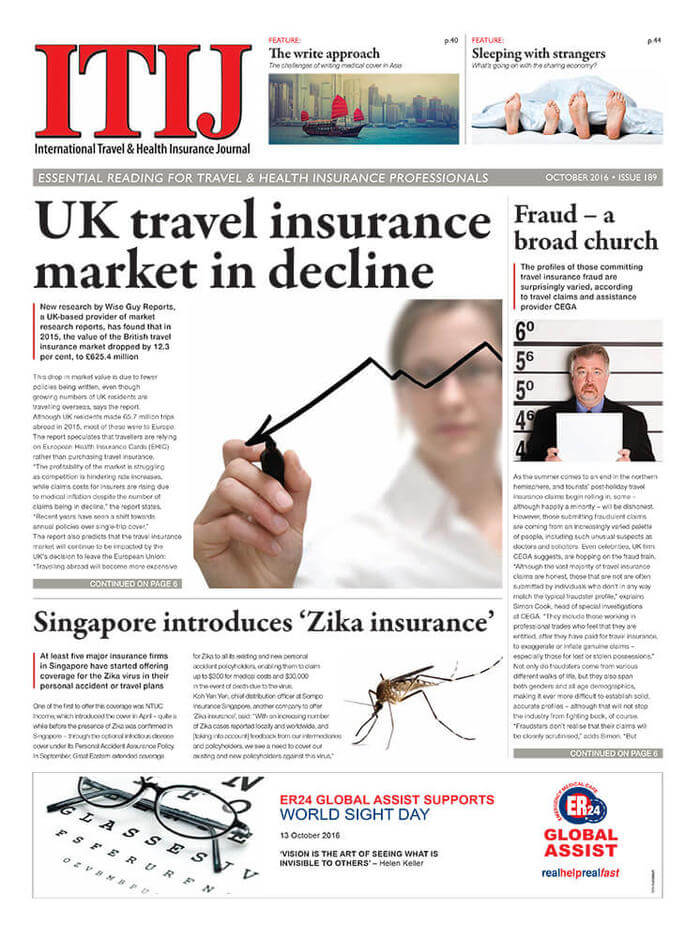
October 2016
Issue
Contents include:
Spike in Australian insurance disputes
Travel insurance accounts for much of the rise
Confusion abounds
UK travellers don’t know what’s happening
Fraudulent claims on the rise
ABI reports notable increase
Out of Africa – a new digital fraud trend emerges
Guest column from International Travel and Healthcare Limited’s Kate Huet
PJ Hayman teams up with Consularcare
New partnership announced
Zika spreads further
But an end may be in sight in some regions
Editorial Team
The Editorial Team updates the ITIJ website daily, and works on features for the print edition. With expert industry knowledge and years of experience in writing about complex travel insurance issues, the Editorial Team is ready to investigate and report on the topics that matter most to ITIJ's readers.