
Case Study: A lifeline in Colombia for a new mother and her infant

Rob Stephenson CBE, Director of Global Assistance at SPS, recounts an arduous mission in a remote region where an unaccompanied mother went into early labour.
SPS’s Global Emergency Assistance and Response (GEAR) is not just an application; it’s a lifeline. As a unique membership programme, GEAR offers more than just routine assistance – it’s specialised for the extraordinary. While regular travel insurance may be oriented towards recovering costs after an event, GEAR’s unique selling point is its focus on handling emergencies such as natural disasters, political unrest, and violent crimes, among other things, at the point of incident, and with costs covered upfront.
The core of GEAR’s functionality is its direct link to the SPS Global Response Centre, where real-time, location-based alerts are monitored by our staff, which, in dire circumstances, could mean the difference between life and death.
The incident
Earlier this year, GEAR was activated to respond to particularly challenging situations. An expectant mother, a GEAR member, had travelled to a remote region in Colombia where the nearest medical facility was an arduous 1.5-hour animal ride away. Unexpectedly, she went into labour early, giving birth away from any transport links and was alone.
With medical complications emerging, she found herself in a potentially life-threatening situation, isolated from immediate medical assistance. This is when GEAR’s unparalleled services stepped in.
The response
Instantaneously, after activating the assistance feature on her GEAR app, the new mother was connected with the SPS Global Response Centre. Those first few moments were crucial. The response team swiftly assessed the situation, gathered essential details, pinpointed her exact location, and connected her to our medical team. This team immediately assessed the nature of her medical complications and the condition of her newborn.
Time was of the essence, and any delay could have had dire consequences. While one part of the team liaised with local medical professionals for preliminary advice, another mobilised evacuation resources. Recognising the urgency and the terrain’s challenges, an aerial evacuation was identified as the most viable option. A helicopter, equipped with the appropriate medical supplies and professionals, was promptly dispatched to her location.
The evacuation
The landscape of the remote region was formidable, dominated by dense foliage and uneven terrain. However, the SPS team was trained and equipped for such challenges. As the helicopter flew over Colombia, the onboard medical team prepared for immediate intervention. The coordination between the GEAR support team, the helicopter crew, and the medical professionals was seamless.
Upon landing, the team found the mother and her newborn, understandably anxious but stable. Preliminary medical procedures were initiated even as they were airlifted to a nearby medical facility. The turbulent journey was made more comfortable, and constant communication ensured that the receiving hospital was prepared for their arrival.
Conclusion
In moments where every minute counts, GEAR provided the mechanism for swift action, which, enabled by the SPS team, ensured the safety of both mother and child. GEAR also ensured that the individuals concerned were spared the additional stress of paperwork, upfront costs, and insurance claims. All they had to focus on was getting to safety and recovering. This incident in Colombia stands as a testament to GEAR’s efficiency and indispensability. When emergencies strike, GEAR proves its worth, reinforcing its pledge to be reassuringly there, protecting its members anytime and anywhere.
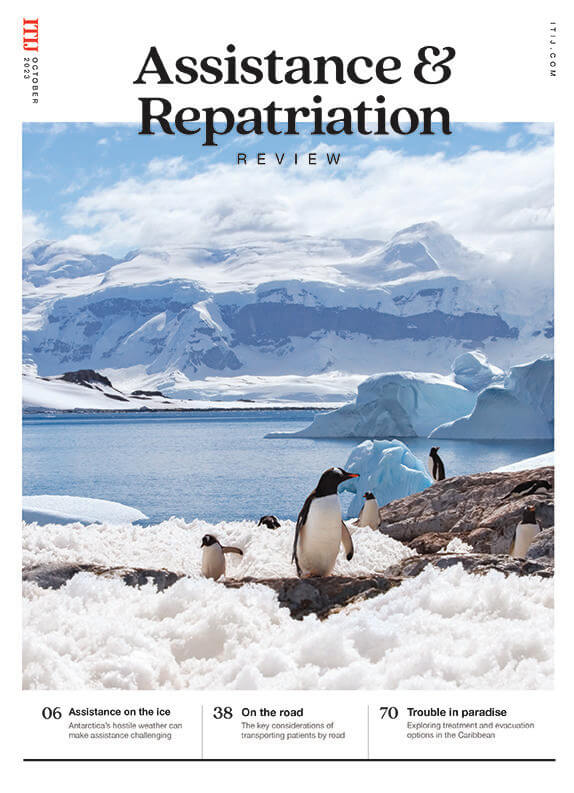
October 2023
Issue
In the second of our Assistance and Repatriation Reviews of 2023 we look at Antarctic assistance and extreme medical assistance for explorers and remote workers. We also examine factors driving cost increases in medical assistance around the world. Covid ramped up the cost of assistance, but what else has actually changed currently? In this issue we also look at treatment and evacuation options from the Caribbean. Finally, we look into the red flags that insurers need to watch out for when contracting with ground ambulance service providers.
Rob Stephenson CBE
Rob Stephenson, CBE, currently serves as the Director of Global Assistance at SPS. Previously, he was the Deputy Commander of NATO Special Operations Headquarters, a role he maintained while serving as the Acting Commander. Throughout his distinguished career, Rob has been deployed on numerous operational tours with the Parachute Regiment and other units. In staff positions, he has taken on multiple roles within both the UK’s Ministry of Defence and the Foreign and Commonwealth Office. In 2009, Rob was honoured as an Officer of the Order of the British Empire (OBE) and was further recognised in 2022 when he was made a Commander of the British Empire (CBE). Rob holds a master’s degree in defence studies from King's College London.