
CASE STUDY: Charles Taylor Assistance in Southeast Asia

A high-budget life-or-death case that required a specialist ECMO helicopter, weeks of intensive care overseas and an air ambulance back to a hospital at home
A man became ill with bacterial pneumonia whilst on holiday in Southeast Asia and was admitted to a local hospital for treatment. But his condition quickly deteriorated, and he was soon moved to intensive care to be put on a ventilator. Charles Taylor Assistance remained in constant contact with his treating doctors to oversee his care on behalf of his insurer. Unfortunately, the man continued to deteriorate and, within days of admission to hospital, was in complete respiratory failure and facing the added complication of kidney failure. By this time, despite being ventilated at the maximum setting, his oxygen levels were still dropping. With the patient’s prognosis undoubtedly poor, our in-house medical team, including a respiratory specialist, consulted with the treating doctors overseas to decide that his only chance of survival was extracorporeal membrane oxygenation (ECMO) treatment: a heart-lung bypass that could allow his lungs time to recover.
A costly challenge
It was increasingly likely that this case was going to cost the patient’s insurer hundreds of thousands of pounds sterling. The man was unlikely to survive without ECMO, but this highly specialised treatment was not available in the hospital to which he had been admitted, or in the local area, and it was hard to predict how long he would need it. Moving him to a suitable hospital would necessitate a complex journey, and a skilled ECMO team to accompany him. Additionally, his oxygen needs were too high and his condition too severe and unstable for transfer in a regular air ambulance, with a real chance that he would not survive the journey. To complicate things more, the Covid-19 global pandemic had restricted travel and hospital admissions.
Taking the right chances
Our chief medical officer was emphatic in her recommendation to the patient’s insurer that an attempt should be made to save the man’s life, whatever the cost. He had a slim chance of survival, but it was worth taking. The insurer agreed.
The next hurdle was to find suitable emergency transport as an alternative to an air ambulance. Fortunately, it wasn’t long before we had sourced a highly specialised ECMO helicopter that had only been commissioned a few months earlier. Arrangements were quickly made for the critical patient’s admission to the second hospital, a 90-minute helicopter flight away, and for a small, specialist ECMO helicopter team to escort him from one bed to another. The very next day, the transfer was successfully underway. The team put the patient on ECMO in the original hospital’s ICU unit, transferred him to the waiting helicopter and cared for his every need during the journey. Meanwhile, all Covid-19 travel restrictions and precautions had been anticipated and managed.
Throughout this, our operations specialists also remained focused on the ‘other patient’; the man’s wife, who of course required a great deal of support herself.
A price worth paying
Against the odds, the patient was successfully weaned off ECMO three weeks after being admitted to the second hospital. Our inhouse medical team had liaised with his treating doctors daily to manage his care, before arranging an air ambulance repatriation when he was fit to fly, his wife by his side. Despite ICU beds being extremely difficult to obtain during the peak of the pandemic, and often the most challenging part of a successful repatriation, admission was arranged to an intensive care bed in the patient’s local hospital, after considerable discussions with the accepting medical team.
Although he still has a long path ahead, the patient is now back in his home country. The total cost of the man’s medical care, ECMO helicopter and air ambulance came close to £500,000. But it was a price the insurer was prepared to pay to preserve a human life.
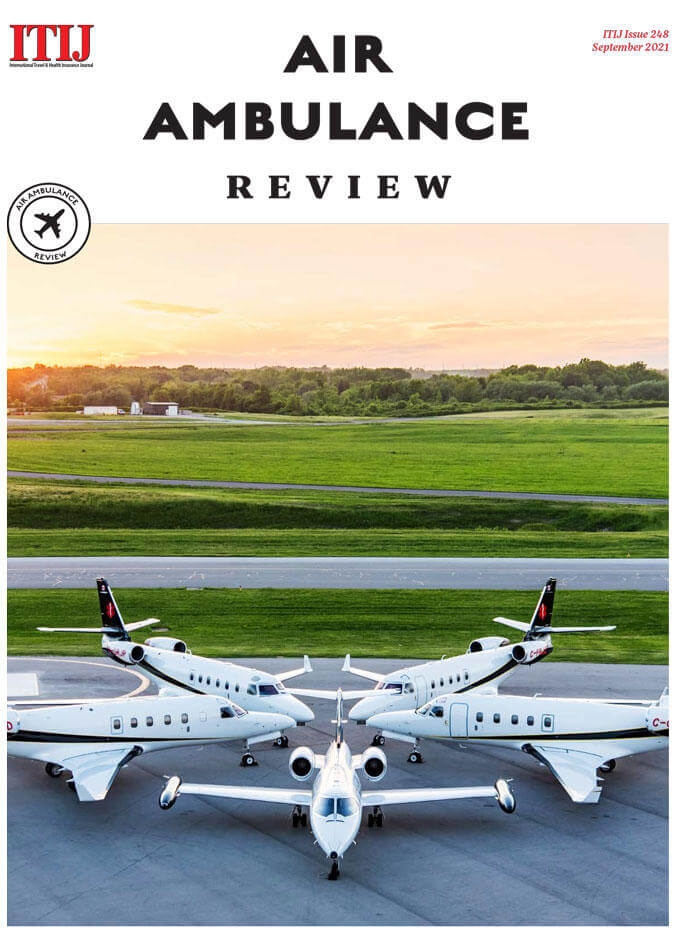
September 2021
Issue
In this Air Ambulance Review:
- Supply chain challenges
- Ensuring standards in Covid transports
- Air ambulance provision in Latin America
- Case studies from around the world
Dr Lynn Gordon
Lynn’s extensive medical experience straddles a range of disciplines, from helicopter trauma medicine and trauma intensive care, to general practice, travel clinic management and global assistance. Former roles include more than 15 years as a senior ship’s doctor for Princess Cruises, P&O and Cunard and several years running her own GP practice in South Africa. She joined CEGA in 2015 as a medical officer and became CMO in 2017.