CASE STUDY: Air ambulances and US ground transport services: an industry begging for change

The industry can do so much better, says John Watson.
After years of climbing in and out of medical helicopters and jet aircraft, one thing remains the same: it’s not possible without ground transportation. Recently, the industry has witnessed a significant decline in ground transport services provided to fixed-wing crews when rendezvousing in the United States, specifically.
Ground transportation for air ambulances has become so unaffordable in the US market that round-trip services for air crews has become a not-so-distant memory. To save on this inflated cost, air ambulances and their subsidiaries have been utilising ride-share services like LYFT® to complete the non-patient portion of their ground transports.
Imagine urgently responding to a mission request for the transfer of a critical patient in need of a lung transplant, leaving Miami, en route to New York. At the airport your team meets a taxi driver that doesn’t know the first thing about the equipment you possess, the team you command, nor the proverbial clock you are inevitably trying to beat. With a logistical knack for Tetris, you begin to artfully pack into the tiny vehicle your: stretcher, airway bag, first-in bag, medical bag, trauma bag, ventilator, heart monitor, medications, narcotics, portable oxygen, suction, a flight nurse, a flight paramedic, and on this day, additional crew completing their flight training.
Easy to accomplish, efficient, operationally appropriate, safe? I think not... Finally, at the referring hospital, your team and equipment are left waiting on the ground of the ambulance bay...
Now what? With bags on backs, straps on shoulders, heart monitor and ventilator in hand, and a stretcher precariously balanced on an office chair found in the lobby, it’s off to the elevators.
Finally bedside, an hour already passed, your patient now packaged and ready, your entourage now one passenger larger, you all proceed back down to the ambulance bay where your transportation is waiting. But this time, it will be an ambulance! Wait... no... it’s happened again. There’s no ambulance available. They’re still 35 minutes away.
With the patient demanding a high consumption of oxygen and nowhere to go, time is ticking. In this case, we brought our patient back inside the hospital’s emergency department and commandeered a spare room to utilise the hospital’s bedside oxygen until transportation finally arrived.
Forty-five minutes have now passed; an ambulance finally clunks into the ambulance bay. Two dishevelled EMTs hop out, all the while a visceral empathy of burn-out now emanating our space. We load the patient into the not-so-gently used van and immediately connect the patient to onboard oxygen.
But wait... you guessed it: there is no oxygen available in this vehicle! After several swift calculations, we agreed that we could utilise every portable oxygen cylinder we had, and still make our destination.
Once at the aircraft, we began calculating our own oxygen consumption for use in-flight. With MEDEVAC priority clearance, we're prepared to rapidly depart. Turning to line up with the runway, a tap on my right shoulder from the flight nurse behind me, and the nauseating motion of a hand signalling back and forth in front of their throat, as if to say, “STOP, STOP, STOP!” We were done... We weren’t going to make it all the way to New York with enough oxygen to safely spare, as it was all used up during the ground transport earlier.
With no ambulance waiting, we were forced to call 911 and utilise emergency services to bring us back to the same hospital we started at just hours earlier. The patient would never make it to New York.
What happened in this case? How did it all fall apart so badly? … And why?
I’m left asking myself what we can do as an industry to ensure that this is not our new norm. We can do better. We have to do better. The flight teams, the air ambulance companies, brokers, assistance companies, travel and insurance networks, the patients, and their families, they all deserve better.
The events of this case study are based on an actual air ambulance mission executed by the author. The recollection therein is an aggrandised summarisation of what took place. The author has intentionally left out any specific details as to the hospital, ground transport services, air ambulance company and patient.
AeroLYFT Transport Solutions
AeroLYFT™ is the leading provider of air ambulance ground transport and concierge services in the South Florida region. We offer our services exclusively to the air ambulance industry. Our team of experienced professionals provides round-trip, non-emergency stretcher transport services with the highest safety standards, at a fraction of the cost.
August 2023
Issue
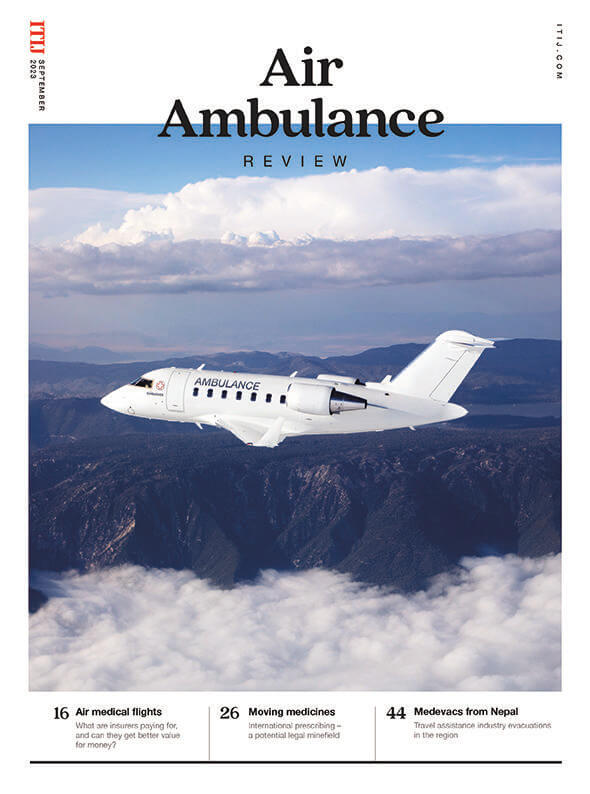
In the September Air Ambulance Review we examine value for money for air medical flights and ask what insurers are paying for. We also look at training for the air medical environment and delve into courses, costs, and competency of crews. Once a region known for questionable evacuations, we consider medevacs from Nepal’s mountains, and ask whether the travel assistance industry has made any progress regarding helicopter evacuations. We also investigate getting medication to clients in hotels with commercial medical escorts. Finally, we take a close look at air ambulance aircraft – giving a profile on each.
John A Watson
John A Watson V, FP-C, CCP-C, NR-P, PNCCT, CCEMT-P, EMT-P John Watson is the Founder and CEO of AeroLYFT Transport Solutions. His experience includes over 20 years with fixed and rotor-wing aircraft, with an emphasis on adult, paediatric and neonatal critical care transport. John has experience globally as an independent contractor and consultant, with a focus on air ambulance operations.