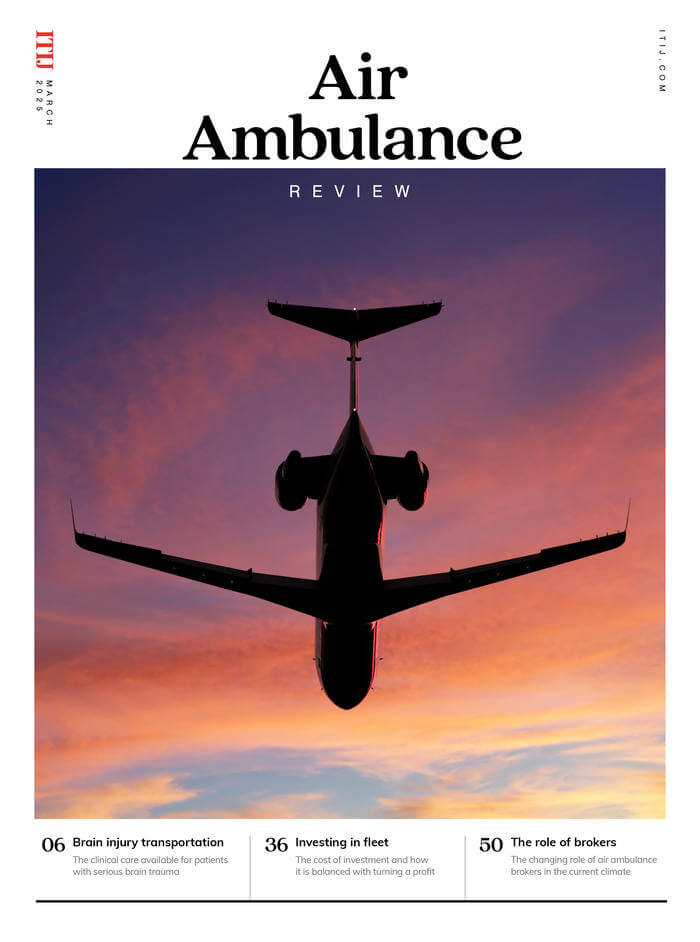
Caring for patients with acquired brain injuries

Oliver Cuenca talks to members of the air medical sector about what to consider when looking after and transporting a patient with a brain injury
When patients suffer head injuries while overseas, taking them home can be challenging due to the risk of secondary injury. Such acquired brain injuries (ABIs) can leave patients in a fragile state that requires a careful consideration of the circumstances, and a considered approach to transport.
They also make up a substantial portion of all operations conducted by many air ambulance companies. Dr Alex Veldman, Medical Director at Unicair, said that “of the roughly 1,000 air ambulance missions we conduct per annum, approximately 320 (almost a third) involve neurological diagnoses, which include stroke, intracranial haemorrhage, neurodegenerative conditions, and traumatic brain injuries (TBIs)”.
Other companies reported high numbers of ABI missions – for FAI, it’s an average of around 120 per year, while AMREF Flying Doctors (AFD) said they deal with an average of eight to 120 per year.
These impairments result from either traumatic brain injury – physical trauma due to accidents, assaults, neurosurgery, or head injury – or nontraumatic injury derived from either an internal or external source
What is an ABI?
Dr Thomas Buchsein, Associate Medical Director at FAI Aviation Group, began by giving a brief definition of ABI, which he described as “brain damage caused by events after birth [which can] result in cognitive, physical, emotional, or behavioural impairments that lead to permanent or temporary changes in functioning”.
He added: “These impairments result from either traumatic brain injury – physical trauma due to accidents, assaults, neurosurgery, or head injury – or nontraumatic injury derived from either an internal or external source: stroke, brain tumours, infection, poisoning, hypoxia, ischaemia, encephalopathy or substance abuse.”
What ABI does not include, however, is damage to the brain resulting from neurodegenerative disorders, he noted.
Transporting ABI patients by air
The exact amount of flying that an ABI patient can endure varies, explained Dr Buchsein, because the term ABI covers “many different diagnoses with just as many severity levels, and all kinds of resulting pathophysiological conditions”.
However, he added that the patient’s limits are typically defined not strictly by the duration of the transport, but by the individual clinical condition of the patient.
Specifically, Dr Buchsein elaborated: “There is one dreaded and not infrequent condition that can occur in practically all ABIs: cerebral oedema, with increased intracranial pressure (ICP). This is a condition which is just as dangerous as it is difficult to treat.”
He clarified, however, that “one can [typically] say that critically high, uncontrolled intracranial pressures are a contraindication for any transport, not only aeromedical”.
There is one dreaded and not infrequent condition that can occur in practically all ABIs: cerebral oedema, with increased intracranial pressure
Dr Buchsein concluded that, ultimately: “Every risk of a transport must be compared with the benefit of a transport, and if it is the case that a patient needs a time-critical, lifesaving neurosurgical intervention, and the only way to get there is by air transport, then this transport must be carried out after all.”
On top of this, he noted that there are a number of other, non-medical factors that can affect the urgency of a flight. This includes families exerting emotionally driven pressure because they want to bring their loved one home, and insurance companies hoping for an expeditious repatriation for cost containment reasons.
Dr Joseph Lelo, Medical Director at AFD, added that the amount of flying that an ABI patient can endure is heavily dependent on the “clinical picture, [as well as] monitoring
and treatment options available on board”.
He agreed that when looking to transport a patient with an ABI, “one must consider the risks and benefits of flying patients too soon after a brain injury. The possibility of continuing bleeding and worsening intracranial pressure is high.”
He added: “In many cases we find the best option for the patient is to move early to a facility that had capability to manage their condition.”

Adequate equipment for the trip
“It is possible to maintain hospital-level care for ultra-long-haul flights with the right medical team, medicine, and equipment,” Dr Lelo said. “However, one needs to bear in mind the extra physiological strain that a long flight would have on a patient.”
In response, air ambulance operators should make sure that they have an adequate set of onboard equipment. The most critical piece of kit, Dr Lelo said, is a ventilator – and backup ventilator – with “invasive blood pressure monitoring capability and intracranial pressure monitoring”, alongside the standard set of medical equipment.
Dr Buchsein added that “it is highly desirable that an existing ICP monitoring, e.g. via an extraventricular drain (EVD), can be continued throughout a transport”, alongside a range of “standard anti-epileptics and mannitol; pentobarbital could also be considered as a last resort to lower ICP”.
Dr Veldman said that monitoring equipment on board should cover a range of physiological variables, “such as temperature, end-tidal carbon dioxide (etCO2), as well as partial pressure of oxygen (pO2) and partial pressure of CO2 (pCO2) in point-of-care blood gas analysis”.
“The goal of therapy in TBI patients is to keep these parameters as normal as possible. Avoid fever, maintain normoxia and normocarbia, and maintain sufficient blood pressure to secure adequate cerebral perfusion pressure (CPP),” he added.
Dr Veldman continued: “Point-of-care ultrasound is a useful tool to assess cardiac function, volume status, venous blood return from the brain, and to quickly rule out respiratory complications such as pneumothorax if a patient suddenly deteriorates in-flight.
“In the future, we will likely have more differentiated means available to assess the wellbeing of the brain en route, such as near-infrared spectroscopy to monitor brain oxygenation and amplitude-integrated electroencephalogram (EEG) to recognise subclinical seizures – both of which are currently being studied in a transport environment.”
However, he noted that alongside the risk of medical complications, “the ever-increasing risk of … equipment failure” is a key consideration when carrying an ABI patient.
“The longer the time spent in the resource-restricted environment of an air ambulance, the greater that risk becomes,” he said. “We address this issue by creating redundancy for critical components, such as ventilators, monitoring, and extracorporeal membrane oxygenation (ECMO) pumps.”

Flights at sea level
One risk of transferring ABI patients by air is their vulnerability to changes in atmospheric pressure. A common strategy for patients who may suffer secondary injuries as a result of such changes in pressure is to fly them at sea level.
Dr Lelo stated that for patients with “air in the cranium, eye injuries, or polytrauma, consideration must be given for sea-level or low-level flights”. However, he noted that due to the higher air density at low altitudes, fuel consumption is “higher at lower altitudes, and may necessitate an extra fuel stop. The costs will therefore be higher by about 10–15%.”
“Sea-level cabin pressurisation requires a careful and individual risk-benefit evaluation,” added Dr Veldman, “taking into account the current altitude the patient is cared for, timing of transport, comorbidities, and performance features of the aircraft utilised for transport.”
Additionally, he noted: “In TBI patients evacuated within the first 72 hours after injury, potential cytokine release in a hypobaric environment might be an additional consideration that favours sea-level cabin pressurisation.”
Dr Veldman added that “the typical secondary TBI patient coming up for interhospital transfer in a non-military environment has been stabilised for several days after injury,
so the most frequently observed air trapping that requires a sea-level flight is impaired ventilation of the frontal or maxillary sinus … and accompanying midface injuries/fractures.”
He did warn, however, that “it is important to remember that cabin pressure … can be adjusted on a sliding scale to find a sweet spot between fuel consumption, air range, and patient safety for each transport”.

Sometimes avoiding sea-level flights is best
Dr Buchsein countered that there have been many sea-level flights that did not need to occur, due to a misunderstanding of Boyle’s law, which states that the lower the pressure of a gas, the higher its volume.
“Too many doctors who suggest a sea-level flight forget that gas laws are only valid for gases – hence the name,” he said. By contrast: “A brain can roughly be described as a ‘wet sponge in a box’, but as long as there is no air in the sponge, Boyle’s law does not apply, and there will be no significant volume expansion.”
Consequently, Dr Buchsein explained, while it is true that “trauma or neurosurgical procedures can result in air pouches inside the brain, which would expand if atmospheric pressure goes down”, the “mere presence of brain oedema is no reason to tamper with cabin pressures”.
The typical secondary TBI patient coming up for interhospital transfer in a non-military environment has been stabilised for several days after injury
He stated that because of this, the lower speeds, higher costs, and more frequent fuel stops may not be worth it. He noted that on top of this, more fuel stops mean “additional landing and handling fees, plus more pilot duty time – plus a possibly delayed next planned mission”.
Additionally, flying at lower altitudes – e.g. 28,000 feet instead of 38,000 feet, means flying “within the weather” rather than above it, said Dr Buchsein, which worsens turbulence and can ultimately result in worsening brain oedema and intracranial pressure if due precautions are not taken.

Conclusion
Despite brain injuries being an extremely common type of mission for aeromedical firms, each case is highly personal, and how it is approached depends entirely on the precise condition of the ABI patient.
Due to the potential for secondary injuries – most critically due to cerebral oedema – patients require careful monitoring, as well as consideration for the physical strain that the body can undergo. Ventilators are a vital piece of kit for all medical transports, but particularly for those involving ABI.
However, while flights at sea level may be effective as a means of ensuring that the patient does not undergo any undue physical pressure, this strategy may not always be effective, and has to be balanced against other factors such as higher fuel costs and slower journey times.